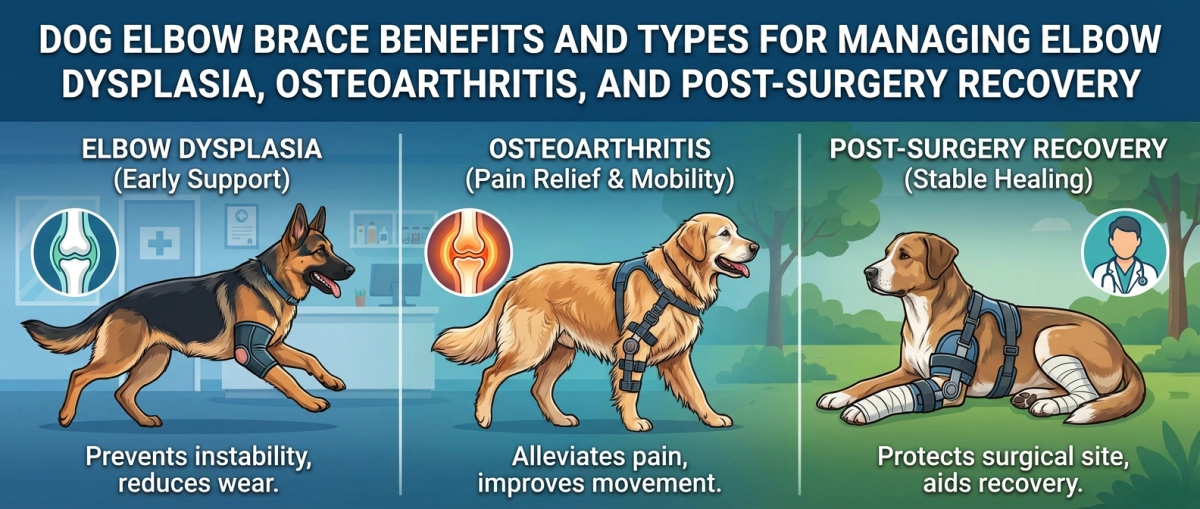
A dog elbow brace helps your dog’s joint. It can lower pain and help your dog move better. More than half a percent of dogs see vets for elbow joint disease. Osteoarthritis and elbow dysplasia cause most of the pain. Many dogs limp, have trouble moving, and feel pain. You want your dog to feel good and stay active. Elbow braces protect the joint and lower strain. They also help your dog heal after surgery. You should use a dog elbow brace with your vet’s plan. This helps your dog move well and stay healthy.
Key Takeaways
-
Dog elbow braces can help lower pain and help dogs move better if they have joint problems like elbow dysplasia or osteoarthritis.
-
A brace can help your dog heal after surgery. It can also stop more injuries or pain from happening.
-
Pick the right brace. Use compression sleeves for small problems. Use semi-rigid supports for bigger problems. Use custom orthoses for very bad cases.
-
Always talk to your vet before using a brace. This makes sure it fits well and is right for your dog.
-
Check your dog's skin under the brace often for any redness or sores. Keep the brace clean so your dog stays comfy and healthy.
Dog elbow anatomy and common problems
Why the dog elbow matters
You want your dog to run, play, and enjoy life. Healthy joints make this possible. The elbow is one of the most important joints in your dog’s front leg. It connects the upper and lower parts of the leg and lets your dog bend, straighten, and bear weight. The elbow joint has three bones: the humerus, radius, and ulna. These bones must fit together perfectly for smooth movement.
The dog elbow faces a lot of stress every day. When the joint surfaces do not line up well, your dog can develop pain and stiffness. Problems in the elbow joint can make your dog limp or avoid using the leg. You may notice your dog struggles to get up or seems less active. The elbow joint also has ligaments and cartilage that help keep everything stable and cushioned.
Some features make the dog elbow more likely to develop joint problems:
-
Joint incongruity: The bones do not align well, causing uneven pressure and wear.
-
Ununited anconeal process: A small bone fragment stays loose, making the joint unstable and painful.
-
Medial coronoid disease: This affects a part of the ulna and is common in large dogs.
-
Osteochondrosis: Cartilage and bone do not develop right, leading to joint issues.
Common conditions: dysplasia, OA, hygroma
Many dogs face joint problems as they age or grow. Elbow dysplasia is a group of conditions that affect the elbow joint. It often starts when your dog is young and can lead to arthritis later. Osteoarthritis, or OA, means the joint loses its smooth surface and becomes stiff and sore. Your dog may slow down, limp, or avoid jumping.
Elbow hygroma is another problem you might see. This happens when your dog rests on hard surfaces. The tissue over the elbow joint swells and fills with fluid. Large and giant breeds get this more often.
Here is a table showing common causes of these conditions:
| Condition |
Common Causes |
|---|---|
| Elbow Dysplasia |
Genetic factors, overnutrition with rapid growth, trauma, hormonal factors. |
| Osteoarthritis |
Wear and tear from aging, previous injury, or joint instability. |
| Elbow Hygroma |
Repeated trauma to the tissue over a bony prominence, especially in large and giant breed dogs. |
You can help your dog by learning about these joint problems. Early care and support for the elbow joint can keep your dog active and happy.
Dog elbow brace benefits
Dog braces help dogs with elbow joint problems. They let your dog stay active and feel better. Braces give support, lower pain, and protect the elbow. You can use them for elbow dysplasia, osteoarthritis, and after surgery. Dog braces do not fix bone or cartilage damage. They help your dog move easier and hurt less. Always use dog braces with your vet’s health plan.
Support for elbow dysplasia
Elbow dysplasia is common in big dogs. The joint does not fit right, so it hurts and swells. Dog braces give extra support and stop painful moves. You can use a dog elbow sleeve or a semi-rigid brace. These keep the elbow steady. This helps your dog walk with less pain and lowers joint pain.
Dog braces for elbow dysplasia help by:
-
Stopping too much bending and straightening.
-
Giving gentle pressure to lower swelling.
-
Helping your dog move better on walks.
-
Supporting the joint for short, safe activity.
Dog braces do not cure elbow dysplasia. They help your dog feel braver. Your dog may stand up easier and move with less pain. Braces also protect the skin from rubbing and sores.
Tip: Always look at your dog’s skin under the brace. Check for redness or sore spots. Change the fit if you see problems.
Relief for osteoarthritis
Osteoarthritis makes joints hurt and stiff. You want your dog to feel less pain and move better. Dog braces for osteoarthritis control movement and give support. A dog elbow sleeve adds warmth and gentle pressure. This can help your dog feel better.
Here is a table showing how dog braces help with osteoarthritis:
| Benefit |
Description |
|---|---|
| Stop elbow rotation |
Stops painful moves that make arthritis worse. |
| Stop sideways movement |
Limits motion that can hurt the joint. |
| Limit joint motion |
Keeps movement safe and lowers injury and pain. |
Dog braces for osteoarthritis also:
-
Give support and gentle pressure to weak joints.
-
Stop pressure sores and hygromas.
-
Help your dog move better and heal faster.
Your dog may walk smoother and get up easier. Braces help your dog enjoy daily life with less pain. Remember, braces do not fix damaged cartilage. They work best with other treatments like weight control and rehab.
Protection for hygroma and post-surgery
Dogs can get hygromas from lying on hard floors. These swellings can hurt or get infected. Dog braces, like a dog elbow sleeve, cushion the elbow and protect the skin. You help your dog avoid new hygromas with padded braces.
Dog braces also help after surgery. Your dog needs safe movement and joint protection. Braces keep the elbow steady and stop sudden twists. This helps your dog heal faster and lowers new injury risk.
Here is a table showing how dog braces protect the elbow:
| Feature |
Description |
|---|---|
| Support |
Keeps the joint steady while healing. |
| Prevention |
Cushions the elbow to stop new hygromas. |
| Controlled Motion |
Limits bending to lower pain and protect healing. |
| Joint Health |
Shields the joint and helps fluid drain. |
Your dog will move better and have safer skin. Braces stop licking and scratching, so healing is faster. Use dog braces as part of a full health plan. Always talk to your vet before using a new brace.
Note: Dog braces do not fix broken bones or torn ligaments. They help your dog feel better and protect the joint while you follow your vet’s advice.
Realistic expectations for comfort, mobility, and skin protection
Dog braces help in many ways, but you need to be realistic. Your dog may walk easier and hurt less, but braces do not cure joint disease. Check the fit and watch for skin problems. Braces protect against sores, calluses, and hygromas. You help your dog heal faster after surgery with good support.
Dog braces work best with weight control, pain relief, and rehab. Follow your vet’s plan and change the brace if needed. Dog braces are a safe way to help your dog move and feel better.
Canine support devices like dog braces help your dog stay active and enjoy life. You give your dog the best chance for healing and joint health by using braces as part of a full care plan.
Types of dog braces for elbows
There are different dog braces for elbows. Each kind helps in its own way. You need to pick the best one for your dog. The main types are compression sleeves, semi-rigid supports, and custom orthoses.
Compression sleeves
Compression sleeves are soft and easy to use. They give gentle help for mild pain or swelling. These sleeves keep the elbow warm and add light pressure. They help dogs with osteoarthritis or early joint problems. You can use them to stop elbow hygromas. Compression sleeves are good for daily comfort.
-
You can use compression sleeves for:
-
Mild elbow dysplasia
-
Osteoarthritis flare-ups
-
Preventing pressure sores
-
Protecting skin after small injuries
-
These braces are simple to put on and take off. Your dog can move easily with them.
| Size |
Price (USD) |
|---|---|
| XS |
$29.95 |
| S |
$29.95 |
| M |
$34.95 |
| ML |
$34.95 |
| L |
$34.95 |
| XL |
$34.95 |
Semi-rigid supports
Semi-rigid supports give more control and keep the elbow steady. These braces use panels or stays to limit movement. Pick these when your dog needs extra help after surgery or has moderate elbow dysplasia. Semi-rigid supports stop twisting and overextension.
-
You can use semi-rigid supports for:
-
Post-surgery recovery
-
Moderate elbow instability
-
Lowering the risk of hyperextension
-
Helping your dog get back to normal activity
-
These braces protect the joint while your dog heals. Your dog will feel safer and more comfortable.
Custom orthoses
Custom orthoses are made just for your dog’s elbow. Use these for tough injuries, long-term pain, or if surgery is not an option. Custom orthoses give strong support and help with pain for a long time.
-
You can use custom orthoses for:
-
Chronic elbow dysplasia
-
Severe osteoarthritis
-
Injury recovery when surgery is not possible
-
Supporting the front leg after major surgery
-
These braces keep the elbow stable and help your dog move with less pain. Your vet will help you get the right fit. Custom orthoses often work with rehab plans for the best results.
Tip: Always ask your vet before picking a brace for your dog. The right brace helps your dog heal and stay active.
Choosing a high-quality dog elbow brace
Sizing and fit tips
You want your dog to get the best results from braces. Start by measuring your dog’s leg above and below the elbow. Use a soft tape measure for accuracy. A high-quality dog elbow brace works best when you choose the right size. The importance of proper fit cannot be overstated. A good fit keeps the brace in place and stops it from slipping or twisting. This lowers the risk of more injury and helps your dog feel comfortable.
Here is a simple checklist for you:
-
Measure your dog’s limb at the points shown in the brace instructions.
-
Check the weight range for each size.
-
Make sure the brace fits snug but not tight. You should fit two fingers under the strap.
-
Watch your dog walk with the brace. Look for smooth movement and no limping.
-
Adjust the straps if you see rubbing or redness.
A custom brace can give your dog a better fit. This makes it more comfortable and helps your dog tolerate the brace longer.
Comfort and build features
You want your dog to wear braces for hours each day. Choose braces made from lightweight material. This keeps your dog cool and does not restrict movement. Look for smooth edges and soft liners. These features protect your dog’s skin and prevent sores. Good braces support the elbow joint and help your dog move with confidence.
Here is a table to help you compare comfort and build features:
| Feature |
Description |
|---|---|
| Comfort |
Lightweight material that does not restrict movement. |
| Support |
Compression design for long-term use. |
| Mobility |
Flexible, snug fit that lets your dog walk and play. |
| Safety |
Check your dog’s skin after use to make sure the brace is safe and comfortable. |
You want your dog to have support and mobility. The right brace helps your dog stay active and happy.
When to consult your vet
You should always talk to your vet before choosing braces. Your vet knows your dog’s health history and can help you pick the right support. If your dog shows signs of pain, swelling, or limping, ask your vet if a brace is needed. Your vet may suggest a brace for injury, recovery, or joint disease. You should also check with your vet if your dog has trouble with the fit or if you see any skin problems.
Tip: Your vet can help you match the brace type to your dog’s condition. This ensures the best support and mobility for your pet.
Owner-reported outcomes matter too. Watch your dog’s activity level and happiness. If your dog seems more active and comfortable, the brace is working well. Always follow your vet’s advice for the best results.
Proper use and care of dog elbow braces
Fitting and break-in process
You want your dog to get the most benefit from elbow braces. Start with a proper fit. Place the brace on your dog’s leg and adjust the straps so they feel snug but not tight. Make sure you can slide two fingers under each strap. Begin the break-in process slowly to help your dog adjust and prevent discomfort. Follow these steps for the first week:
-
Day 1: Let your dog wear the brace for 30 minutes, 2-3 times.
-
Day 2: Increase to 1 hour, 2-3 times.
-
Day 3: Wear for 2 hours, 2-3 times.
-
Day 4: Try 3 hours, 2-3 times.
-
Day 5: Move up to 4 hours, 2 times.
-
Day 6: Wear for 6 hours.
-
Day 7: Wear for 8 hours.
-
After the first week, your dog can wear the brace up to 12 hours a day. Remove the brace at night.
Adjust the straps and neoprene cuffs several times each day. Watch for any signs of hair loss or chewing. A good fit helps with support and prevents further injury.
Skin checks and monitoring
You need to check your dog’s skin every day. Look for redness, irritation, or sores under the brace. Use this table to guide your checks:
| Action Item |
Description |
|---|---|
| Inspect for skin irritation |
Check for any signs of redness or sores. |
| Contact veterinarian if irritation is present |
Call your vet if you see any irritation or swelling. |
| Keep brace and skin clean |
Wash the brace and clean your dog’s skin often. |
If you notice swelling, heat, or your dog resists wearing the brace, contact your vet. These signs may mean the fit is wrong or your dog needs a different type of support.
Cleaning and maintenance
Keep your dog’s brace clean for comfort and hygiene. Remove hair from Velcro with a toothbrush. Wash the brace weekly with mild dish soap. Follow these steps:
| Step |
Description |
|---|---|
| Soaking |
Soak the brace in laundry detergent and water for five minutes. |
| Scrubbing |
Lay the brace on a towel and scrub all sides with a washrag. |
| Rinsing |
Rinse under running water until all soap is gone. |
| Drying |
Air-dry the brace or use a hairdryer on a cool setting. |
Do not use high heat or wire brushes. Clean braces last longer and give better support.
Rehab pairing and activity guidelines
You can help your dog recover faster by pairing braces with rehab. Use massage, swim therapy, or underwater treadmills to build muscle and reduce pain. Ask your vet or physiotherapist for a home exercise plan. Avoid slippery floors and do not let your dog jump or run up stairs. These steps help with support and prevent further injury. Always follow your vet’s advice for improved rehabilitation outcomes and enhancing recovery.
Tip: A well-fitted brace, regular checks, and proper cleaning help your dog stay comfortable and active during recovery.
You want your dog to feel sure when walking. Dogs can be more active with elbow braces. These braces support joints and lower pain. They help your dog move in a normal way. You can pick compression sleeves, semi-rigid supports, or custom orthoses. Each type helps your dog in different ways. The right brace keeps the front leg steady. It lowers the chance of injury. Your dog can stay active while healing. Always ask your vet before choosing a brace. Your vet will help you find the best one for your dog. Use soft beds and take away hard floors. Give your dog gentle exercise to help recovery. Using a good brace every day helps your dog heal. It makes recovery better and faster.
FAQ
How do I know if my dog needs an elbow brace?
You should watch for signs like limping, stiffness, or swelling in your dog’s front leg. If your dog avoids using one leg or has trouble getting up, ask your vet if a brace can help.
Can my dog wear an elbow brace all day?
You should let your dog wear the brace during active hours. Remove it at night or when your dog rests. Always check your dog’s skin for redness or sores after use.
Will a dog elbow brace cure joint disease?
A brace will not cure joint disease. It helps your dog move better and feel less pain. You should use it as part of your dog’s full care plan with your vet.
How do I clean my dog’s elbow brace?
Wash your dog’s brace with mild soap and water. Let it air dry. Clean the brace often to keep your dog’s skin healthy and prevent odor.
What activities can my dog do while wearing an elbow brace?
Your dog can go for short walks, do gentle play, or follow rehab exercises. Avoid running, jumping, or rough play. The brace helps your dog stay active but safe.
0 Comments