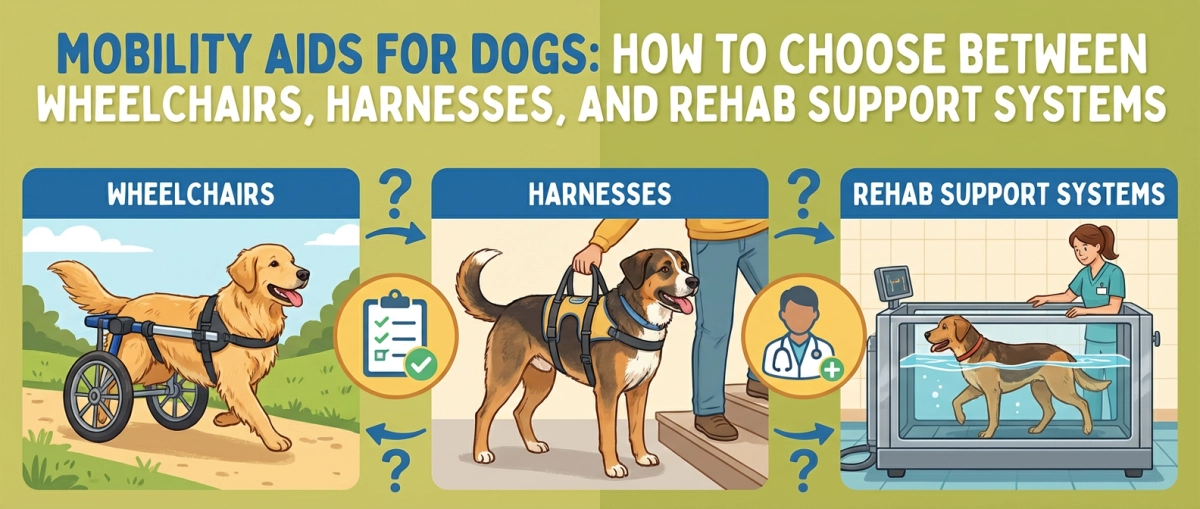
If you take care of an older dog or a dog that has trouble moving, you want them to be happy and comfortable. This guide explains how mobility aids for dogs can help your dog every day and keep them feeling good.
Mobility aids for dogs are things like wheelchairs, harnesses, and orthotic braces. These tools help many dogs stand up, walk, and play, even if they have arthritis or get hurt. You will see that mobility aids for dogs can really help your dog feel safer and happier. Always ask your veterinarian before you pick any mobility devices for your dog.
Here is a quick look at how common these problems are:
| Condition |
Percentage of Affected Dogs |
|---|---|
| Osteoarthritis |
20% of dogs over one year |
| Osteoarthritis |
Up to 80% of dogs older than eight years |
Dogs might need mobility aids for many reasons:
-
Injuries
-
Hip dysplasia
-
Disc disease
-
Arthritis
-
Degenerative myelopathy (DM)
-
Cancer
-
Other problems that make it hard to move
Mobility aids for dogs help keep joints steady, support weak muscles, and can make your dog more comfortable at home.
Key Takeaways
-
Mobility aids like wheelchairs, harnesses, and braces help dogs move better. These tools make dogs feel more comfortable and let them stay active.
-
You should talk to your veterinarian before picking a mobility aid. This helps make sure the aid is right for your dog's needs.
-
Watch for signs that your dog needs help. Limping, trouble going up stairs, or getting tired on walks are some signs.
-
Pick the best aid for your dog's problem. Use wheelchairs for big movement problems. Use harnesses for extra support. Use braces to help joints stay steady.
-
Check your dog's skin often for any irritation. Make sure the aid fits well so your dog stays safe and comfortable.
Understanding Mobility Aids for Dogs
Common Mobility Issues in Dogs
You want your dog to run, play, and enjoy life. Sometimes, health problems make it hard for your dog to move. Many dogs face these common mobility issues:
-
Hip and elbow dysplasia can cause pain and swelling in your dog’s joints. These problems often start when your dog is young.
-
Spinal issues, like intervertebral disc disease, can make it tough for your dog to walk or even stand.
-
Cruciate ligament injuries often happen when your dog jumps or twists. You might notice your dog limping or not wanting to put weight on a leg.
-
Osteoarthritis is very common in older dogs. It makes your dog’s joints stiff and sore.
-
Fractures from accidents can stop your dog from moving around.
-
Tick-borne diseases sometimes make your dog’s joints hurt and feel stiff.
When your dog has trouble getting up, walking, or doing things they used to love, it can be hard for both of you. You want to help your dog stay mobile and comfortable. Mobility aids for dogs can support your dog’s joints, help them move, and may improve their comfort at home.
When to Consider Mobility Aids
You might wonder when your dog needs extra support. Look for these signs:
-
Your dog walks less than before or seems tired quickly.
-
You see your dog limping or not using one leg.
-
Your dog struggles to climb stairs or jump into the car.
-
Your dog has pain when you touch their legs or back.
-
Your handicapped dog cannot stand up without help.
Veterinarians suggest using mobility aids for dogs when you notice these changes, especially in senior dogs or those with arthritis. These tools help your dog stay mobile and enjoy daily life. If your handicapped dog has a hard time moving, the right device can help them feel safer and more confident.
Quick Takeaways
Wheelchairs help a dog with weak or paralyzed legs move around and play.
Harnesses support your dog during walks, bathroom breaks, or when climbing stairs.
Braces help stabilize joints after injury or surgery.
Mobility aids for dogs support your dog’s comfort and activity—they do not cure the problem.
Always talk to your vet before choosing a device for your dog.
Dog Wheelchairs: Types and Indications
Rear, Front, and Quad Support Wheelchairs
You might feel overwhelmed when you see all the different dog wheelchairs out there. Each type supports your dog in a special way. Here’s a quick guide to help you understand:
-
Rear dog wheelchairs: These support your dog’s back legs. If your dog has weak or paralyzed hind legs but strong front legs, this type lets them walk, run, and play again.
-
Front dog wheelchairs: These help dogs with front leg weakness. They are less common but can make a big difference for dogs who need extra help in the front.
-
Quad (four-wheel) dog wheelchairs: These give support to both the front and back legs. If your dog has trouble in all four legs, a quad wheelchair helps them stay balanced and safe.
Some wheelchairs come with padded seats and all-terrain wheels. These features keep your dog comfortable and let them move smoothly on different surfaces.
Best Uses for Dog Wheelchairs
Dog wheelchairs help in many situations. You might choose a dog wheelchair if your dog has:
-
Hind leg paralysis or weakness
-
Arthritis or hip dysplasia
-
Spinal problems like Intervertebral Disc Disease (IVDD)
-
Degenerative Myelopathy (DM)
-
Recovery after surgery or injury
-
Amputation or sudden paralysis
A dog wheelchair helps your dog stand, walk, and even play. It supports their body and keeps them active, which can boost their mood and comfort.
Pros and Cons of Dog Wheelchairs
Dog wheelchairs offer many benefits, but you should know both sides before you decide.
| Pros |
Cons |
|---|---|
| Lets your dog move and play |
Some dogs may get skin sores if not fitted right |
| Improves your dog’s quality of life |
Needs regular checks for comfort and fit |
| Makes daily care easier for you |
Some dogs need time to adjust |
Tip: Always check your dog’s skin for any redness or sores when using a dog wheelchair. Start with short sessions and increase time as your dog gets used to it.
Dog wheelchairs can help your dog enjoy life again. They support mobility and comfort, but you should always talk to your vet before choosing one.
Dog Harness: Support and Lifting Options
Types of Dog Harnesses
You have a lot of choices when it comes to picking a dog harness. Each one helps your dog in a different way. Here are the main types you might see:
-
Support harness: This harness wraps around your dog’s chest or hips. It helps you guide your dog during walks or when they need a little extra balance.
-
Lifting harness: You can use this harness to help your dog stand up, climb stairs, or get into the car. Handles on the harness make it easy for you to lift or steady your dog.
-
Full-body harness: This harness supports both the front and back of your dog. It is great for dogs who need help all over, not just in one spot.
-
Sport harness: Made from breathable material, this harness is adjustable and comfortable. It is not for pulling but works well for lifting and carrying.
-
Utility harness: This harness looks like a sport harness but has a sturdy handle. It protects your dog’s back and is strong enough for daily use.
You can find mobility harnesses for small dogs, big dogs, and every size in between.
When to Use a Dog Harness
You might wonder when a support harness or lifting harness is the best choice. Here are some common times you might reach for one:
-
You want to help your dog go up or down stairs safely.
-
Your dog needs a quick bathroom break outside, and a lifting harness makes it easier.
-
You need to help your dog get in or out of the car, especially if your dog is older or recovering from surgery.
-
Your dog has trouble standing up on their own, and a support harness gives them a gentle boost.
A support harness or lifting harness can make daily tasks less stressful for both you and your dog.
Pros and Cons of Dog Harnesses
Dog harnesses offer many benefits, but you should know a few things before you choose one. Here’s a quick look:
| Pros of Full-Body Harnesses |
Cons of Full-Body Harnesses |
|---|---|
| Flexibility: Lets you help your dog move with support |
Needs you to help your dog often |
| Adjustable support: Use only when needed |
May not give enough support for severe problems |
| Great for short-term use |
You get better control and support for your dog, especially if they have injuries or trouble moving. A harness is safer than a collar, especially for dogs that pull or slip out of collars. Many older or injured dogs do better with a harness, since you can use the handles to help them stand or walk.
Tip: Always check that your dog harness fits well and does not rub or pinch. A good fit keeps your dog comfortable and safe.
Orthotic Braces for Dogs
Stifle and Hip Braces
Your vet may suggest stifle or hip braces if your dog needs more joint support. These braces go around your dog’s knee or hip to help keep the joint steady. They help your dog feel more comfortable and remind them how to move their leg. This kind of support can really help dogs who have trouble walking or standing.
Here are some common orthotic braces you might find:
-
Leg braces help with injuries or weak legs.
-
ACL braces have hinges to help the knee bend.
-
Hip braces help with pain and hip dysplasia.
-
Ankle and wrist braces support the lower leg or paw.
-
Elbow braces help with front leg problems.
-
Back braces support the spine.
These braces come in many sizes and shapes. You can pick one that fits your dog best.
Indications for Orthotic Braces
You might wonder when your dog should use a brace instead of something else. Vets often recommend stifle or hip braces for these problems:
-
Cruciate ligament tears, like ACL injuries
-
Arthritis in the knee or hip
-
Luxating patella, when the kneecap moves out of place
-
Tibial crest fractures
-
Pivot shift instability
A stifle brace helps your dog heal after a knee injury. Hip braces can help with hip dysplasia or arthritis. Braces give support by keeping the joint steady and help your dog feel more sure during rehab.
Here’s a quick look at what braces do:
| Purpose of Orthotic Braces |
Description |
|---|---|
| Enhance proprioception |
Remind your dog how to move the leg |
| Support a joint |
Keep the joint steady and safe |
| Facilitate injury repair |
Help tendons and ligaments heal |
| Prevent complications |
Stop new injuries from happening |
| Rehabilitative aid |
Help your dog get stronger during recovery |
Pros and Cons of Braces
Orthotic braces can help your dog, but you should know the good and bad before you pick one.
| Pros |
Cons |
|---|---|
| Support for joint stability |
Skin problems if not fitted right |
| Prevention of further injury |
Need for proper fitting |
| Assistance in rehabilitation |
Some dogs may feel discomfort |
Most dogs do well with a brace if you follow your vet’s advice. Always check your dog’s skin for redness or sores. If you see any problems, stop using the brace and call your vet.
Tip: Begin with short times and watch how your dog moves. This helps your dog get used to the brace and stay comfortable.
Choosing the Right Mobility Aid
Comparing Dog Wheelchairs, Harnesses, and Braces
Picking the best way to support your dog starts with knowing what each option does. You want to match the right tool to your dog’s needs. Some dogs need help with walking, while others need support for stairs or getting into the car. Let’s look at how wheelchairs, harnesses, and braces compare.
Here’s a quick table to help you see the differences:
| Aid Type |
Best For |
Not Ideal When |
Learning Curve |
Typical Use Time |
Fit Complexity |
Approx. Cost Range |
Care/Maintenance |
|---|---|---|---|---|---|---|---|
| Wheelchairs |
Hind leg paralysis, severe arthritis, long walks |
Uncontrolled pain, open wounds, poor tolerance |
Moderate |
30 min–hours |
High |
$$$ |
Clean pads, check skin |
| Harnesses |
Minor injuries, stairs, car assists, short walks |
Severe paralysis, poor limb strength |
Low |
Minutes–short tasks |
Medium |
$$ |
Washable, check fit |
| Braces |
Joint stabilization, post-surgery recovery |
Open wounds, acute injuries needing surgery |
Low–Moderate |
Hours–daily wear |
Medium–High |
$$–$$$ |
Clean liners, check skin |
You can use this table to match your dog’s needs with the right aid. For example, wheelchairs work best for dogs who want to walk or play but can’t use their back legs. Harnesses help with stairs and car rides. Braces stabilize joints after injury or surgery.
Tip: Always check your dog’s skin for redness or sores when using any aid. Start with short sessions and increase time as your dog gets used to it.
Quick Comparison List
-
Harnesses: Great for helping your dog on stairs or getting in and out of the car. They support minor mobility problems.
-
Dog Wheelchairs: Best for longer walks and exercise. They let your dog move independently with full support.
-
Braces: Help stabilize joints and support recovery after surgery or injury.
Everyday Tasks and Which Aid to Use
-
Stairs: Use a support harness for safe climbing.
-
Bathroom breaks: Try a harness or wheelchair, depending on your dog’s strength.
-
Car assistance: A lifting harness works best for getting your dog in and out.
-
Daily walks: A wheelchair supports your dog for longer periods and encourages exercise.
Factors to Consider (Size, Fit, Temperament, Owner Ability)
Choosing a mobility aid for your dog means thinking about more than just the type. You want to make sure the aid fits well, matches your dog’s personality, and works for your family.
Here are some things to keep in mind:
-
Size and Fit: Measure your dog carefully. A good fit keeps your dog comfortable and safe. An ill-fitted wheelchair or brace can cause discomfort or even make things worse.
-
Breed and Weight: Big dogs need sturdy aids. Small dogs need lighter, adjustable options. Always check the weight and size limits before you buy.
-
Mobility Needs: Some dogs have trouble with their back legs. Others need help with their front legs or joints. Pick the aid that matches your dog’s problem.
-
Temperament: Some dogs love new things. Others need time to adjust. Watch how your dog reacts and go slow if needed.
-
Owner Ability: You need to feel comfortable using the aid. Look for easy on/off designs and clear instructions. If you have trouble lifting or guiding your dog, choose aids with handles or adjustable straps.
-
Commitment to Rehab: You play a big role in helping your dog get used to their new aid. Be ready to support your dog during the learning process.
Here’s a table showing what to think about:
| Factor |
Description |
|---|---|
| Veterinary assessment |
Your vet checks your dog’s health and mobility before you choose an aid. |
| Activity level and behavior |
Active dogs adjust faster to new aids. |
| Physical condition |
Strong limbs help your dog use wheelchairs or braces better. |
| Commitment to rehabilitation |
You need to help your dog learn and get comfortable with their new aid. |
| Quality of life improvement |
The goal is to help your dog move better and feel less pain. |
Note: Always talk to your vet before you pick a mobility aid. Your vet knows your dog’s health and can help you choose the best option.
Buyer’s Checklist for Mobility Aids
-
Adjustable fit for your dog’s size and shape
-
Even pressure distribution to avoid sore spots
-
Anti-slip liners for comfort and safety
-
Easy on/off design for quick use
-
Durable, washable materials
-
Clear return policy and size exchanges
-
Video fitting guides for extra help
Setting Realistic Expectations
You want your dog to feel better and move more. Mobility aids for dogs help stabilize joints, support movement, and may improve comfort. These tools do not cure your dog’s condition, but they can make daily life easier and more enjoyable. You might see your dog become more independent, happier, and more active.
Tip: Start slow and watch your dog’s progress. Celebrate small wins, like standing up or walking a few steps. Your support makes a big difference.
Fitting and Sizing Mobility Aids for Dogs
Getting the right fit for your dog’s mobility aid makes a big difference. A good fit keeps your dog safe, comfortable, and ready to move. You want to measure carefully before you buy any device.
Measuring for a Dog Wheelchair
You need a few key measurements to find the best wheelchair for your dog:
-
Measure from the floor to the top of your dog’s back at the hindquarters.
-
Check the height from the top of the back to the ground.
-
Measure the length from the middle of the hips to the shoulders.
-
Find the width across the body at the widest point.
-
Measure the girth around the body at the widest point.
-
While your dog lies on their side, measure the rear leg height.
-
Weigh your dog to pick the right frame size.
�� Image caption prompt: Diagram showing where to measure your dog for a wheelchair fit.
Sizing a Dog Harness
A harness should fit snug but not tight. Here’s what to do:
-
Wrap a tape measure around the widest part of your dog’s chest, just behind the front legs.
-
Measure the neck if the harness has a neck loop.
-
Make sure the harness allows your dog to move freely.
-
Check for even pressure across the body to avoid sore spots.
-
Adjust the harness as your dog grows or changes weight.
�� Image caption prompt: Correct way to lift a dog with a support harness.
Fitting Orthotic Braces
Braces need to fit well to support your dog’s joints and prevent injury:
-
Choose the right type of brace for your dog’s needs (single, double, or hinged).
-
Measure the limb circumference and length as shown in the product guide.
-
Make sure the brace feels secure but not too tight.
-
Watch for any signs of discomfort or skin irritation.
-
Ask your vet for help if you’re unsure about the fit.
�� Image caption prompt: Checking brace fit and skin contact points.
Printable Sizing Checklist
-
Gather a soft tape measure and scale.
-
Write down your dog’s weight.
-
Measure chest, neck, and limb as needed.
-
Double-check all numbers.
-
Try the device and watch your dog walk.
-
Look for rubbing or red spots daily.
-
Adjust as needed for comfort.
Tip: A well-fitted device helps your dog stay active and happy. Always check for changes in fit and comfort.
Safety, Care, and Break-In Protocols
Safe Use of Mobility Aids
You want your dog to feel safe and comfortable when using a new mobility aid. Start slow. Let your dog sniff and explore the device before you put it on. Begin with short sessions—about 10 to 15 minutes—on a flat, non-slip floor. Stay close and watch your dog as they move. Give treats and praise to make the experience positive.
Check your dog’s skin every day, especially under straps and at contact points like the armpits, groin, and hips. Look for redness, hair loss, or sore spots. If you see any changes, take a break and talk to your vet.
�� Image caption prompt: Where to check your dog’s skin for redness or pressure marks when using a mobility aid.
Cleaning and Maintenance
Keeping your dog’s mobility aid clean helps prevent skin problems and keeps the device working well. Here’s a simple care schedule you can follow:
| Frequency |
Task |
|---|---|
| After Each Walk |
Wipe down the frame, check straps, inspect wheels, sanitize leg rings if soiled. |
| Weekly |
Wash harnesses, disinfect the frame, inspect for wear. |
| Monthly |
Tighten bolts, oil moving parts, check fit adjustments. |
| Seasonally |
Replace worn tires or padding, deep clean. |
A clean device feels better for your dog and lasts longer.
Signs to Stop and Consult a Vet
Sometimes, your dog may show signs that mean you should stop using the mobility aid and call your vet. Watch for these warning signs:
-
Excessive panting or trouble breathing
-
Sudden head tilt that does not go away
-
Clumsiness or tripping over their feet
If you notice any of these, remove the device and reach out to your veterinarian. You know your dog best, so trust your instincts if something feels off.
Tip: Regular checks and gentle care help your dog stay happy and safe with their mobility aid.
Choosing the right mobility aid can help your dog stay active and happy. You should always talk with your vet and use sizing guides before you buy anything. To help your dog every day, try these steps:
-
Monitor your dog's weight.
-
Use ramps, slings, or harnesses for support.
-
Add non-slip rugs at home.
-
Visit your vet often to check progress.
You can find more tools like support wraps, strollers, and elevated feeding stations. Remember, mobility aids help your dog enjoy life—they do not cure the problem. Keep helping your dog by watching their comfort and making changes as needed.
FAQ
How do I know if my dog needs a mobility aid?
You might notice your dog struggles to stand, walk, or climb stairs. If your dog limps, tires quickly, or avoids play, a mobility aid can help. Always ask your vet before choosing any device.
Can my dog wear a mobility aid all day?
No, your dog should not wear a mobility aid all day. Start with short sessions. Watch for skin changes or discomfort. Give your dog breaks to rest and move freely.
Will my dog get used to a wheelchair or harness?
Most dogs adjust with time and patience. Use treats and praise. Start slow and keep sessions short. Your support helps your dog feel safe and confident.
Are mobility aids for dogs safe for puppies or senior dogs?
Yes, mobility aids can help both puppies and seniors. You need to pick the right size and type. Always check with your vet to make sure the device fits your dog’s needs.
Where can I find sizing guides and product options?
You can view sizing guides and product options on our website. Look for clear instructions and videos. For the best results, ask your vet to help you choose and fit the right mobility aid.
Ready to help your dog move better? Check out our sizing guides and product options. Always talk to your vet for the best advice!
0 Comments