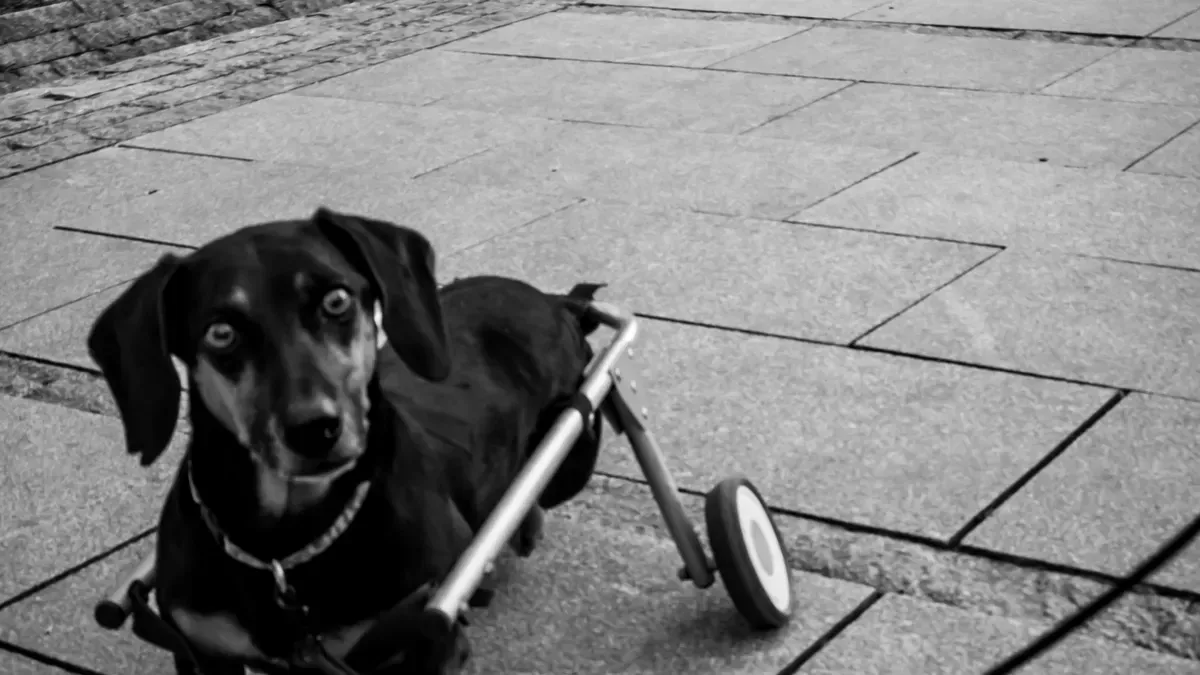
Stairs expose the gap between support equipment that works and equipment that just looks supportive. For a dog that knuckles — dragging the top of the paw instead of placing the pad — the difference comes down to two design details most product pages skip: where the straps sit and whether the brace tension line tracks the joint's natural axis. Get either wrong and the device works against the dog. Get both right and stair navigation changes from a daily hazard into something the dog can manage.
Why Strap Placement Matters More Than Harness Strength on Stairs
A harness rated for 150 pounds means nothing if the lifting force concentrates under the dog's armpits. The design feature that separates functional harnesses from decorative ones is not material strength. It is strap width and attachment-point geometry.
When a dog is lifted on stairs, body weight transfers through the harness straps into the handler's hand. A two-strap configuration — one chest band, one belly band — concentrates that load onto two narrow lines. Under a 60-pound dog, each linear inch of strap may carry 15 to 20 pounds of pressure. That pressure pinches skin, restricts breathing, and makes the dog resist the harness the next time it appears.
A lifting harness with broad chest and abdomen panels spreads the same load across a larger contact area. A four-inch-wide chest panel distributes the force so that no single point exceeds the pressure a dog tolerates during normal leash walking. The physics is straightforward: double the contact area, halve the pressure per square inch. The dog breathes easier. The handler gets a more cooperative lift. The harness gets used instead of abandoned in a closet.
Strap placement matters for a second reason that is less obvious. Dogs knuckle most often in the hind limbs — the rear paws drag or flip under. A harness that anchors only at the chest leaves the rear half of the dog unsupported during a stair climb. The handler ends up dragging the front end while the hind legs scramble. That is not assistance. It is a tug-of-war with the dog's own weight.
Harnesses that extend the support panel under the abdomen — or better, include a rear lift handle — let the handler control both ends of the dog independently. On a staircase, the handler can lift the hindquarters just enough to clear each step while the front legs do the work they are still capable of. This two-point control is the difference between guided movement and a dead lift.
In practice: after five minutes of stair assist, unbuckle the harness and check the skin under the strap lines. Deep red grooves that do not fade within two minutes signal pressure concentration — the strap width or placement needs adjustment. Faint, even pinkness that fades quickly means the load is distributing as intended.
Joint Alignment in Orthotic Devices: Why a Half-Inch Misfit Undoes the Support
A carpal brace or toe-up device works through a simple mechanism: an elastic tension line pulls the paw into extension so the pad — not the dorsal surface — contacts the ground. The design sounds foolproof. The execution rarely is.
The tension line must track the paw's natural flexion axis. That axis runs through the carpal joint — roughly where the paw bends when a healthy dog lifts it. If the elastic anchor point sits anterior to that axis, the tension pulls the paw into more flexion, not less. The brace exacerbates the knuckling it was meant to correct. If the anchor sits posterior, the tension extends the paw as intended — but only if the force vector stays in plane with the limb's sagittal motion.
Here is the causal chain that determines whether the device helps or harms: elastic anchor placement determines the tension force vector. The force vector relative to the carpal joint center determines the rotational moment applied to the paw. That moment either extends the paw (pad down) or flexes it (dorsum down). The result is not a matter of degree. It is binary — the paw lands pad-first or it does not. A brace that produces extension on flat ground can still fail on stairs, where the incline shifts the dog's weight distribution and changes the angle at which the tension line pulls.
The difference between a well-designed toe-up device and a poorly designed one is not visible in product photos. Both look like a strap and an elastic cord. The difference lives in the anchor geometry — whether the manufacturer patterned the anchor position from joint kinematics or just placed it where the stitching was easiest.
In practice: watch the dog take ten steps on a flat surface with the brace on. Count how many times the paw lands pad-first versus dorsal-surface-first. Then repeat on the bottom three steps of a staircase. If the pad-first count drops on stairs, the tension line is drifting off-axis under incline loading — the brace is failing in the exact scenario it was bought for.
When Support Equipment Helps on Stairs — and When It Does Not
Support equipment performs best when it matches a specific deficit with a specific mechanical solution. The mismatch zone is large, and it is where most disappointment lives.
Where harnesses and slings help. A dog with proprioceptive deficits — the neurological kind where the brain cannot sense paw position — often retains enough limb strength to push. The dog does not need a device to move the leg. It needs a device to prevent the paw from folding under while the dog figures out where the ground is. A full-body lifting harness with rear support handles lets the handler catch the hind end before the paw flips. The dog learns to trust the stair surface because the harness prevents the consequence of misplacement — the stumble, the scrape, the fall.
Where orthotic braces help. When knuckling comes from isolated carpal or hock weakness — the joint collapses under load but the hip and shoulder are strong — a brace that stabilizes that single joint can restore stair function. The brace does not power the movement. It removes the collapse point so the healthy joints above can do their job. This is mechanical shielding, not rehabilitation.
Where equipment does not help. Severe bilateral hind-limb weakness — the dog cannot push off from either rear leg — exceeds what any harness or brace can compensate for on stairs. A harness still helps the handler carry the dog, but the dog is not navigating stairs. It is being carried up stairs. That distinction matters because owners who expect a harness to restore stair independence in a dog with end-stage weakness will blame the product for a limitation of physics. Ramps or environmental modifications — blocking stair access, moving the dog's living space to one floor — address the real constraint here.
Breed conformation introduces another variable. A brace patterned on a Lab's carpal angle will sit differently on a Dachshund's leg — the joint angles differ, the limb proportions differ, and the soft tissue coverage differs. The same labeled size can fit one dog and pinch another.
Disclaimer: if the dog's leg conformation falls outside the breed norms a brace was patterned for — particularly dogs with angular limb deformities, very deep chests that shift harness panel placement, or double coats that mask pressure points — the fit checks described here may not catch every rub or pressure concentration. Hand-check under straps and panels after the first five minutes of use, and do not rely on visual inspection alone for heavily coated breeds.
Material and Fit Choices That Determine Whether the Device Gets Used
A support device that stays in the cabinet helps no dog. Design decisions about materials, closures, and cleaning directly affect whether the equipment becomes part of the daily routine or an expensive regret.
Neoprene versus mesh-lined panels. Neoprene provides structure and controlled stretch — it holds shape under load, which matters for braces that must maintain joint alignment. But it traps heat and moisture. Under a short-coated dog in summer, a neoprene panel can become sweat-slicked within fifteen minutes. The dog fusses. The handler removes the brace. The stair session ends. Mesh-lined panels exchange air but sacrifice the structural memory that keeps a brace aligned after repeated loading. The tradeoff is real: stability versus skin tolerance. There is no universal "better" material — only a better match to the dog's coat type, activity duration, and environment.
Closure design. Quick-release buckles save time but introduce a failure point — a panicked dog can pop a side-release buckle by twisting against a stair riser. Velcro straps distribute tension continuously along their length, which reduces hot spots, but they collect hair and lose grip after weeks of daily use. The practical answer is not one closure type. It is checking closure function before every stair session — a five-second habit that catches a failing Velcro panel or a cracked buckle before it fails mid-climb.
Cleaning as a design factor. A device that requires hand-washing and air-drying for twelve hours is a device that skips days. Removable, machine-washable liners change the usage pattern: the liner goes in the wash, a spare liner goes on the brace, and the dog does not miss a day. This is not a convenience feature. For a dog showing early knuckling signs, consistency of support determines whether the paw placement pattern improves or degrades. Missed days erase progress.
FAQ
Can a dog wear a toe-up brace and a lifting harness at the same time?
Yes, and the combination often works better than either device alone on stairs. The brace keeps the paw oriented correctly. The harness lets the handler manage weight distribution during the climb. Fit each device independently — a brace that is snug enough on bare skin may be too tight when a harness strap overlaps it. Check for double-layer pressure points after the first stair session.
How do I know whether my dog needs a harness, a brace, or both?
Watch the stair motion in slow motion if possible. If the paw folds under but the dog can push off from the upper leg, a brace may be enough. If the dog cannot generate the upward push at all, a harness gives the handler the control needed to assist. If both problems appear — weak push-off and paw folding — a brace plus harness addresses both failure points simultaneously.
Why does my dog's brace work on flat ground but fail on stairs?
The incline shifts the dog's center of mass rearward, which changes the angle between the tension line and the joint axis. A brace designed and tested only on flat surfaces can drift off-axis under incline loading. If the paw lands pad-first on tile but dorsal-first on step three, the brace's anchor geometry was not validated for stair angles.
0 Comments