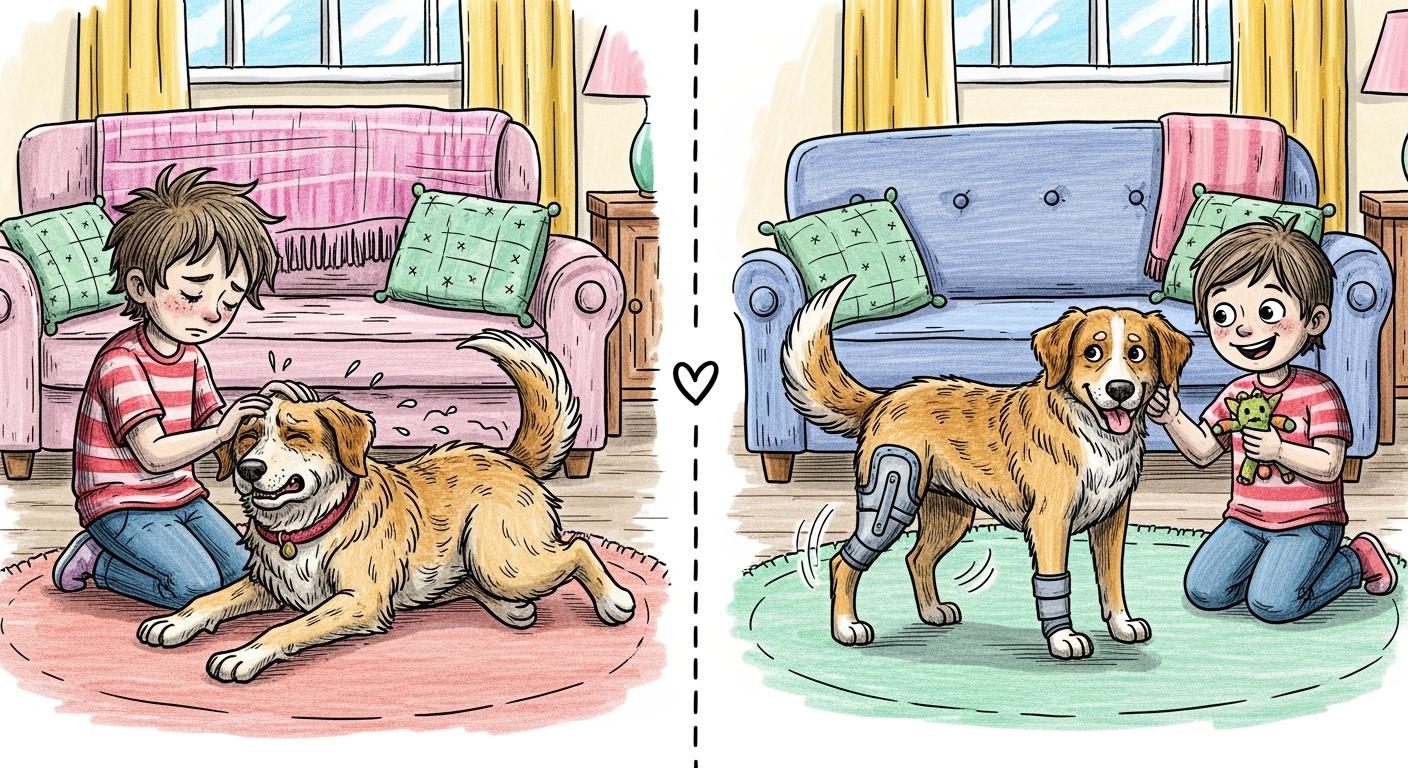
A dog limps after a run. The knee looks stable at rest but shifts under weight. The first instinct is to wrap it tight. Tight feels like support. But a CCL dog brace does not work by squeezing harder. It works by controlling where force travels through the joint. That comes down to two design decisions most owners never think about: whether the hinge sits on the joint axis, and whether the straps spread load or concentrate it.
The Joint Axis Problem: Why Half an Inch Changes Everything
A stifle joint does not hinge like a door. It rolls and slides — the femur rocks backward over the tibial plateau as the leg flexes. The cranial cruciate ligament stops that roll from turning into a slide. When the CCL is weak or partially torn, the femur drifts forward on every step. The joint becomes unstable not because it lacks tightness, but because it lacks a restraint at a specific point along the motion arc.
This is where hinge placement becomes the difference between a brace that helps and one that fights the leg.
A polycentric hinge — the type found in articulated stifle braces — has two pivot points that trace a curved path. When that path matches the dog's natural stifle motion, the hinge transfers ground reaction forces straight along the mechanical axis of the leg. The joint surfaces stay evenly loaded. The remaining intact ligament fibers do less work because the brace carries the shear component externally.
When the hinge sits even half an inch above or below the joint line, the path diverges. The brace tries to move the leg through one arc while the dog's anatomy moves through another. At best, the brace slides down the leg during activity. At worst, it redirects force into the joint at an angle that stresses collateral ligaments and menisci — structures that were not the original problem.
You can verify alignment at home. Put the brace on, walk the dog for ten minutes on flat ground, then check whether the hinge center still sits at the midpoint of the stifle joint — roughly a thumb's width behind the kneecap. If it has migrated up or down by more than a quarter inch, the hinge axis and the joint axis are not tracking together. The brace is working against the leg, not with it.
A dog CCL brace that maintains its hinge position through a full walk is doing something structurally different from one that starts in the right place and drifts. The difference is usually in the proximal strap anchor — how the top strap locks onto the thigh above the stifle. A wide contoured thigh strap that wraps around the femur's taper resists downward migration better than a narrow straight strap, because the thigh narrows as it approaches the knee and a contoured strap catches that slope like a wedge.
Strap Width, Force, and the Pressure Problem
A strap that carries a dog's ground reaction force through a one-inch-wide band concentrates that force into a ring around the leg. A strap that carries the same force through a two-and-a-half-inch-wide band spreads it across roughly two and a half times the surface area. The physics is straightforward — pressure equals force divided by area. But the design implication runs deeper.
Narrow straps create high-pressure rings. These rings compress superficial blood vessels and lymphatic channels at the skin surface. The result is not always visible as a sore. Sometimes it shows up as the dog licking the spot hours after the brace comes off — a sign of low-grade tissue irritation that the owner attributes to "getting used to the brace" rather than a design issue.
Wider straps with a breathable inner liner change the equation. They reduce unit pressure. They also resist rolling — a narrow strap under tension tends to curl at the edges, turning a flat contact surface into a cord-like contact line. That line pressure is what causes the red stripe you see after removing a poorly designed brace.
The material between the strap and the skin matters just as much as the width. Neoprene alone traps moisture. After twenty minutes of walking, sweat and body heat create a damp microclimate inside the brace. Wet skin under pressure breaks down faster than dry skin — the stratum corneum softens, friction increases, and the skin's barrier function drops. A liner that wicks moisture away from the skin (a hydrophobic inner layer bonded to a hydrophilic outer layer) keeps the contact surface dry even when the dog is active.
Here is an observable check: after twenty minutes of walking, run a finger under each strap edge. The skin should feel warm but dry. If it feels damp or tacky, moisture is building up. If there is a defined red line that stays visible more than five minutes after removing the brace, that strap is concentrating pressure — the design is creating a constriction ring, not distributing support.
These are not comfort preferences. They are the difference between a brace a dog tolerates for weeks and one that gets abandoned after three days because of constant licking. A dog knee brace lives or dies by its contact interface.
Where the Design Works — and Where It Reaches Its Limits
The design logic described above assumes a specific set of conditions. Understand those conditions, and you understand when a CCL brace is the right tool.
Conditions That Favor Brace Performance
A hinged stifle brace performs best when the CCL injury is partial rather than complete. A partial tear leaves some ligament fibers intact. Those fibers still provide proprioceptive feedback — they tell the dog's nervous system where the joint is in space. The brace adds external mechanical restraint, but the dog's own ligament still contributes positional awareness. The two systems work together.
Dogs with straight-leg conformation — where the femur and tibia meet at a relatively upright angle — tend to get more consistent hinge tracking. The joint axis is easier to match because the motion path is simpler. Dogs with very angulated stifles (common in breeds like German Shepherds) have a more complex roll-slide motion that is harder for any off-the-shelf hinge to replicate exactly.
A dog brace also performs better when the dog is not significantly overweight. Extra body mass increases ground reaction forces proportionally — a dog carrying 20% extra weight generates roughly 20% more force through the brace with every step. The strap system and hinge mechanism are designed for a specific force envelope. Exceed it, and migration, pressure points, and material fatigue accelerate.
The brace works best for activities within a predictable range: leashed walking on level ground, controlled stair use, standing up from rest. It is not designed for sudden directional changes, sprinting, or jumping — motions where the force vector changes faster than the hinge mechanism can redirect it.
Conditions Where a Brace Is Not the Answer
A complete CCL rupture with significant rotational instability — where the tibia can rotate internally relative to the femur — exceeds what external bracing can control. The brace wraps around soft tissue. Soft tissue compresses. There is always some play between the brace and the bone. When rotational forces are large enough, that play translates into joint surface shear that the brace cannot prevent.
Dogs with very short legs relative to body length — Dachshunds, Basset Hounds, Corgis — present a geometric challenge. The stifle sits close to the ground. The available thigh length above the stifle for strap anchorage is minimal. A short anchor zone means less leverage for the hinge mechanism, which means the brace must work harder to resist migration.
Severe muscle atrophy in the affected leg also reduces brace effectiveness. The brace relies partly on the leg's natural contours for positioning. When muscle bulk disappears, the contours flatten. The brace has less to grip. In these cases, stabilization becomes progressively harder as atrophy continues — a feedback loop the brace alone cannot break.
Disclaimer: These fit assessments assume a short-coated dog where skin contact is visible and palpable. Double-coated breeds may show subtler rub marks that require hand-checking rather than visual inspection. If a dog's leg conformation falls outside the breed norms this brace pattern was developed for — particularly dogs with angular limb deformities, very deep chests, or disproportionately short femurs — the alignment checks described here may not catch every pressure point.
Design Details That Shape Daily Use
The Adjustment Problem
Most braces have straps. The number of straps, their placement, and how they tighten matter more than most spec sheets suggest.
A brace with two straps — one above the stifle, one below — controls movement in one plane. It stops the knee from hyperextending. But it does not control rotation or side-to-side tilt. A three-strap configuration adds a mid-strap that crosses near the joint line. That third point of contact creates a triangular force configuration. Triangles resist twisting better than lines.
But more straps create more adjustment points. Each strap is a potential failure point — over-tighten one and you create a pressure hotspot. Under-tighten one and you lose migration resistance. The design challenge is not "more straps equals more support." It is "how many anchor points are needed to control the specific instability this dog has, and no more."
Some CCL brace designs use hook-and-loop straps with numbered tension indicators — markings that let the owner reproduce the same tension each time. This matters because strap tension drifts. On Monday the owner tightens to what feels right. By Friday the same strap might be two notches looser. Without a reference mark, consistency disappears. Inconsistent tension means inconsistent support, which means the joint gets different levels of stabilization day to day. Scar tissue that forms under variable loading is less organized than scar tissue that forms under consistent loading.
Materials and the Moisture Cycle
A brace that cannot get wet limits the dog's life. It comes off for rain, for wet grass, for a quick splash through a puddle. It becomes an indoor-only device.
The outer shell material determines whether the brace survives real-world use. Medical-grade thermoplastics resist water absorption — they do not swell, soften, or delaminate when wet. Foam-backed neoprene, by contrast, soaks up water. Once saturated, it gains weight, loses structural stiffness, and takes hours to dry. A wet brace left on the dog creates the same moisture-trapping problem described earlier, but amplified.
The inner liner faces a different challenge: it must handle repeated exposure to dog skin oils, dirt, and occasional urine splash without breaking down or harboring bacteria. Stitched liners create needle holes — entry points for moisture into the padding layer. Heat-welded or bonded liners eliminate those holes. The difference shows up after a few weeks of daily use: a stitched liner develops odor and stiffness faster because the padding behind it is slowly absorbing contamination through the stitch holes.
Sizing Logic
The measurement that matters most for CCL brace sizing is not leg length. It is the circumference at the stifle joint and the circumference three to four inches above the joint. These two measurements define the taper of the thigh. The taper is what keeps the brace from sliding down. A leg with identical circumferences at both points has no taper — the brace sits on a cylinder, and cylinders offer nothing to grip.
Most size charts reduce this to a single circumference range. That is a simplification that works for dogs with typical proportions. For dogs at the edges — very muscular thighs on a lean dog, very thin legs on a heavy-bodied dog — the single-measurement approach can place the dog in the wrong size. Two dogs with the same stifle circumference can have completely different thigh tapers, and the thigh taper determines migration resistance more than the stifle circumference does.
FAQ
Does hinge type matter for a CCL brace?
Yes. Single-pivot hinges move in a simple arc. Polycentric hinges trace a compound curve that more closely follows the stifle's natural roll-slide motion. The difference is most noticeable during the stance phase of gait, when the joint is loaded and the motion path is most complex. A polycentric hinge maintains more consistent bone-to-brace alignment through that loaded phase.
How tight should the straps be?
Tight enough that you cannot easily slide a finger under the strap, but not so tight that the skin bulges around the strap edges. The test: slide one fingertip under the strap. You should feel resistance but still be able to insert the fingertip. If you cannot insert it at all, the strap is compressing soft tissue. If it slides in without resistance, the strap is not transferring force to the brace frame.
Can a dog wear a CCL brace all day?
Not continuously. The skin needs periods without pressure to maintain normal circulation and barrier function. A practical schedule is wear during active periods — walks, time in the yard, moving around the house — and removal during rest. The brace should come off at night. For dogs that are sedentary most of the day, wearing the brace during the few active hours may be sufficient.
What material holds up best in daily use?
Thermoplastic shells with bonded (not stitched) inner liners tend to resist moisture damage and odor buildup longer than stitched neoprene alternatives. The bonded construction eliminates stitch holes that act as moisture entry points into the padding layer. This matters most for dogs that go outside in wet conditions or have active lifestyles where the brace sees daily use.
0 Comments