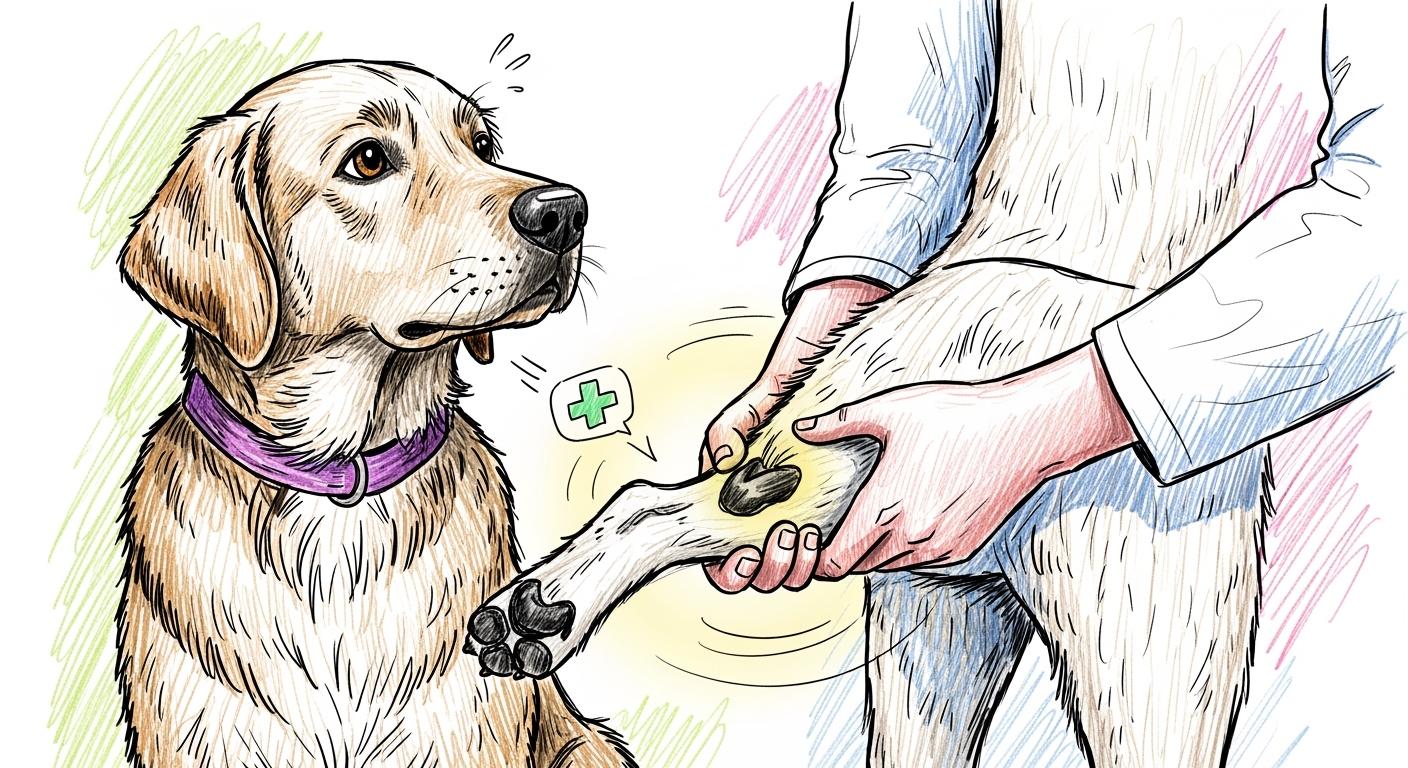
A dog pushes off, and the hock joint snaps straight for a split second — tendons taut, tarsal bones locked into a rigid lever. Then the paw hits ground and the same joint flexes, absorbing impact through a chain of small bones that slide and compress against each other. Propulsion and shock absorption. Power and give. The hock does both, hundreds of times per walk, and it does them through the same set of ligaments and cartilage surfaces.
That dual role is why designing a brace for this joint is harder than it looks. Lock the joint and you kill propulsion. Leave it free and you offer no protection. The question is not whether a brace supports the hock. It is which motions it restricts, which it leaves alone, and whether the hardware aligns with the joint's actual axis of rotation. Get the alignment wrong and the brace fights the dog. Get it right and the dog forgets the brace is there.
How the Hock Joint Moves — And What That Means for Brace Design
The canine hock joint sits on the hind leg just above the paw. It is the anatomical equivalent of a human ankle: an assembly of seven tarsal bones, interconnected ligaments, and the common calcaneal tendon — the Achilles tendon equivalent — that drives propulsion. The joint creates the sharp rear-leg angle visible when a dog stands.
But the hock is not a simple hinge. It is a compound joint. The primary motion — flexion and extension — happens at the talocrural joint, where the tibia meets the talus. That is the axis a dog hock brace needs to track. Below it, the intertarsal joints allow subtle gliding and rotation that fine-tune foot placement on uneven ground. Above it, the muscles of the upper hind limb deliver force through the Achilles tendon, which inserts on the calcaneus — the bony point at the back of the hock.
This is the causal chain that decides whether a brace stabilizes or interferes:
Hinge aligned with the talocrural axis → force transfers along the joint's natural load path → joint surface contact stays uniform → the dog moves with less compensation → the brace stays seated without overtightening → skin tolerates longer wear.
Break any link. A hinge placed even a quarter-inch forward of the true joint axis redirects load into soft tissue instead of bone. The brace shell pushes into the front of the leg during extension and gaps at the back. The dog compensates by shortening stride on that side. The altered gait loads the stifle and hip asymmetrically. The brace shifts, the owner tightens the straps, and the cycle accelerates.
This is not subtle. You can check it. Have the dog walk ten strides, then stop and look at the brace hinge from the side. The hinge center should still sit directly over the bony prominence on the outer hock — the malleolus. If it has drifted forward by more than the width of your thumb, the alignment is off. The brace is no longer guiding the joint; the joint is fighting the brace.
What Makes a Hock Brace Stabilize Rather Than Just Wrap
Take two braces. Both fit. Both have straps. One stays put through a sprint. The other shifts by the third stride. The difference is not materials or brand. It is three design decisions that operate below the surface.
Strap configuration and force dispersion. A hock brace must resist two forces: rotational torque — the joint twisting — and shear — the bones translating sideways relative to each other. A single wide strap does neither. It provides circumferential compression, which feels snug at rest but offers no resistance to rotation. The brace needs at least two anchor points: one above the joint, one below. The straps must pull diagonally across the joint line, creating a force couple. Tension from the upper anchor resists rotation. Tension from the lower anchor resists translation. Strap width matters too. A narrow strap concentrates force into a thin band — pinch points, restricted blood flow. A wider strap spreads the same tension, lowers unit pressure, and the dog tolerates it longer.
Hinge design and motion stops. A free-swinging hinge that moves both ways offers zero protection against hyperextension — the exact motion that strains hock ligaments when a dog plants a foot and twists. A hinge with a mechanical extension stop, set to match the breed's normal range, allows walking flexion but blocks the terminal degrees of extension where ligament strain peaks. The stop angle is not universal. A sighthound needs more extension range than a bulldog. A brace with adjustable stops can serve different conformations, but only if the adjustment increments are fine. A stop that jumps ten degrees per step is too coarse — it either overshoots and blocks useful motion, or undershoots and lets harmful motion through.
Liner as shear interface, not cushion. The liner's job is not padding. It is grip. When the dog moves, the brace shell wants to slide. The liner must convert that sliding force into hold — without adhesive, without overtightening. A closed-cell foam liner with a textured skin-contact face creates micro-interlock with the coat. Vertical ribbing resists up-down slip while letting the brace self-center as the dog moves. A smooth liner slides. A neoprene-only liner traps moisture against skin. Both fail within the first active session.
A dog knee brace for the stifle faces a related but distinct set of alignment demands — the stifle is a hinge joint with cruciate ligament constraints, and its brace design centers on limiting cranial tibial translation rather than the tarsal rotation control a hock brace requires. The principles are parallel, but the mechanical problem is different.
Here is an observable test for force dispersion. After fifteen minutes of the dog walking on mixed terrain — grass, a slope, a curb or two — slide your fingers under each strap edge. Feel the skin temperature under the strap versus the skin just outside it. A temperature difference is a pressure signal. Warm skin under the strap means friction heat — the strap is moving against skin. Cool skin means restricted circulation — the strap is too tight. Uniform temperature across the strap boundary means the force is spread wide enough that blood flow and friction are both within normal limits. The skin tells you what the strap is doing.
When a Hock Brace Works — And When It Does Not
A hock brace solves a specific set of mechanical problems. It is not a general-purpose leg sleeve, and knowing where its design reaches its ceiling is as important as knowing where it excels.
Where the design performs. A well-aligned hock brace is most effective when the joint has instability in one or two planes but retains functional muscle control. Partial ligament tears fall into this category — intact tissue can still guide motion, and the brace blocks the end-range movement that stresses the torn fibers. Post-surgical recovery periods also fit: repaired tissues need guarded, progressive loading, and the brace limits the joint to a safe arc while the dog rebuilds strength. Chronic hock osteoarthritis responds to external support that reduces peak loads during activity without full immobilization — the joint stays mobile, but the brace absorbs a share of the impact forces that would otherwise travel through worn cartilage.
Where the design hits its ceiling. A brace cannot replace a completely ruptured ligament. No external device can replicate the internal restraint of a healthy ligament — to match that, the hardware would need to be anchored directly to bone. It cannot correct a congenital angular limb deformity, which originates at the growth plate and cannot be redirected by external force. It cannot compensate for a neurological deficit. If the dog cannot feel where the foot is placed, external support cannot restore proprioceptive control.
A dog CCL brace addresses a different mechanical failure — cranial tibial thrust in the stifle — but shares the same design logic: align the hinge, control the harmful motion, leave the rest free. The joint is different. The principle is not.
Second observable check: have the dog stand on three legs, lifting the opposite hind leg. Watch the braced hock. If the joint line drifts sideways by more than the width of the joint itself, the brace is not controlling shear. A brace that feels secure in a square four-leg stance can fail the moment the dog shifts weight to one side — which happens every time it turns, steps over an obstacle, or climbs onto a surface. The single-leg stance exposes whether the strap configuration manages torque or just squeezes.
Disclaimer: These fit checks assume a short-coated dog where the brace sits against visible skin. Double-coated breeds may hide warmth or moisture signals — run your fingers under strap edges and along hinge points to feel for heat the coat conceals. Dogs with angular limb deformities or breeds with extreme hock angulation may not achieve the hinge-to-joint alignment described here, and the single-leg stance test can produce misleading results in those cases.
Design Details That Change the Daily Wear Experience
Sizing and the three-measurement problem. A hock is not a cylinder. The circumference above the joint, at the joint line, and below the joint are all different. A brace sized from a single measurement — leg girth at one point — will fit one zone and gap or bind at the others. Proper sizing uses at least three measurements: upper shank circumference, joint circumference, and lower shank circumference. The strap system must then adjust each zone independently. Without independent zone adjustment, the brace ends up tight at one level and loose at the next — exactly the kind of fit that either restricts circulation or slides out of position.
Shell construction and production consistency. The shell material governs everything downstream. Injection-molded thermoplastics produce consistent wall thickness across production runs — the hinge bosses, strap slots, and vent cutouts come out dimensionally identical every cycle. That matters because a hinge boss that is even half a millimeter off-spec produces the alignment drift described earlier. Fabric-and-stay designs — sewn sleeves with internal plastic or metal stiffeners — offer greater flexibility for dogs whose proportions fall between standard size breaks, but they introduce sewing variance. Stitch tension, stay alignment, and seam placement shift slightly from unit to unit. Each approach solves a different problem: molded shells for dogs near standard size profiles, sewn constructions for dogs with outlier proportions.
Liner removability and wear life. A liner that cannot be removed and cleaned has a fixed lifespan. Saliva, dirt, and skin oils degrade foam cell structure. The textured grip surface smooths out. The liner loses its shear resistance, then the straps must be tightened to compensate, then the pressure cycle starts. A removable, washable liner resets this clock. Hook-and-loop strap closures that drag across the liner edge during removal gradually pill the surface fabric — a design that routes strap anchors through shell slots rather than over the liner edge eliminates this friction path entirely.
The difference between a hock brace and a simpler wrap comes down to these structural elements. A wrap provides uniform compression — useful for mild strains and sensory feedback, but incapable of resisting rotation or shear. A brace adds hinges, stays, and a rigid or semi-rigid shell. It controls specific motion planes rather than squeezing the whole joint. The question is which specific harmful motion needs to be blocked, and whether the brace's design actually blocks it.
Frequently Asked Questions
How can I tell if a hock brace fits correctly?
After five minutes of walking on level ground, check three things. The hinge center should align with the bony prominence on the outer hock; if it has drifted up or down, the straps are not holding position. You should be able to slide one finger between any strap and the skin — tighter restricts circulation, looser than two fingers lets the brace migrate. After removal, skin indentations or red marks that persist longer than two minutes indicate pressure concentration. Lines that fade within two minutes are normal.
Can a hock brace replace surgery for a torn ligament?
A brace can manage instability from a partial tear by blocking the motion that stresses the injured fibers. A partial tear still has tissue bridging the joint — tissue that can do work if it is protected. A full rupture has no mechanical connection left to preserve. The brace can provide external support that improves comfort, but it cannot restore the internal joint restraint that only surgical reconstruction or natural fibrosis can provide.
How long can a dog wear a hock brace in one session?
Start with thirty-minute sessions and check the skin after each removal. If the skin is dry, with no indentations lasting beyond two minutes and no warmth concentrated at pressure points, increase by fifteen-minute increments. Most dogs with healthy skin tolerate four to six hours of daytime wear with a properly fitted brace. Overnight wear is not recommended: the dog cannot consciously shift its position, and a pressure point that develops over hours of stillness will not self-relieve.
What is the difference between a hock brace and a hock wrap?
A wrap applies uniform compression. It can reduce mild swelling and provide proprioceptive feedback — the dog senses the wrap and becomes more aware of joint position. But it has no hinge, no mechanical stop, no structural resistance against rotation or shear. A brace adds rigid or semi-rigid elements that control specific motion planes. Use a wrap for mild strain recovery and sensory cueing. Use a brace when the joint needs protection from a specific harmful motion.
0 Comments