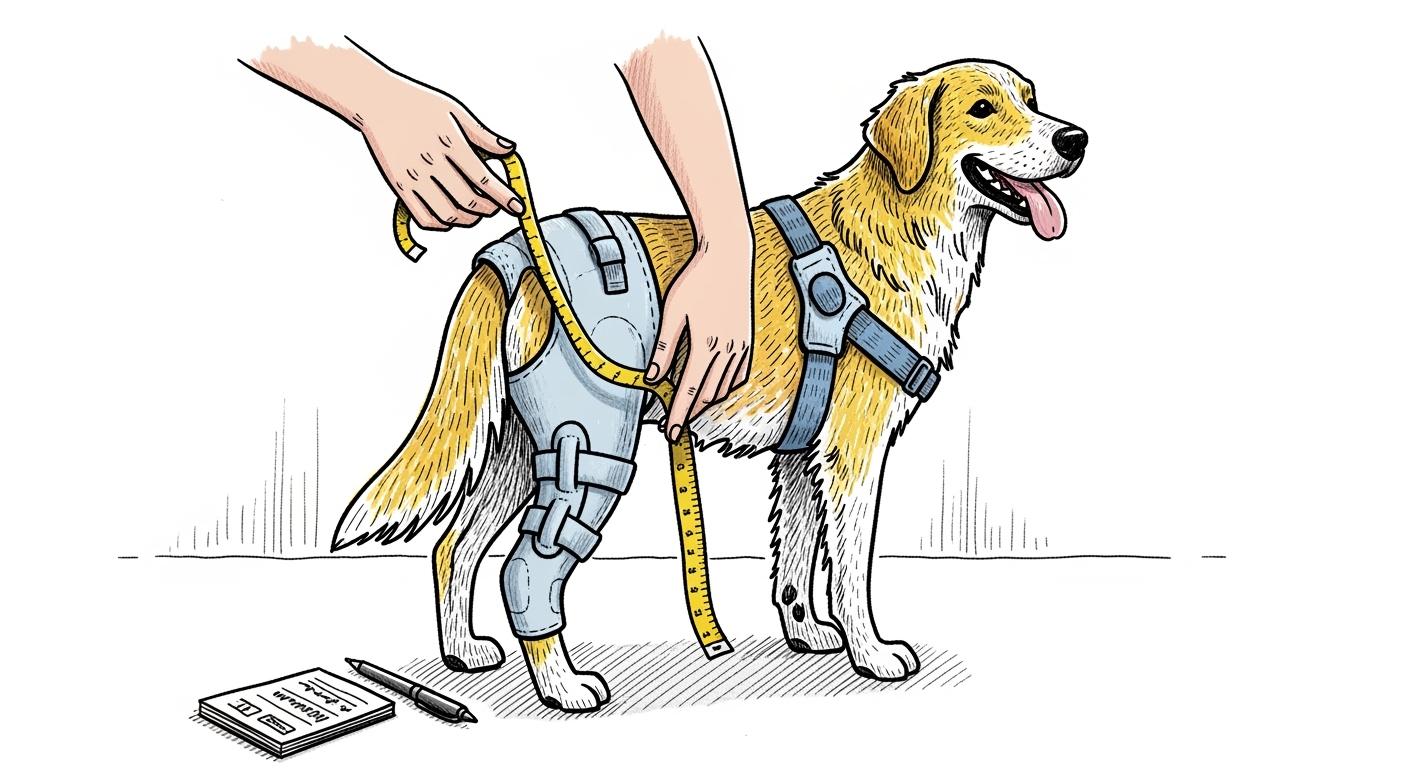
When a dog puts weight on a braced hind leg, two things happen at once. The hinge either tracks the joint axis or it does not. The straps either spread the reaction force across a broad contact patch or concentrate it into narrow bands. These two details determine whether the leg gets stabilized or just wrapped.
What Makes a Hind Leg Brace Actually Stabilize the Joint
A dog knee brace works by limiting the range and direction of joint motion, not by immobilizing the leg. The distinction matters. A fully rigid sleeve transfers all ground reaction force to the femur and tibia — the bones take the load, but the soft tissues around the stifle absorb none of the work they are designed to handle. A brace that permits controlled flexion while blocking anterior translation of the tibia keeps the joint surfaces in their normal working relationship while muscles and ligaments still participate in gait.
This is where hinge placement becomes the make-or-break detail. The hinge center must sit within a few millimeters of the knee's instant center of rotation. When it does, the brace's pivot and the joint's pivot share the same axis. The mechanical couple between them transmits force cleanly — compression along the femur, tension in the brace arms, shear across the joint surfaces in the pattern the dog's anatomy expects. When the hinge sits even a quarter-inch off, the mismatch creates a bending moment. The brace pushes the femur one way while the dog's weight pushes the tibia another. The dog compensates by altering its gait to reduce the discomfort. That shifts load to the other hind leg or the spine.
That works for a few steps. It fails over weeks of daily use.
Strap width and anchoring points are the second half of the equation. A two-inch-wide strap spreads the brace's reaction force over roughly twice the skin area of a one-inch strap — peak pressure at the skin interface drops by nearly half. Multi-point anchoring with straps above and below the joint, plus a mid-brace strap at the tibial crest, creates a three-point force couple that resists rotation. A single-strap design cannot create that couple. The brace migrates down the leg within minutes of walking.
After a 10-minute walk, check whether any strap has drifted more than half an inch from its original position. If it has, the anchoring configuration is not creating enough rotational resistance for that dog's leg geometry.
The dog ACL brace category includes designs that get both of these details right and designs that get neither. The difference shows up in how the dog moves after the first five minutes of wear — not in the product photo or the spec sheet.
In practice: After the brace has been on for five minutes of standing and slow walking, feel for the hinge center through the outer shell. Compare it to the bony prominence on the lateral side of the stifle — the fibular head. If the hinge sits more than a fingertip-width forward or back of that landmark, the brace is not tracking the joint axis. The dog will shorten its stride on that side within the first few minutes of a walk.
How Fit Quality Affects What the Brace Can Do
A brace that fits well stays put. A brace that fits poorly migrates, rubs, and gets abandoned. Fit quality is not about the measurement numbers matching a chart. It is about whether the brace's contact surfaces maintain their positional relationship to the joint throughout the dog's normal movement.
Measuring for a hind leg brace starts with the dog standing square on a level surface. Three circumference measurements anchor the fit: thigh circumference roughly one inch below the groin, knee circumference at the stifle joint center, and lower leg circumference halfway between the hock and the paw. The distance from the knee joint center to the hock determines the brace height.
These four numbers are not independent. If the thigh-to-knee circumference ratio falls outside the range the brace's strap geometry was designed for, no amount of strap tightening will make the brace track correctly. A dog with a heavily muscled thigh and a relatively slender lower leg — common in Greyhounds, Whippets, and some working-line Shepherds — puts the brace's upper strap under high tension while the lower strap stays loose. The brace tilts. The hinge tilts with it.
Straps should fasten with enough tension that you can slide one finger under the strap edge but not two. This is not a comfort guideline — it is a pressure threshold. Straps that are too loose allow migration, which moves the hinge off the joint axis. Straps that are too tight compress superficial veins and lymphatics. After 20 to 30 minutes, the leg begins to swell, and the same strap tension that felt snug at the start now becomes a tourniquet.
After 20 minutes of the dog walking or standing in the brace, open the straps and check the skin. Dry skin with no indentations deeper than the weave pattern of the strap liner means the tension is right. Damp, red, or deeply indented skin means adjust. Fit checks done while the dog stands still on a table miss the migration that happens during movement. Check strap position after the dog has walked, not before.
A dog brace that uses independent upper and lower strap tensioning can compensate for disproportionate leg segments, because each strap pair adjusts to its own segment's circumference rather than pulling from a shared tension path. This matters most for breeds where the thigh circumference is disproportionately large relative to the lower leg.
When a Hind Leg Brace Works and When It Does Not
A hind leg brace supports the joint best when the primary problem is instability under load — a partial cruciate tear, mild to moderate arthritis with joint laxity, or post-surgical protection during controlled activity. In these conditions, the brace's external constraint replaces some of the stabilizing work the damaged ligament or weakened musculature can no longer perform. The joint moves through a protected range rather than collapsing into the painful end range.
A hind leg brace is the wrong tool for a complete fracture, an acute complete cruciate rupture with gross instability, an active joint infection, or a neurological deficit where the dog cannot feel the leg. In those cases, no amount of strap adjustment solves a structural problem that requires surgical fixation or medical management first.
Disclaimer: If the dog's hind leg conformation falls outside the proportional norms the brace was patterned for — particularly dogs with angular limb deformities, very deep chests that alter standing limb angle, or disproportionate muscle wasting on one side — the fit checks described here may not catch every pressure point. Hand-check the skin under every strap edge and bony prominence after the first 10-minute wear session, regardless of how well the measurements matched the size chart.
The hock brace addresses a different joint but follows the same design logic. When instability is concentrated at the tarsus rather than the stifle, a brace designed for that specific joint geometry keeps the ankle from collapsing into hyperextension or valgus during weight-bearing. The principles are identical — hinge alignment and strap force distribution — but a stifle brace cannot substitute for a hock brace any more than a knee sleeve can stabilize an ankle in a human athlete.
For dogs with multi-joint hind leg weakness — common in advanced arthritis or geriatric muscle loss — a leg brace that spans the stifle and hock together may offer more functional support than two separate braces. A single frame eliminates the mechanical gap where two separate devices can interfere with each other during the swing phase of gait.
Design Details That Affect Daily Wear Tolerance
A brace that is mechanically sound but intolerable after 30 minutes is not a working brace. The lining material, ventilation pattern, and edge finishing determine whether the dog accepts the brace as part of its environment or works constantly to remove it.
Neoprene linings grip well against fur — the closed-cell foam compresses into the coat and resists migration. But neoprene does not breathe. After 20 to 30 minutes, moisture builds between the liner and the skin. The same friction that prevented migration now macerates the skin. A perforated neoprene or mesh-faced liner trades some grip for airflow. That trade is worth it for dogs wearing the brace more than an hour at a time, because skin integrity becomes the limiting factor, not strap slip.
The frame material sets the stiffness-to-weight ratio. A heavier brace needs more strap tension to stay in place, which circles back to the skin pressure problem. Thermoplastic frames can be contoured to follow the leg's shape, distributing contact pressure across the full inner surface. A flat-plate frame that does not contour contacts the dog along two narrow lines — the front and back edges of the plate — concentrating pressure exactly where the skin is least tolerant of it.
After the dog has worn the brace for 30 minutes of quiet rest, open the straps and press a dry paper towel against the inner lining for three seconds. If the towel comes away damp, the lining is not moving moisture away from the skin fast enough for that dog's activity level and coat type. Short-coated breeds show this faster than double-coated breeds, whose undercoat provides some natural wicking.
Disclaimer: This check assumes a short-coated dog. Double-coated breeds may show subtler moisture accumulation — run your fingers under the brace edge and feel for dampness at the skin surface rather than relying on visible wetness in the lining.
Strap edge finishing is the detail most owners notice first but understand last. Rolled or folded strap edges distribute edge pressure across a curved surface. Raw-cut strap edges present a 90-degree corner to the skin. Under tension, that corner digs in. The difference is only a millimeter or two. After an hour of wear, the dog knows which one it is wearing.
A dog brace for ACL injury recovery adds one more requirement: the frame must resist rotational forces during pivoting, not just linear forces during straight-line walking. When a dog turns, the femur rotates relative to the tibia. If the brace frame twists under that load, the hinge alignment shifts mid-stride. A frame with torsional stiffness maintains hinge position during turns. A frame that twists loses alignment exactly when the joint needs it most — turning movements create the highest cruciate ligament strain.
Daily inspection is not about finding catastrophic failures. It is about catching the small shifts that compound. Check strap positions after each wear session. If the brace has moved more than a quarter-inch from its original position, adjust. If it moves the same amount the next session, the fit is not right — the brace geometry does not match the leg geometry, and no amount of re-tightening will fix it.
A dog using an ACL brace for the first time may show a shortened stride or a slight head bob during initial acclimation. That is the dog learning to trust the external constraint. If the gait asymmetry persists beyond the third or fourth wear session, the brace is interfering with movement rather than guiding it. The distinction between adaptation and interference is measured in days, not weeks.
For smaller or older dogs, a knee brace for small breeds and senior dogs faces an additional constraint: lower body weight means less gravitational force to seat the brace during standing. The strap anchoring has to work harder per pound of dog. Smaller circumference also means a given strap width covers a larger fraction of the leg's total surface area, which changes the pressure distribution math. These are not smaller versions of large-breed braces — the scaling is nonlinear, and the strap geometry should reflect that.
FAQ
How long should a dog wear a hind leg brace each day?
Start with 15 to 30 minutes. Increase in 15-minute increments as the dog's skin tolerance allows. The skin, not the joint, sets the wear-time ceiling during the first two weeks.
Can a dog walk or play while wearing the brace?
Controlled walking on level surfaces, yes. Unrestricted running, jumping, or rough play with other dogs, no — the rotational loads during sudden direction changes exceed what an external brace can manage without shifting.
How is a dog hind leg brace cleaned?
Wipe the inner lining with a damp cloth after each use. Let it air-dry fully before the next session. Moisture trapped in the liner overnight breeds bacteria that irritate the skin the next day.
What signals that the brace needs adjustment or replacement?
Strap migration of more than half an inch during a single walk. Skin redness that persists more than 15 minutes after brace removal. Any crack in the frame or hinge housing. A gait change that does not resolve by the third acclimation session.
Is veterinary guidance needed before using a hind leg brace?
A veterinary exam establishes the diagnosis and rules out conditions a brace cannot address — fractures, complete ruptures requiring surgery, infections, and neurological deficits. Once those are ruled out, brace selection becomes a mechanical question of matching design geometry to leg geometry.
0 Comments