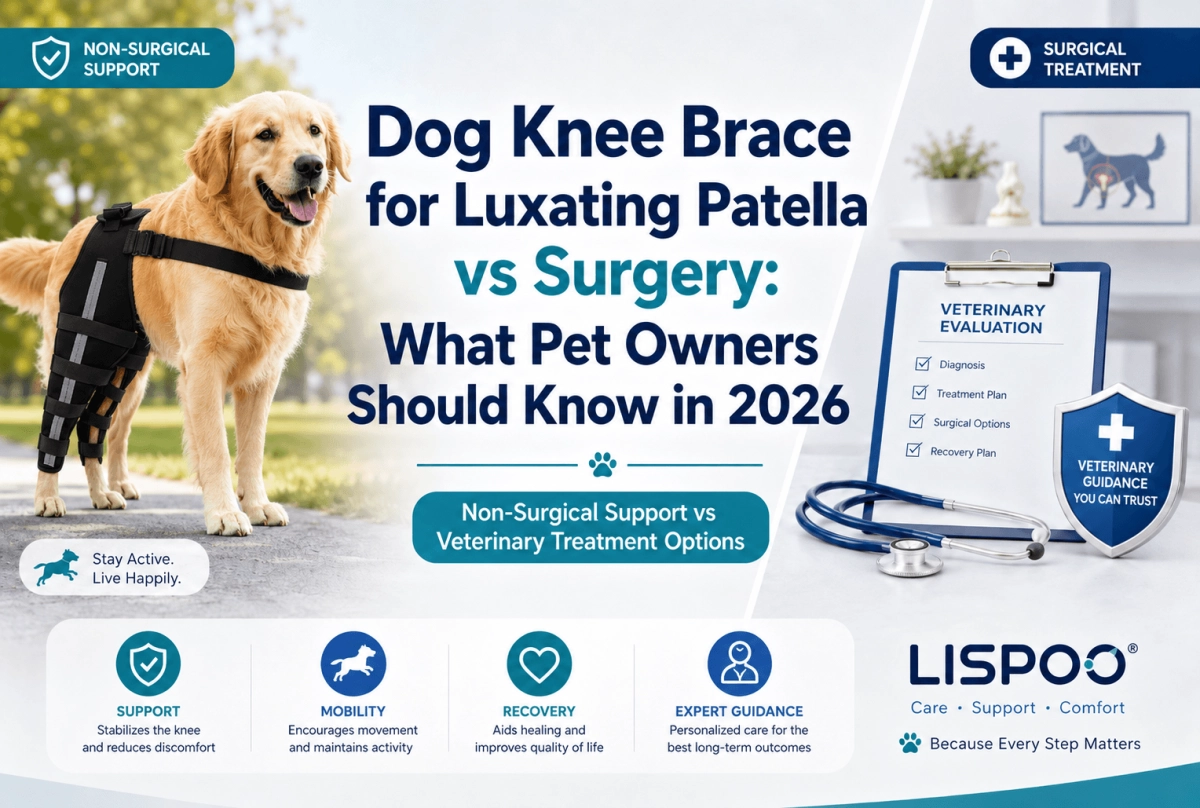
A dog with a luxating patella takes a step, and the kneecap slips. The leg buckles for a second, then reloads. Put a brace on that same leg and the kneecap stays put — but only if the hinge sits directly over the joint axis. Miss by half an inch and the brace becomes an expensive sleeve. That half-inch is where design matters.
About 1.3% of dogs develop luxating patella, with small breeds carrying the highest risk. Luxating patella brace for small dogs can guide the kneecap back into its groove during movement. But how well it does that depends entirely on two design decisions: where the hinge sits and how the straps distribute force. Neither has anything to do with how tight you crank it.
Hinge Alignment: Why Joint Axis Tracking Determines Everything
A dog's stifle joint rotates around a fixed mechanical axis. The patella glides along a groove in the femur as that axis rotates. When the groove is too shallow — the structural problem behind most luxating patellas — the kneecap drifts sideways under load.
A brace hinge placed directly over that joint axis does not simply "hold" the patella. It constrains lateral movement by creating a mechanical track. As the dog flexes and extends the leg, the hinge arms transmit force along the same line the patella should naturally follow. This alignment means the brace redirects the patella into its groove with each stride rather than fighting against the dog's own movement pattern.
The causal chain runs like this: hinge-to-axis alignment → force travels along the joint's natural rotation plane → patella stays centered in the groove through the full range of motion → the dog walks with a near-normal gait → the brace feels less like an obstacle and more like a guide → the dog tolerates hours of wear without resisting.
Misalignment breaks every link in that chain. If the hinge sits even a finger's width above or below the joint line, extension forces pull the brace up or push it down with each step. The brace migrates. The patella loses its guide. The owner tightens the straps to compensate. Now the dog has both an unstable kneecap and a tourniquet.
You can verify alignment at home. Let the dog walk for ten minutes at a normal pace, then check whether the hinge center still lines up with the bony prominence on the outside of the stifle. If it has drifted forward or backward by more than half an inch, the hinge placement is wrong for that leg — regardless of what the size chart claimed.
The hinge design itself matters too. Polycentric hinges — those with multiple pivot points — mimic the femur's changing center of rotation as the joint flexes. Single-pivot hinges cannot do this. At full extension the alignment holds; at deep flexion the pivot drifts off-axis. For dogs that spend most of their time walking rather than sprinting, a single-pivot hinge may perform fine. For a dog that crouches, jumps onto furniture, or climbs stairs, a polycentric dog knee brace hinge maintains alignment through a wider range of motion.
Strap Force Distribution: Wide Straps Beat Tight Straps Every Time
If hinge alignment is the precision component, strap configuration is the endurance component. A brace can be perfectly aligned at minute zero and useless by minute twenty if the straps create pressure points the dog cannot tolerate.
The physics is straightforward. A narrow strap concentrates the brace's stabilizing force onto a thin band of skin and underlying tissue. That concentrated pressure compresses capillaries, irritates nerve endings, and within minutes triggers the dog to lick, bite, or rub the brace off. A wide strap spreads the same total force across three to four times the surface area. The pressure per square inch drops proportionally. The dog stops noticing the brace exists.
This is not about comfort in the soft sense. It is about compliance. A brace that the dog removes with its teeth within an hour delivers zero patella support regardless of how well the hinge is engineered. Wide straps — particularly those with neoprene-backed padding that conforms to the leg's taper — keep the brace in place without needing excessive tension. The difference between a two-inch strap and a one-inch strap is not cosmetic. It is the difference between the brace staying on for a full walk and coming off halfway through.
Strap placement follows the same principle. A strap that crosses directly over the patella applies downward pressure that can push the kneecap further out of its groove — the exact opposite of what the brace is supposed to do. Proper placement runs above and below the joint, creating a stable bridge that guides without compressing the patella itself. Dog acl ccl brace designs often share this same strapping logic: stabilize the joint above and below, leave the injury site uncompressed.
Observable check: after twenty minutes of wear, lift the edge of each strap and look at the skin underneath. Pink and dry is passing. Red, indented, or damp is failing — reduce tension, check strap width, or both. Double-coated breeds may need a hand-check rather than a visual one; run a finger under the strap edge and feel for heat or raised skin.
Where Brace Design Reaches Its Structural Limit
A patella brace guides. It does not reshape bone, deepen a groove, or realign a tibial crest. Those are structural corrections. And when the underlying structure is too far from normal, no amount of external guidance can compensate.
The grading system for luxating patella maps directly onto what a brace can and cannot do:
| Grade | What Happens in the Joint | What a Brace Can Do | Why Design Falls Short |
|---|---|---|---|
| I | Patella displaces with manual pressure, returns spontaneously | Guide the patella during activity; counter intermittent slipping | Hinge alignment sufficient — the groove is shallow but functional |
| II | Patella luxates during movement, stays out until manually reduced | Limit lateral excursion; reduce frequency of luxation events | Strap force distribution critical — the brace must hold without irritating |
| III | Patella is luxated most of the time, can be manually reduced | Provide partial guidance; comfort during limited activity | Groove is effectively absent — the brace fights structural deformity with every step |
| IV | Patella is permanently luxated, cannot be manually reduced | Minimal; may offer comfort but cannot reposition the patella | External guidance cannot overcome fixed structural displacement |
Grades III and IV represent a structural reality that no external brace design can solve. The trochlear groove is either too shallow or absent. The tibial crest may be medially displaced, pulling the patellar ligament off its natural line of tension. These are problems of bone geometry. A hinge and straps sit on the outside. Surgery addresses them from the inside — deepening the groove, repositioning the tibial crest, tightening the joint capsule. The brace is not "worse" than surgery in these cases. It is designed for a different problem.
This is the design boundary, not a failure. Every product has conditions it was built for and conditions it was not. A patella brace is built for joints where the patella can track correctly but needs help staying there. When the joint lacks the geometry to track correctly at all, the brace's mechanism — external guidance along a natural axis — has no axis to guide along.
Disclaimer: The fit checks described here assume a dog with typical breed leg conformation. Angular limb deformities, very deep chests, or unusually short femurs can shift the hinge-to-joint relationship enough that standard alignment tests produce false negatives. In those cases, a hands-on fitting with someone who understands how joint geometry interacts with hinge placement produces more reliable results than any at-home checklist.
Material Choices That Affect Daily Wear
Hinge alignment and strap width are the two big design decisions. But several smaller ones determine whether a well-aligned brace actually gets worn.
Neoprene versus mesh backing. Neoprene provides even compression and holds its shape through repeated flex cycles. It also traps heat and moisture. After thirty minutes of active movement, the skin under a full-neoprene liner becomes warm and damp. Some dogs tolerate this indefinitely. Others start licking within the hour. Mesh-backed panels — particularly where the brace contacts the inner thigh — allow evaporative cooling at the cost of slightly less conforming compression. The tradeoff is between thermal comfort and compressive consistency. For a dog in a hot climate or a double-coated breed, mesh panels can mean the difference between all-day wear and constant removal.
Stitching orientation. Circumferential seams — stitches that wrap around the leg like a ring — concentrate stress along a single line. Every flex cycle pulls on that line. Over weeks of daily use, circumferential stitching tends to stretch unevenly, creating loose zones within the brace body. Longitudinal seams run parallel to the leg and distribute flex stress along their length. In production, longitudinal stitching is harder to execute cleanly on curved brace panels, which is why lower-cost braces default to circumferential patterns. But the longevity difference is measurable: a longitudinally seamed brace maintains consistent compression weeks longer than a circumferentially seamed one under the same wear conditions.
Closure systems. Hook-and-loop closures dominate brace design because they allow infinite adjustability. But the quality gradient within hook-and-loop is steep. Medical-grade fasteners use tighter loop density — more loops per square inch — which means the hook grips at lower pressure and releases with less tearing force. Consumer-grade fasteners need to be pressed harder to engage and pulled harder to release. Over months of daily use, the difference shows up as frayed loop fabric on the consumer-grade side versus intact fabric on the medical-grade side. For a brace that goes on and off twice daily, that material quality difference compounds fast.
None of these material choices change what the brace does mechanically. They change whether the dog and owner keep using it.
FAQ
How do hinge type and activity level interact?
A single-pivot hinge tracks the joint axis accurately during walking — the motion stays within a narrow flexion arc. When the dog crouches, jumps, or climbs, the femur's center of rotation shifts. A polycentric hinge has a second pivot that accommodates this shift. For a low-activity dog, a single-pivot design performs fine. For a dog that regularly jumps onto couches or navigates stairs, the polycentric design maintains alignment across a wider motion range.
Why does strap width matter more than strap tightness?
Pressure equals force divided by area. Double the strap width and you halve the pressure on the skin without reducing the stabilizing force at all. A tight narrow strap delivers less net stabilization than a moderately snug wide strap because the dog will work harder to remove it. The brace that stays on provides more support than the brace that was tightened maximally but got chewed off ten minutes later.
Can a brace help after patella surgery?
Post-surgical bracing serves a different purpose than standalone management. After surgery, the joint has been structurally corrected but the surrounding soft tissue needs protection during healing. A brace in this context limits the range of motion to prevent the repair from being stressed before tissue remodeling is complete. The design priorities shift: range-of-motion restriction becomes more important than patella guidance, and padding thickness matters more than hinge precision. The mechanism of patella bracing during recovery differs from the mechanism during long-term management of mild cases.
What signals that a brace is no longer sufficient?
The most reliable signal is not pain or limping — those can come from many sources. Watch for visible luxation events while the brace is worn. If the kneecap slips out despite the brace being properly aligned and tensioned, the condition has likely progressed beyond what external guidance can manage. A second signal: the brace keeps the patella in place but the dog refuses to bear weight on the leg anyway. That pattern suggests joint surface damage — cartilage wear or osteophyte formation — that a brace cannot reverse.
0 Comments