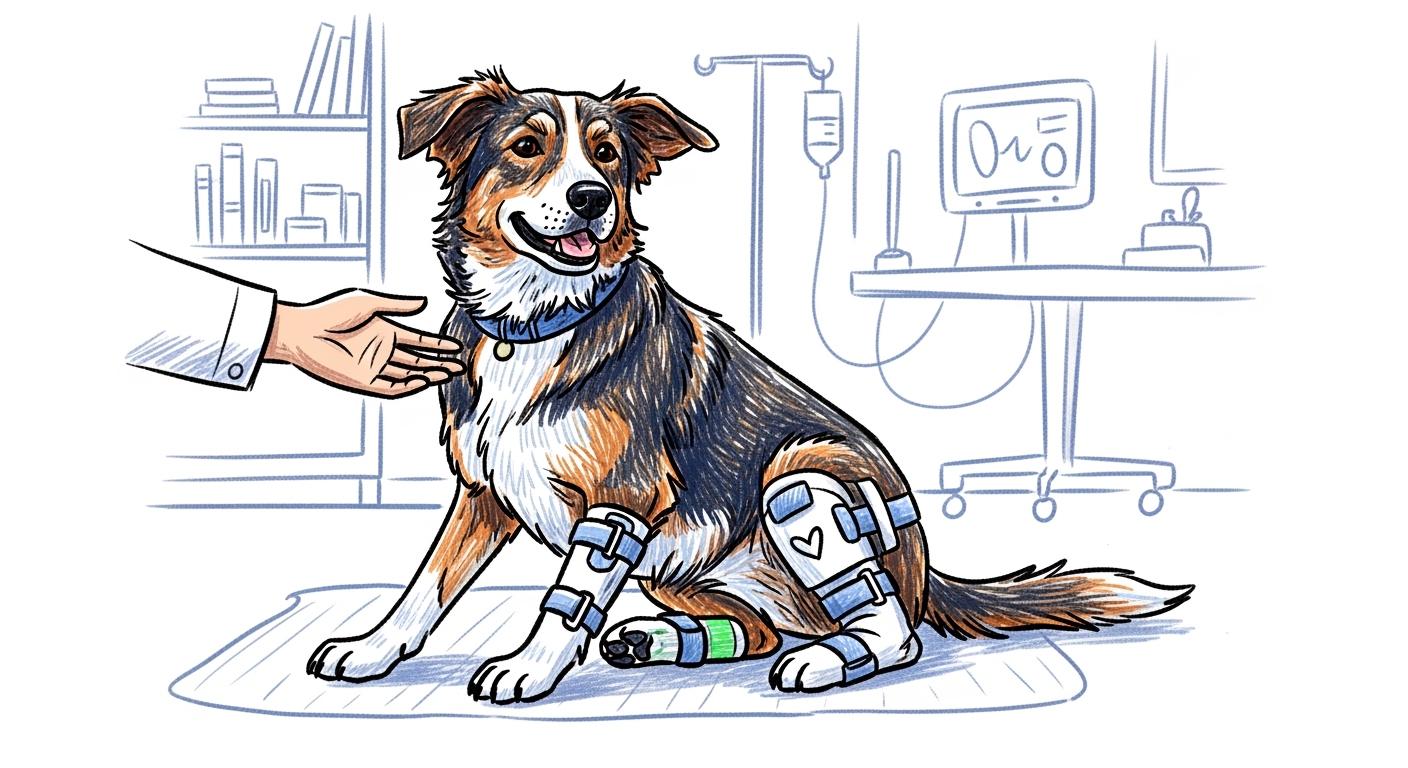
A dog knee brace either locks onto the stifle and moves with the leg, or it rides up, twists, and turns into a sleeve. The difference is not how tight the straps are. It is where the hinge sits and how the straps spread force across the limb.
Two braces can look identical on a table and perform nothing alike on a dog. One holds position through a walk, a stand-up, a stair climb. The other shifts within minutes. The gap comes down to a handful of design choices that are easy to miss and hard to fix after the fact.
When Hinge Alignment Determines Whether a Brace Supports or Just Sits There
A dog knee brace hinges on a single mechanical relationship: the brace hinge axis and the stifle joint axis either line up, or they do not. When they line up, the brace rotates with the joint. The femur and tibia move through their natural arc, the hinge follows, and the load travels straight down the limb's mechanical axis. The dog does not fight the brace with every step.
When the hinge sits even a half-inch forward or back of the joint center, the geometry breaks. The brace arc and the joint arc diverge. Each step creates a lever arm between the hinge pin and the actual joint axis—the longer that lever arm, the more torque the brace applies to the leg instead of absorbing from it. The result: the brace fights the joint, the dog compensates by altering its gait, and the brace migrates down the leg as soft tissue gives way under off-axis pressure.
This is the causal chain that separates a functional brace from a passive wrap. Hinge misalignment → off-axis torque → compensatory gait → soft-tissue displacement → brace migration. You can feel it. After ten minutes of walking, check whether the hinge pivots still sit directly over the bony landmarks of the stifle. If they have drifted forward or back by more than a quarter-inch, the alignment is off and the brace is no longer delivering support through the joint axis.
Knee braces built for CCL injuries place the hinge at the stifle's center of rotation—the point where the femoral condyles roll across the tibial plateau. This is not a guess based on breed averages. A correctly positioned hinge references the individual dog's joint geometry, measured with the dog standing and weight-bearing. The standing position matters because joint center shifts under load. A measurement taken on a sedated dog with the leg extended will put the hinge in the wrong place once the dog stands and the joint settles into its loaded position.
Hinge design itself splits into two paths. Single-axis hinges rotate in one plane—flexion and extension. They keep the joint from rotating internally or externally, which is what you want when the cranial cruciate ligament can no longer resist tibial thrust. Polycentric hinges follow a multi-radius path that mimics the rolling-sliding motion of the canine stifle. They allow some physiologic rotation. That works better for dogs with some remaining ligament stability who need motion guidance more than rigid constraint.
Neither design is universally better. A dog with a fully ruptured CCL gets more from a single-axis hinge that blocks tibial translation outright. A dog with mild instability and intact ligament fibers often tolerates a polycentric hinge better because it lets the knee move without fighting residual stability. The design that matches the instability pattern outperforms the one that does not—every time, regardless of price or material quality.
Why Strap Configuration Changes Where Pressure Lands
Tight straps do not make a brace stable. Wide straps, placed at the right angles, make a brace stable. The physics is straightforward: a strap applies force perpendicular to the limb surface. A narrow strap concentrates that force into a small contact patch. A wide strap spreads the same tension across more square inches of skin and underlying muscle, reducing pressure at any single point.
The three-point pressure system used in double knee braces for bilateral support depends on this principle. One anchor sits above the stifle, one below, and the hinge assembly provides the third contact point at the joint itself. When strap width is adequate—at least an inch and a half for a medium-sized dog—the system creates a stable triangle. Force vectors cancel. The brace stays where you put it.
When straps are too narrow or placed too close together, the triangle collapses toward a straight line. The brace can rotate around that line like a weather vane. The dog takes three steps, the brace twists, and suddenly the hinge is no longer facing the right direction. You can verify this yourself: walk the dog for ten minutes, then check whether each strap's top and bottom edge are still parallel to the ground. If one edge has tilted, the strap is too narrow or too close to its neighbor to resist rotational force.
Strap angle relative to the leg is equally consequential. Straps that run perpendicular to the long axis of the femur and tibia resist vertical migration because their holding force opposes gravity directly. Straps angled diagonally introduce a vertical force component that either pulls the brace down or pushes it up, depending on direction. A well-designed knee brace places its anchor straps perpendicular to the limb segments, not at the angle that was easiest to sew in production.
Padding material under the straps adds the final variable. Open-cell foam feels soft in the hand but compresses under sustained pressure. Within twenty minutes, the effective strap tension drops and the brace loosens. Closed-cell foam resists compression but breathes poorly—moisture builds, skin macerates, and the dog starts licking. A composite pad—closed-cell foam for structure with a thin open-cell contact layer for skin comfort—balances both demands without over-engineering either. Peel back the strap after twenty minutes of wear. If the skin underneath is wet to the touch, the pad is not breathing. If the strap has visibly loosened, the pad collapsed. Both fail the same test: the brace moved.
Where a Knee Brace Works—and Where It Does Not
A stifle brace works within a clear biomechanical window. The joint must still have passive stability from intact or partially intact soft-tissue structures. The brace provides external constraint that supplements what remains—it does not replace what is gone.
This means a brace performs best in three scenarios. First, partial CCL tears where some ligament fibers still resist anterior tibial translation—the brace blocks the translation the damaged fibers can no longer handle. Second, post-surgical protection where the joint is structurally repaired but needs external shielding during the remodeling phase. Third, degenerative stifle conditions in senior dogs where the goal is load-sharing across an arthritic joint rather than stabilizing an unstable one.
A brace cannot correct a complete ligament rupture with gross instability. It cannot realign a joint with severe angular deformity. It cannot overcome neurologic deficits where the dog cannot position the limb correctly regardless of external support. In these cases, the mechanical demand exceeds what an external orthosis can deliver. The hinge can align perfectly and the straps can distribute force evenly—the joint still collapses under load because the internal structures are absent, not just weakened.
The brace also cannot fix a poor fit. A dog with very short, heavily muscled thighs—common in bully breeds—may not have enough flat surface area above the stifle for the proximal strap to anchor. A dog with extremely fine bone structure—Italian Greyhounds, Whippets—may lack the limb circumference for straps to grip without over-tightening. These are not design failures. They are fit-boundary conditions inherent to any external orthosis.
Disclaimer: This fit assessment assumes a dog with standard leg conformation for its breed. Dogs with angular limb deformities, very deep chests that alter standing limb angle, or heavily coated breeds where fur obscures bony landmarks may experience pressure points that visual inspection alone cannot detect. Hand-check under straps after the first wear session regardless of breed.
Patella support braces operate under a related but distinct constraint. The patella tracks in the femoral trochlear groove. A brace can provide medial-to-lateral compression that discourages luxation, but it cannot deepen a shallow trochlear groove or tighten a loose patellar ligament. For dogs with grade 1 or 2 luxation where the patella spontaneously reduces, a brace often helps. For grade 3 or 4 luxation where the patella stays out, external compression alone is rarely sufficient.
Material Decisions That Shift Daily-Use Performance
Materials matter most in the places where the brace touches skin for hours. The inner liner is the interface that determines whether the dog tolerates the brace or fights it. Neoprene wetsuits the leg—it holds heat and traps moisture. Nylon mesh breathes but abrades with movement. A brushed polyester liner wicks moisture away from the skin surface while presenting a low-friction face that does not grab fur during flexion.
Sewing technique changes durability in ways that are invisible on a new brace. A flat-felled seam lies flush against the liner and does not create a raised ridge. An overlock seam leaves a protruding edge that presses into the skin under strap tension. After an hour of wear, that ridge can leave a red line, then a raw spot, then an open sore. This is not a material failure—it is a seam specification failure that plays out on the dog's skin. Brace designs that prioritize skin tolerance use flat-felled or taped seams throughout the liner, not just on the outer shell where they are visible in product photos.
Strap hardware is the second silent differentiator. Plastic side-release buckles are light and cheap but can pop open under the dynamic loads of a dog scrambling to its feet. Metal ladder-lock buckles hold tension more reliably but add weight. A hybrid approach—ladder locks at the primary load-bearing anchor points with side-release buckles at secondary tensioning straps—puts retention strength where the forces peak and saves weight everywhere else.
Check strap hardware after the first few days of use. If any buckle shows deformation at the load-bearing face under a fingernail press, the plastic grade is inadequate for the repeated impulse loads of canine movement. Brace hardware specified for sustained tension will show no surface change under the same inspection.
The practical difference between a brace that lasts and one that degrades within weeks often traces to these sub-surface choices: seam construction, liner lamination method, buckle material grade. None of these appear on a spec sheet. All of them show up in daily use.
FAQ
How do I know if the hinge is aligned with my dog's stifle joint?
Stand the dog on a level surface. Palpate the bony prominences on either side of the stifle—the femoral condyles laterally and medially. The hinge pivot should sit directly over these landmarks. Walk the dog for ten minutes, then recheck. If the hinge has drifted forward or back, the alignment is off. A correctly aligned hinge stays centered through movement.
Why does my dog's brace keep sliding down even when the straps feel tight?
The brace is likely migrating because the proximal anchor—the strap above the stifle—is too narrow to resist vertical load, or the thigh taper does not give it enough surface to grip. Tightening does not fix this. The strap angle relative to the limb, the strap width, and the limb contour above the stifle determine whether the brace stays put. If the thigh circumference tapers by more than fifteen percent from top to bottom of the brace zone, a custom-contoured shell may be needed rather than a straight-cut design.
Can a knee brace replace surgery for a torn CCL?
A knee brace cannot restore a fully ruptured CCL. It can supplement partial tears by blocking anterior tibial translation during weight-bearing. It can also protect the joint post-surgically during the remodeling phase. But when the ligament is completely torn and the stifle is grossly unstable, external bracing alone cannot replace the internal constraint the CCL provides.
What is the difference between a single-hinge and double-hinge brace?
Single-hinge braces use one pivot point per side and constrain motion to a single plane—flexion and extension. They block rotation and are suited to unstable joints. Double-hinge or polycentric designs use linked hinge arms to follow the stifle's natural rolling-sliding motion, allowing some rotation. They suit joints with partial stability. The right choice depends on how much internal constraint the dog's knee still has.
How long does it take for a dog to adjust to wearing a knee brace?
Most dogs accept a properly fitted brace within a few short sessions if the liner does not trap heat and the straps do not pinch. Start with fifteen-minute wear periods on a flat surface. If the dog licks the brace repeatedly, check for moisture under the liner or a pressure point at a seam. Discomfort almost always traces to heat buildup, seam pressure, or strap-edge digging—not to the concept of wearing a brace.
0 Comments