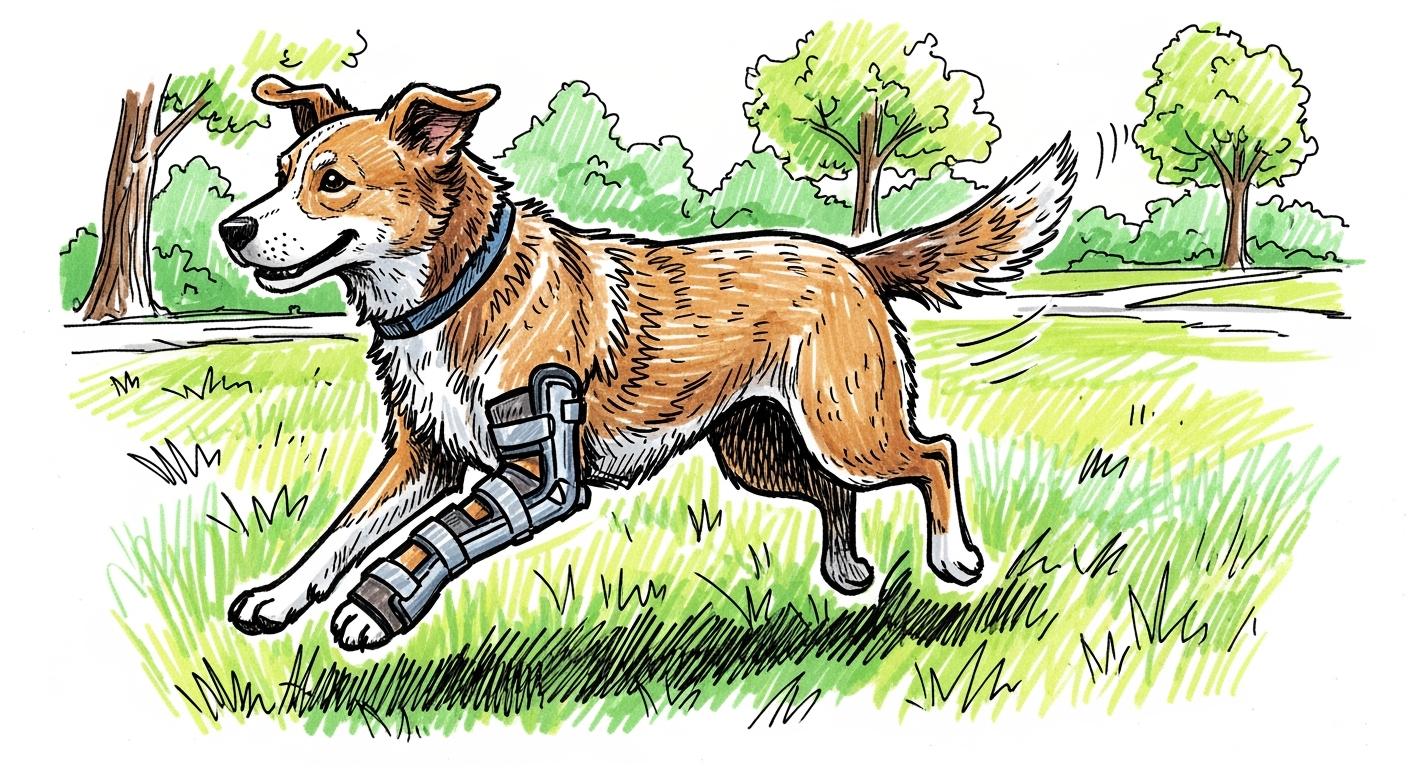
A dog limping on a front leg usually has a problem in one of two joints: the carpus (wrist) or the elbow. These joints fail in opposite ways. The carpus collapses forward under load. The elbow drifts sideways. A brace designed as a one-shape tube around the leg addresses neither failure mode directly.
What separates a brace that helps from one that does not is how its structure maps to the specific joint it is asked to support. That mapping — not strap count, not material thickness — determines whether the dog moves better or just wears hardware.
Joint-Specific Structure: Why a Front Leg Is Two Different Support Problems
Front leg braces face a mechanical split that rear leg braces rarely contend with. The carpal joint and the elbow joint fail along different axes, under different loads, at different points in the stride cycle.
The carpus absorbs impact when the paw hits the ground. If the palmar ligaments stretch or tear, the joint hyperextends — the wrist drops and the paw flattens. A carpal brace must resist forward collapse without blocking the flexion the dog needs to push off. The support structure has to sit behind the joint, not around it. A rigid posterior stay transfers ground reaction force up the leg before it can lever the wrist past its normal range.
The elbow, by contrast, is a hinge that takes side loads during turns and uneven terrain. Elbow dysplasia creates instability in the medial-lateral direction — the joint wobbles side to side. An elbow brace needs lateral containment, not posterior blocking. Straps alone cannot provide it, because fabric stretches under the rotational forces the elbow generates during a tight turn. A rigid shell with medial and lateral panels creates a mechanical boundary the joint cannot cross.
Here is where the structural logic runs deeper: a hinge that aligns with the elbow's anatomical axis transmits force along the joint's natural line. When that hinge sits even a quarter-inch high or low, the force vector tilts. Instead of loading the joint surfaces evenly, it concentrates pressure on one edge of the cartilage. Over weeks of daily use, that concentration matters more than how tightly the brace is strapped. A well-aligned brace with moderate strap tension outperforms a misaligned brace cranked to maximum tightness every time.
A table of how joint mechanics map to brace structure:
| Joint | Primary Failure Direction | Brace Structure That Counters It | Why the Structure Works |
|---|---|---|---|
| Carpus (wrist) | Forward hyperextension | Rigid posterior stay behind the joint | Blocks over-extension while preserving forward flexion for push-off |
| Elbow | Medial-lateral instability | Hinged shell with side panels | Creates rotational boundary without locking flexion/extension axis |
What Rigidity Level Actually Does for a Joint Under Load
Rigidity is not binary — soft versus hard. It is a continuum, and where a brace lands on it changes what the joint experiences during movement.
A neoprene wrap provides compression and proprioceptive feedback. The dog feels the wrap and instinctively moderates movement. That works for mild strains where the ligaments are stretched but intact. The sensory cue is the mechanism — not mechanical blocking. A dog brace at this end of the spectrum trades structural support for comfort and all-day wearability.
A rigid custom brace, by comparison, physically limits range of motion. For a carpus with torn palmar ligaments, the brace becomes the posterior stabilizer the ligaments can no longer be. The stiffness of the stay material — typically a formed thermoplastic or carbon composite — determines how much ground reaction force it redirects before the joint takes any load.
The causal chain: stiffer stay material → higher percentage of ground force bypassing the joint → less micro-motion at damaged ligament attachment points → reduced inflammatory signaling → less compensatory limping → more even weight distribution across all four limbs.
But that chain only holds if the rigidity matches the condition. A rigid brace on a mild sprain removes mechanical stimulus the healing ligament needs to remodel. The tissue weakens from disuse. A soft wrap on a fully torn ligament loads structures that cannot bear load. Both mismatches cause harm.
Here is an observable check: after 15 minutes of walking on a hard surface, remove the brace and watch how the dog distributes weight standing still. If the dog shifts weight off the braced leg immediately, the brace is either too rigid (causing discomfort from immobilization) or too soft (the joint took load it could not handle). If weight stays balanced across both front legs for at least 10 seconds, the rigidity level is roughly in the right zone. This is not a substitute for veterinary assessment, but it catches gross mismatches fast.
A comparison across rigidity levels:
| Rigidity Level | Mechanism | Best Match | Main Limitation |
|---|---|---|---|
| Soft wrap (neoprene) | Compression + proprioception | Mild sprains, early arthritis, short-term use | No structural blocking; joint still takes full load |
| Moderate (flexible shell with stays) | Partial load redirection + range limiting | Moderate instability, chronic conditions, post-surgical support | May not prevent hyperextension under high-impact loads |
| Rigid custom (thermoplastic/carbon) | Full mechanical load bypass | Severe hyperextension, torn ligaments, carpal collapse | Muscle atrophy risk with prolonged uninterrupted use |
Where the Design Works — and Where It Reaches Its Limit
A front leg brace works when the joint instability is mechanical and the brace structure has a surface to push against. The carpus, with its flat palmar surface, provides an excellent counterforce plane. The elbow, with its more complex geometry, demands precise shell contouring — a close match between brace curvature and the dog's specific elbow shape.
Conditions where a brace tends to help: mild to moderate carpal hyperextension where ligaments are stretched but not fully ruptured, elbow dysplasia managed conservatively, post-surgical support after joint procedures, and arthritic joints where load reduction improves comfort during controlled activity.
Conditions where a brace alone is typically insufficient: complete ligament avulsion where the ligament has detached from bone entirely, acute fractures requiring surgical fixation, and elbow dysplasia with large osteochondral fragments floating in the joint space. In these cases, the mechanical problem exceeds what external bracing can address — surgery addresses the source, not the symptom.
A front leg brace for carpal support also depends on the dog accepting the device. Dogs who panic or fight the brace will generate forces that overwhelm the strap system — the brace becomes a liability, not an aid. Gradual introduction over several days, starting with short sessions on a leash, tends to produce better compliance than immediate full-day wear.
Disclaimer: The weight-distribution check described above assumes a short-coated dog on a flat, hard surface. Double-coated breeds may show subtler weight shifts that require hand-checking the braced leg's muscle tension rather than visual observation. If the dog's front leg conformation falls outside breed norms — particularly in dogs with angular limb deformities, very deep chests, or disproportionately short legs — the fit principles discussed here may not catch every pressure point. A veterinarian or certified canine orthotist should evaluate fit in those cases.
Design Details That Change Daily Use
Beyond joint mapping and rigidity, three design details determine whether a front leg brace gets used consistently or collects dust.
Strap configuration. Straps that converge on a single anchor point concentrate tension — and pressure — in one location. Over hours, that concentration causes skin irritation, then the dog licks, then the owner removes the brace. Straps distributed across two or three independent anchor points spread the load. The brace holds position with less tension per strap, which reduces the localized pressure that drives most compliance failures. Check this after 20 minutes of activity: run a finger under each strap edge. If any strap leaves a defined groove that takes more than a few seconds to fade, tension at that anchor is too high. A properly distributed strap system leaves faint impressions that fade within seconds.
Liner breathability. Neoprene liners trap heat and moisture. In warm weather, skin maceration begins within 30 to 45 minutes. A perforated or mesh-lined shell allows evaporation. The difference shows up fast: remove the brace after a 20-minute walk. If the skin under the liner is damp to the touch, ventilation is inadequate for anything beyond short sessions. Dry skin after the same duration means the liner is managing moisture adequately for the dog's activity level and environment.
Cleaning access. A brace that cannot be wiped down daily accumulates bacteria in the liner within a week of regular use. Removable, washable liner sleeves solve this. Fixed liners that require soaking the entire brace degrade the structural adhesives over time. The design trade-off is real: a permanently bonded liner feels more secure during manufacturing, but a removable liner keeps the brace in service longer because it can be cleaned without compromising the support structure.
The design differences across front leg braces are not about which one is better in absolute terms — they are about which structural approach matches the specific joint, the severity of instability, and the dog's daily environment. A brace optimized for a 15-minute controlled walk fails on a dog that needs 8-hour support. A brace built for all-day wear may lack the rigidity a severely hyperextended carpus demands. The right match is the one where the design's strengths align with the dog's actual use conditions.
For dogs with injuries spanning both the carpal and elbow joints, some dog leg brace designs combine support across multiple joint levels. These combination braces add complexity — more straps, more adjustment points, more surfaces to check for pressure — but they solve a real problem for dogs with multi-joint instability or neurological conditions affecting the entire front limb.
A dog with a ligament injury often compensates by shifting weight to the opposite leg, which can create secondary strain patterns. The brace on the affected front leg must account for this — if it only restricts one joint, the compensation load simply moves up or down the limb to an unsupported joint.
The sizing and adjustment process for any leg brace follows the same principle: measure the leg at the anatomical landmarks the brace is designed to anchor against, not at the widest or narrowest point. A brace sized to the wrong reference point will drift during movement regardless of strap tension.
Bracing fits into a broader picture of arthritis management and rehabilitation where the brace's role is mechanical load reduction — not pain relief in the pharmacological sense, but the physical consequence of removing stress from a joint that cannot handle it. The distinction matters. A brace does not treat arthritis. It changes the loading conditions that make arthritis symptoms worse during activity.
FAQ
How do you know which rigidity level your dog needs?
The joint's behavior under body weight is the guide. If the carpus drops visibly with each step, the ligaments are not holding — a rigid posterior stay is the minimum. If the dog limps but the joint holds its shape, a moderate brace with proprioceptive feedback may be enough. A veterinarian determines the underlying structural damage; the brace rigidity is then matched to that finding, not to the dog's pain level.
Can a front leg brace cause muscle loss?
It can. A rigid brace worn continuously without breaks removes the mechanical load muscles need to maintain mass. Most rehabilitation protocols include periods without the brace for controlled, low-impact movement. The observable signal: check the braced leg's muscle bulk compared to the unbraced leg every two weeks. Any visible asymmetry warrants a discussion about wear schedule.
How long does it take a dog to adjust to a front leg brace?
Most dogs adapt within three to seven days when introduced gradually — 10-minute sessions on day one, adding 5 to 10 minutes per day. A dog still fighting the brace after a week typically signals a fit problem or a rigidity mismatch, not a training failure.
What is the difference between a carpal splint and a carpal brace?
A splint typically supports only the carpal joint and does not extend under the paw. A full carpal brace includes a paw plate, creating a continuous support column from the ground to the mid-forearm. The paw plate matters most when the dog needs to bear weight through the brace rather than just receive joint guidance.
0 Comments