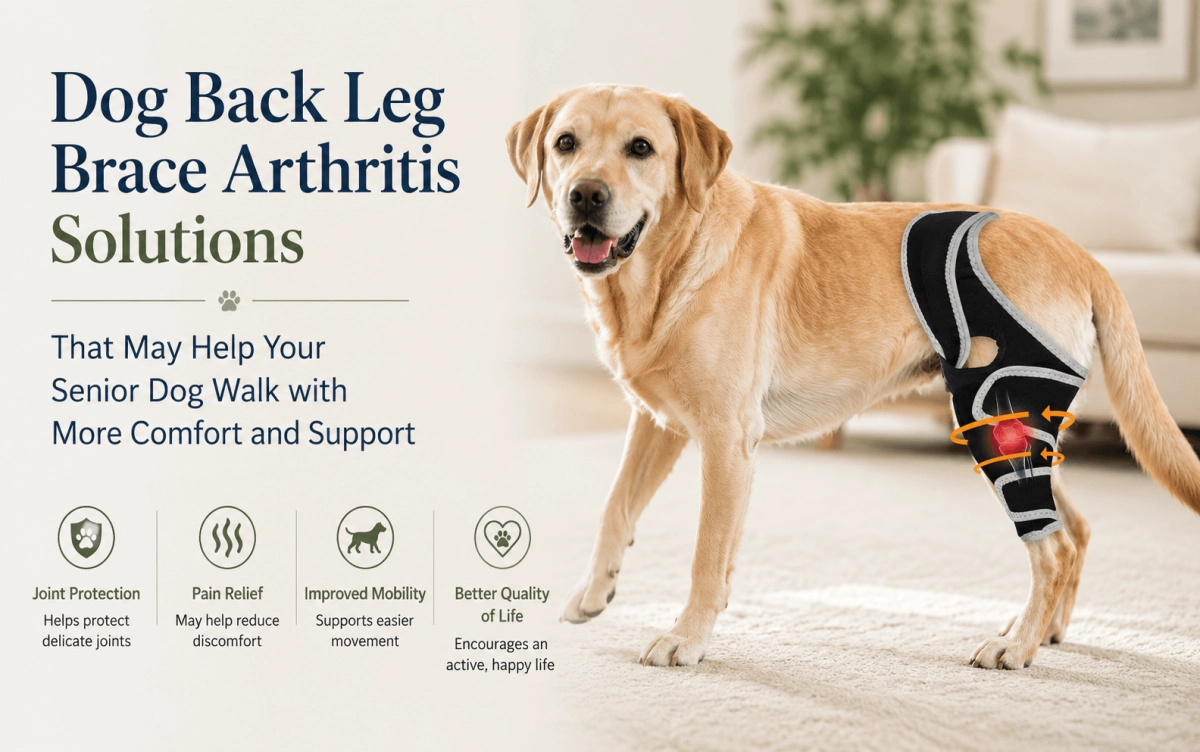
A brace wraps the leg. That part is obvious. What is less obvious is that wrapping force alone does not determine whether the brace helps.
The hinge — or the structural stiffening element in hingeless designs — must sit over the joint's natural axis of rotation. When it does, the brace redirects ground reaction force along the leg's normal load path. The joint surface compresses evenly. The surrounding muscles do not have to brace against off-axis torque. The dog loads the leg more naturally, and over days, this can translate into a visibly smoother gait.
When the hinge sits even half an inch forward or back of the joint line, the force vector angles off-axis. The brace becomes a lever arm working against the joint rather than with it. The dog compensates by shifting weight elsewhere — often to the opposite leg or the front end — and the brace that was supposed to help now changes the gait pattern it was meant to correct.
This is the difference between a dog brace that stabilizes and one that merely wraps. It is not about how rigid the shell is or how tight the straps pull. It is about whether the structural elements track the joint's actual motion.
In practice: Most dogs with arthritic back legs compensate by shifting weight forward. Watch your dog from the side during a slow walk. A dog that loads the hind leg evenly shows a slight hip dip on the weight-bearing side. A dog that avoids loading keeps the hip level or lifted on the affected side, using the front legs as crutches. A correctly aligned brace often changes this pattern within the first few sessions — not because it cures anything, but because stable support reduces the instinct to unload the leg.
When Hinge Alignment Determines Whether a Brace Works
The hinge-to-joint relationship is not a comfort detail. It is the mechanism that separates support from compression.
An arthritic stifle joint loses the ligamentous control that normally prevents excessive rotation and shear. When the dog plants the foot, the femur and tibia slide relative to each other in ways the joint was not built to handle. A brace hinge positioned on the joint axis intercepts those shear forces and redirects them along the mechanical axis of the leg. The load path stays linear; the joint surfaces stay congruent; the dog steps with less instability.
A hinge offset by even a quarter-inch changes the leverage. The brace frame now pivots around a point that does not match the joint center. As the leg flexes, the brace pushes the limb into a slightly different arc than the joint naturally follows. The mismatch is small in any single step — but over hundreds of steps in a walk, the accumulated off-axis force fatigues the surrounding muscles and can create pressure points where the brace edge digs into soft tissue rather than riding over bone.
Observable check: After ten minutes of walking on flat ground, find the bony landmarks you identified when first positioning the brace — the femoral condyles for a stifle brace, the calcaneus for a hock brace. If the hinge or stiffened panel has migrated more than half an inch from its starting position, the brace is not tracking the joint axis. It is riding on soft tissue, and the alignment advantage is lost. That fails.
Which Joint, Which Brace — Matching Structure to the Problem
The term "back leg brace" covers at least two joint-specific designs that are not interchangeable. Each addresses different motion requirements and different failure patterns.
A stifle brace wraps the thigh and upper calf, with a hinge at the knee level. The knee is a hinge joint with roughly 110–140 degrees of range during normal walking in most dogs. The brace must allow that range while blocking excessive rotation and lateral shear. The hinge mechanism is load-bearing: it absorbs side forces that the arthritic joint's weakened soft tissues no longer manage.
A hock brace supports the tarsal joint, which moves through a smaller, more constrained arc. The hock functions like an ankle — absorbing shock and driving propulsion during push-off. The primary design challenge here is compression distribution: the brace must prevent hyperextension during weight-bearing without creating pressure points over the Achilles tendon area. An adjustable dog hock brace targets lower-leg weakness without restricting upper-leg motion.
When arthritis affects both stifle and hock — common in older large-breed dogs — a full rear leg brace covering from thigh to below the hock links both joints into a single support. The tradeoff: more coverage means more material against the skin, raising ventilation and monitoring demands.
For mild arthritis — stiffness each morning that eases after a few minutes of movement — a flexible brace provides warmth and light proprioceptive feedback without restricting motion. The warmth increases local blood flow, reducing the stiffness arthritic joints feel after inactivity. For moderate to advanced degeneration where the joint shows visible laxity during weight-bearing, a rigid or hinged brace becomes necessary: the structural frame takes over stabilizing functions the joint's own soft tissues can no longer perform. A stifle brace with an adjustable hinge works for knee-focused arthritis where the hock remains stable.
A back leg brace built for arthritis differs from post-surgical braces in one key respect: it prioritizes all-day wearability over maximum immobilization. The straps are wider, the liners thicker, the hinges lighter — because the dog is expected to live in it, not recover in it.
| Design Feature | Performance Difference | Main Limitation |
|---|---|---|
| Hinged stifle brace | Blocks rotation and shear while allowing flexion | Hinge offset from joint axis creates leverage against the leg |
| Hock brace | Prevents hyperextension during push-off | Pressure over Achilles tendon if strap placement is wrong |
| Full rear leg brace | Stabilizes multiple joints in one structure | More skin coverage raises ventilation and monitoring burden |
| Soft flexible brace | Warmth and mild feedback with minimal restriction | Insufficient for joints with mechanical laxity |
Material Choices That Change How a Brace Wears Through the Day
A brace that supports well for twenty minutes but becomes intolerable after two hours is not a usable brace. Material selection dictates whether the brace stays on through a full walk, a car ride, or an afternoon around the house.
Neoprene is the most common liner for a reason: it traps body heat, and warmth reduces the stiffness that arthritic joints develop at rest. The material conforms to the leg, distributing pressure across the contact surface rather than concentrating it at strap edges. The tradeoff is straightforward — neoprene does not wick moisture. After extended wear, the skin underneath can become damp, and damp skin under sustained pressure is more vulnerable to irritation and breakdown. A brace with breathable lining addresses this at the material level rather than through shorter wear times.
Perforated neoprene splits the difference. The holes provide escape paths for moisture vapor without eliminating the thermal retention that makes neoprene useful. The tradeoff shifts to durability: perforations create stress concentration points in the material, which can tear under repeated tension cycles — particularly around strap attachment points where pull forces peak.
Rigid shell materials — typically thermoplastics — provide structural stiffness for hinged braces. These materials are inherently non-breathable; their leg contact is indirect, through the liner. The design challenge is keeping the shell light enough that the dog does not swing the leg differently to compensate for added weight, while stiff enough to resist bending under body mass during sharp turns or stair climbing.
Observable check: After twenty minutes of indoor wear, lift a brace edge and press a finger to the skin underneath. Dry and warm — the liner is breathing adequately for this dog and this activity level. Damp or cool — moisture is trapped, and either the material, the fit tension, or the wear duration needs adjustment. Run this check at two points: under a strap and under an unstrapped panel. The difference tells you whether pressure points or the material itself is the ventilation bottleneck.
| Material Type | Performance Difference | Main Limitation |
|---|---|---|
| Neoprene liner | Retains heat, conforms to leg contour, distributes pressure | Traps moisture; damp skin under pressure breaks down faster |
| Perforated neoprene | Adds moisture vapor escape while keeping most thermal benefit | Perforations weaken material at tension points, reducing lifespan |
| Rigid thermoplastic shell | Structural stiffness for hinged designs; indirect skin contact | Weight must be minimized to avoid gait compensation |
Where Back Leg Braces Help — and Where They Don't
A back leg brace supports a joint during weight-bearing activity. It does not rebuild cartilage, reverse degenerative changes, or restore lost muscle mass.
The brace is most useful for dogs whose arthritis causes mechanical instability — the joint feels loose or gives way during movement — rather than primarily inflammatory pain without mechanical laxity. In the first case, the brace performs a structural function the joint no longer can. In the second, warmth and mild compression may help, but the benefit tends to be subtler.
Dogs with early-stage arthritis who still load the leg reasonably well tend to adapt to a brace within days to a week. Dogs with advanced degeneration, significant muscle atrophy, or concurrent neurological deficits may not show a clear benefit — the brace cannot stabilize what the dog no longer actively uses.
Back leg braces tend to provide the clearest benefit during controlled, predictable activity: leash walks on flat ground, standing up from rest, navigating a few stairs. During unstructured activity — running, rough play, uneven terrain — the brace may shift or forces may exceed what the design manages. This is not a design failure; it is the design operating outside its intended conditions.
When a dog's hind leg weakness progresses to the point that the dog cannot stand independently even with a brace, or when both hind legs are involved to a degree that a single brace shifts the problem to the opposite leg, a different support approach may be more appropriate — rear support harnesses or wheelchairs distribute load differently and address a different set of functional limitations. A back support brace combined with hind leg support can help when instability spans multiple regions.
Short-term relief is common; a brace that fits well can reduce visible limping and improve weight-bearing within the first few sessions. But the underlying arthritis continues to progress — the brace manages symptoms, not the disease process. Adjusting expectations to match this distinction prevents frustration and helps owners recognize when the brace's window of usefulness is closing.
Disclaimer: The fit observations described here assume a short-coated or smooth-coated dog where bony landmarks are visible and skin changes are easy to spot. Double-coated breeds — Huskies, Malamutes, rough-coated Collies — may show subtler rub marks that require hand-checking rather than visual inspection. Run your fingers along the skin under the brace edge after each session; do not rely on seeing redness through dense undercoat. If the dog's leg conformation falls outside the breed norms this brace was patterned for — particularly dogs with angular limb deformities or very deep chests that change standing angles — the standard fit checks described here may not catch every pressure point.
Routine care extends the useful life of a brace. Hand-wash liners with mild detergent and air-dry fully before reuse. Inspect strap stitching and hinge attachment points weekly — these fail before the shell does, and a failed strap during a walk turns support into a tripping hazard. Check hook-and-loop fasteners for hair buildup; a wire brush restores grip in seconds.
A brace designed for hip and hind leg arthritis can be part of a broader mobility strategy, but it is not a standalone solution. Weight management, controlled exercise, and home environment adjustments — non-slip flooring, raised food bowls, ramps for stairs — each contribute independently to how well the dog moves and how long the brace remains useful.
FAQ
How long can a dog wear a back leg brace each day?
There is no universal number. Start with 1–2 hour sessions and check the skin after each removal. If the skin is dry and free of marks, extend by an hour. Most dogs with well-fitted braces settle into 4–6 hours of comfortable daytime wear, but this depends on the brace material, the dog's activity level, and ambient temperature. A neoprene-lined brace worn during a hot summer afternoon will reach the moisture threshold faster than the same brace worn during a cool morning walk.
Can a dog sleep in a back leg brace?
No. Nighttime removal lets the skin recover from hours of contact pressure and gives the underlying tissue a chance to dry completely. Even the best-ventilated brace creates a microclimate against the skin that benefits from a daily reset. The brace supports weight-bearing activity — it serves no structural function while the dog is lying down, since there is no ground reaction force to redirect through the joint.
Does a back leg brace stop arthritis from getting worse?
It does not. Arthritis is a progressive degenerative condition. A brace can change how the dog loads the joint during activity — reducing the mechanical stress that accelerates degeneration — but it cannot halt or reverse the underlying cartilage changes. The realistic goal is maintaining function and comfort for as long as the dog's condition allows, not curing the disease.
0 Comments