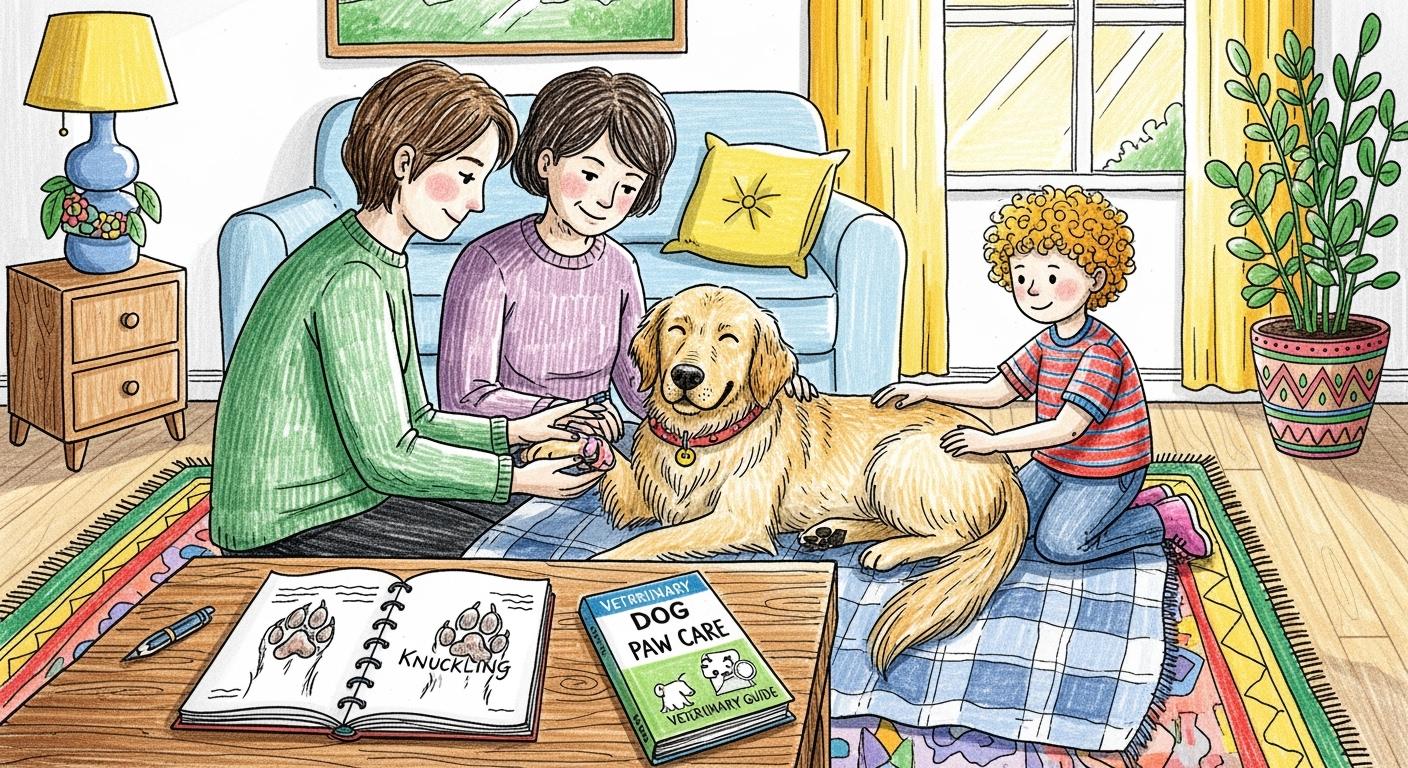
A dog's paw curls under mid-stride. The owner sees it, records it, shows the vet. The diagnosis is knuckling — a proprioceptive deficit where the dog places the top of the paw on the ground instead of the pad. What happens next depends on understanding that not all support devices work the same way. Two anti-knuckling aids that look similar can produce opposite results. One corrects paw placement during movement. The other covers the paw without changing how it lands.
The difference is not brand. It is not price. It is strap routing and material choice — two design decisions that determine whether a device retrains paw placement or merely pads the problem. Recognizing early knuckling signs determines how soon intervention starts. But understanding device design determines whether that intervention actually works.
How Strap Routing Determines Whether a Device Corrects or Covers
A strap that wraps around the paw holds it in place. A strap that routes across the carpus or hock joint changes how force reaches the paw. The distinction sounds minor. It is everything.
When a strap encircles only the paw, it creates a compression ring. The paw stays inside the device. But the forces that cause knuckling — muscle weakness, nerve signaling gaps, joint instability — originate above the paw, at the wrist or hock. Wrapping the paw does nothing to redirect those upstream forces. The dog still lands on the dorsum of the paw. The device now cushions that landing instead of preventing it.
A strap configuration that crosses the joint axis works differently. As the dog steps, tension in the strap pulls along the line of the joint's natural flexion-extension path. This creates a force couple: the dorsal strap resists hyperflexion while the palmar strap guides the paw back toward a plantigrade position. The correction happens at the joint level, not at the paw surface. The paw lands pad-down because the wrist or hock was guided into the correct angle before the paw touched the ground.
This is the causal chain: strap path determines the force vector direction. The force vector direction determines joint angle at ground contact. Joint angle at ground contact determines paw orientation at landing. A paw-wrap strap produces a radial compression vector — force pushes inward toward the center of the paw. A joint-spanning strap produces an angular correction vector — force pulls along the limb's functional axis. Same materials, same closure type. Opposite mechanical outcomes.
You can verify this yourself. Mark the strap anchor point on the device with a small piece of tape. Watch your dog walk ten steps. If the strap anchor sits above the joint and the paw lands pad-down more often than without the device, the routing is producing angular correction. If the paw still lands knuckled-over but feels cushioned, the device is wrapping — not correcting.
Where Strap Width Changes the Equation
Strap width is not about comfort. It is about pressure distribution. A narrow strap — under half an inch — concentrates tension into a small contact patch. Force per square inch runs high. Circulation slows beneath the strap. The dog feels numbness. The device gets rejected after fifteen minutes.
A wider strap — three-quarters of an inch or more — spreads the same tension across a larger area. Peak pressure drops. The dog tolerates longer wear sessions. Longer wear means more steps taken with correction. More corrected steps means more neuromuscular repetition. For a dog relearning plantar paw placement, repetition volume matters as much as correction angle.
This is where wrist support designs that integrate broad dorsal straps show their advantage. The strap anchors proximally above the carpus and distributes tension across the full width of the joint rather than cinching at a single narrow point. The correction force reaches the paw through the joint — not despite it.
Material Choice and the Wear-Time Equation
A device that corrects perfectly for five minutes and then comes off delivers less rehabilitation than one that corrects moderately for two hours. Wear tolerance determines effective treatment time. Material choice determines wear tolerance.
Neoprene appears frequently in anti-knuckling devices. It provides structure and controlled stretch. But closed-cell neoprene traps heat and moisture against the skin. In a short-coated dog, after twenty minutes of indoor wear, the skin under the brace turns warm and damp. In a double-coated breed, the same material may feel merely warm — the undercoat wicks some moisture away from the skin surface.
The observable check is straightforward. Put the device on. Wait twenty minutes. Remove it. Flip back the lining and touch the skin. Dry and cool to the touch means the material is breathing adequately for that dog in that environment. Damp or hot means moisture is building up — the wear session should be shortened or the material choice reconsidered for longer rehabilitation sessions.
Mesh-lined alternatives shift the trade-off. An open-weave inner layer allows air exchange while the outer structural layer maintains tension. The cost is durability: mesh linings abrade faster against rough surfaces. For a dog that drags the paw across concrete or asphalt, a mesh lining may last weeks rather than months. For indoor rehabilitation on carpet or matting, the same lining may outlast the dog's recovery period.
This is a manufacturing-level trade-off, not an oversight. A device built for outdoor-heavy use prioritizes outer-shell abrasion resistance over inner-layer breathability. One built for extended indoor rehabilitation sessions inverts those priorities. Neither is universally better. Each matches a different use profile. Products in the mobility rehabilitation category often reflect this split — some prioritize structural durability for active outdoor dogs, while others optimize for the long indoor wear sessions that neuromuscular retraining demands.
Where Anti-Knuckling Support Works — and Where It Does Not
A support device can help when the knuckling mechanism is mechanical — meaning the paw position can be influenced by external force applied at the joint level. This covers most cases of proprioceptive deficit where muscle tone is still present but coordination is impaired. The device provides a physical cue: when the paw starts to curl, strap tension increases, and the dog receives proprioceptive feedback that helps re-establish correct placement over repeated steps.
A support device cannot help when the knuckling mechanism is purely neurological and complete — meaning no motor signal reaches the muscles that control paw position regardless of external input. In degenerative myelopathy, for instance, a device may protect the paw from abrasion but cannot restore placement that the nervous system has stopped commanding.
The distinction matters because it changes what you watch for. With a mechanical knuckling pattern, you expect gradual improvement in unassisted paw placement over weeks of device use — the dog is relearning. With a neurological pattern, you watch for skin integrity under the device, not for unassisted improvement — the goal shifts from correction to protection. That shift changes which device features matter: strap routing for the first case, material softness and coverage for the second.
Disclaimer: This check assumes a short-coated dog where skin changes under the device are visually obvious. In double-coated breeds — huskies, malamutes, shepherds — rub marks and pressure points can hide under dense fur. Hand-check the skin by parting the coat at each strap contact point after every wear session, even if the coat looks undisturbed. What you feel matters more than what you see.
When Knuckling Pattern Dictates Device Type
Front-leg knuckling and rear-leg knuckling involve different joints and different force paths. A device built for carpal-level correction does not translate to hock-level correction. The joint axis is different. The flexion-extension range is different. The strap anchor points must shift to match.
Front-leg knuckling typically involves the carpus buckling forward. The correction force needs to pull dorsally — resisting hyperflexion. Non-slip socks can supplement this by improving traction and reducing the slip component that triggers the buckling reflex. But the primary correction still needs to come from above the carpus. The sock prevents the trigger. The strap provides the correction. Two devices, two distinct mechanical roles.
Rear-leg knuckling often involves the hock dropping and the digits dragging. Here the correction vector runs from above the hock to the metatarsals, spanning a longer lever arm. A device that works on the front leg may have the wrong strap length, the wrong anchor angle, or the wrong tension range for a rear-leg application — even if the paw circumference matches. The paw size is the same. The biomechanics are not.
| Performance Difference | Why It Matters | Main Limitation |
|---|---|---|
| Strap anchored above carpus/hock vs. paw-only wrap | Joint-level correction produces pad-down landing; paw-wrap only cushions the impact | Joint-anchored straps require precise placement — a half-inch offset changes the force vector direction |
| Broad strap vs. narrow strap | Wider straps reduce peak pressure, extending tolerable wear time for neuromuscular repetition | Broad straps add bulk and may interfere with the opposite leg in narrow-stance dogs |
| Mesh-lined inner vs. solid neoprene inner | Mesh allows moisture escape for extended indoor sessions; neoprene suits shorter outdoor use | Mesh linings wear faster on abrasive surfaces and offer less structural rigidity |
| Multi-point adjustable vs. single tension setting | Independent strap tension lets you tune correction force separately from retention force | More adjustment points mean more ways to misadjust — consistent daily placement becomes critical |
Design Details That Change Daily Use Outcomes
Closure Type and Session-to-Session Consistency
Hook-and-loop closures dominate anti-knuckling devices for a reason: they allow micro-adjustment. A buckle sets tension at fixed increments. A hook-and-loop strap lets you land between increments — snugger by a quarter-inch, looser by an eighth. For a device worn multiple times daily, this granularity matters.
But hook-and-loop wears. After weeks of repeated fastening, the loop side mats down and the hook side loses grip. The closure that held perfectly in week one slips by week four. The observable check: after fastening, tug the strap laterally. If it separates with less force than it took to open a week ago, the closure is degrading. Some designs address this with longer loop panels — you fasten to a fresh section as the primary contact zone wears. The extra material costs pennies in production. It adds months to usable life.
Sizing Granularity and the Fit Window
A device offered in three sizes — small, medium, large — covers a wide range of dogs. It also guarantees that most dogs in that range get an approximate fit. The medium fits a 40-pound dog with a medium-built carpus. The same medium fits a 55-pound dog with a slender carpus. The tension required to get correction on the larger dog may exceed what the smaller dog's skin tolerates. Same device. Different dogs. Different outcomes.
More sizing increments — five or six sizes instead of three — narrow the range each size must cover. This is a production decision with direct use consequences. More SKUs mean higher manufacturing complexity. Fewer SKUs mean wider fit ranges and more reliance on strap adjustability to compensate. Neither approach is wrong. But understanding the trade-off explains why two dogs of similar weight can have different experiences with the same device size.
Cleaning Design and Device Longevity
A device worn daily collects skin oils, shed fur, and moisture. A non-removable liner that cannot be wiped down accumulates these deposits. After two weeks, the inner surface changes — it becomes slicker, or stiffer, or develops an odor. The dog's tolerance drops. The owner uses it less. Rehabilitation stalls — not because the device stopped working, but because it stopped being used.
A removable, wipeable liner extends the device's usable period not by being higher quality in some abstract sense but by maintaining a consistent inner surface over time. The design choice that matters here is whether the liner attaches with hook-and-loop tabs — replaceable, but they can shift during wear — or is bonded to the shell — stable, but it cannot be refreshed when it degrades. Each approach serves a different priority: replaceability versus positional stability.
In practice: After a week of daily use, run a finger along the inner lining under bright light. If you see a visible residue trail or feel a texture difference from the unused sections near the edges, the liner needs cleaning. If it cannot be cleaned, the device's effective life on that dog is being shortened by every additional wear session.
Frequently Asked Questions
How long before a support device shows results?
If the knuckling has a mechanical component — muscle strength is present but coordination is off — improvement in unassisted paw placement can appear within two to three weeks of consistent daily use. The operative word is consistent. A device worn for twenty minutes twice a day produces fewer corrected steps than one worn for two hours daily, even with identical strap configuration. The learning is repetition-dependent.
What you track is not the device's performance but the dog's performance without it. After each week, record a short video of the dog walking unassisted on a hard floor. Count how many steps land pad-down versus knuckled-over. The ratio should shift toward pad-down over time if the device is providing effective proprioceptive feedback.
Can a device make knuckling worse?
Yes, in two specific ways. First, if strap tension is set too high, the device restricts blood flow. The dog experiences numbness, compensates by altering gait further, and may develop a new and worse movement pattern to avoid the sensation. Second, if the device holds the paw in a position the dog's joint cannot naturally achieve — for instance, forcing full dorsiflexion in a dog with limited carpal range — the resulting strain can cause the dog to resist bearing weight on that leg entirely.
The pass signal: the dog walks with the device on without lifting that leg higher than normal, without hopping, and without freezing mid-stride. If any of those appear, reduce tension by one adjustment increment and recheck.
Does the device need to be worn during sleep?
No. Anti-knuckling devices correct paw placement during weight-bearing movement. During sleep, no weight passes through the limb and no proprioceptive learning occurs. Wearing the device during sleep adds skin exposure hours with zero rehabilitation benefit — it increases the risk of pressure sores without adding a single corrected step. Remove the device when the dog is resting unsupervised.
Disclaimer: If the dog has a neurological condition where the paw remains curled even at rest and the skin on the dorsum is in continuous contact with bedding, a lightweight protective sock during sleep may prevent abrasion. But this is skin protection, not correction. The two functions should not be conflated when choosing a device or evaluating its performance.
What separates a support device that helps from one that does not is rarely visible in a product photo. Strap routing, material choice, closure design, sizing granularity — these are manufacturing-level decisions that show up in how the device performs across weeks of daily use. Recognizing them turns a purchase into a tool. Missing them turns a tool into an accessory. For a dog relearning where to place its paw, the difference is every step.
0 Comments