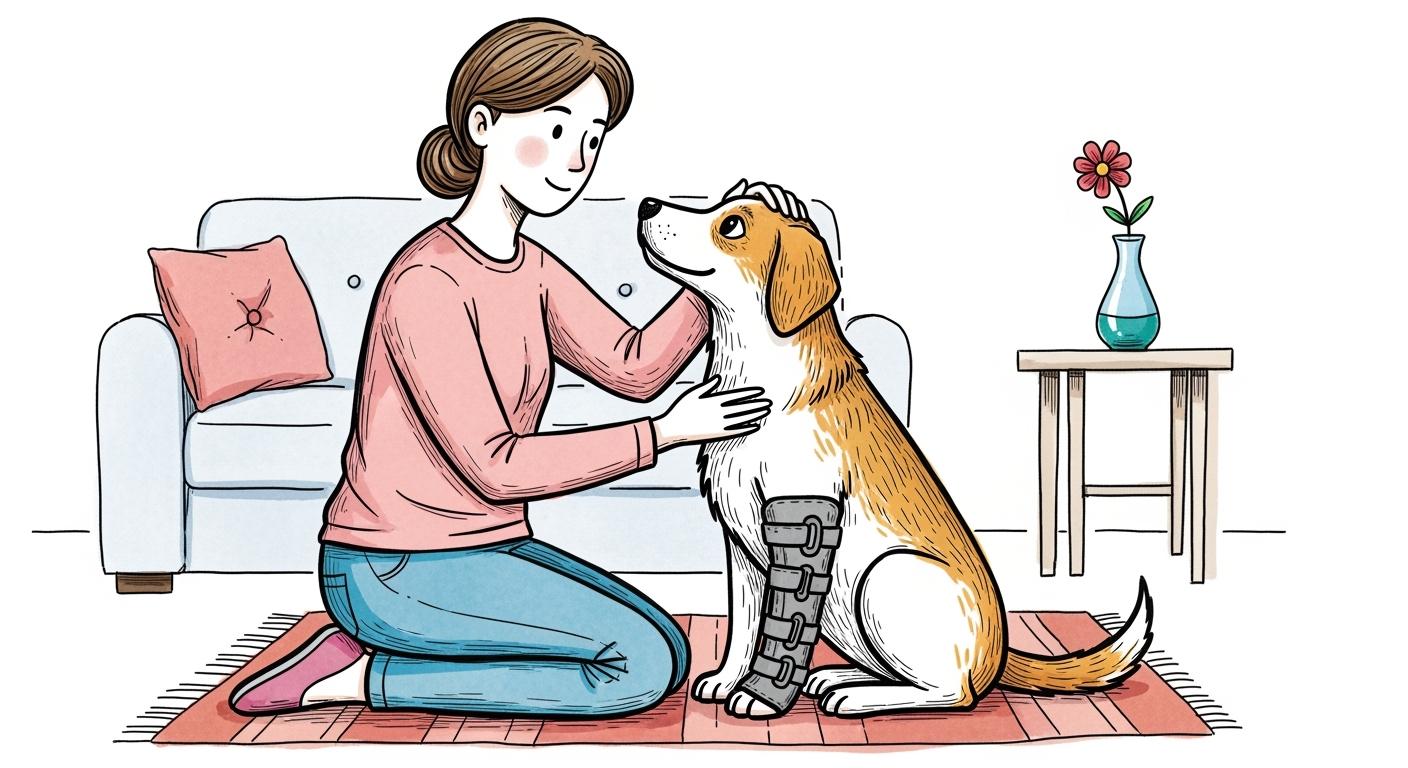
A dog torn ligament brace does not work by squeezing the knee harder. It works — when it works — because its hinge tracks the joint's natural axis. Align that hinge half an inch off, and the shell becomes a rigid tube the dog fights against with every step. Get the alignment right, and the shell does what the torn ligament can no longer do: it resists the tibia from sliding forward under load.
This hinge-to-joint relationship is the single design variable that separates a brace that stabilizes from one that merely wraps. Everything else — strap count, shell material, liner thickness — builds on whether that hinge pivot lands where the knee actually bends.
Hinge Alignment: The Design Variable Behind Real Stability
A knee brace stabilizes a torn cranial cruciate ligament by resisting anterior tibial translation — the forward slide of the shin bone that an intact CCL normally blocks. The shell achieves this by transferring load from the tibia to the femur through a rigid external frame. But that load path only travels cleanly when the hinge pivot sits at the knee's true axis of rotation.
When hinge and joint axis coincide, force moves in a straight line along the leg's natural loading direction. Joint surfaces stay evenly loaded. The dog's gait changes minimally — and a near-natural gait keeps surrounding muscles engaged. Active muscle is the second-best stabilizer a recovering knee has. The causal chain runs one way: aligned hinge → straight force path → even joint loading → natural gait → muscle engagement preserved → brace tolerated for longer wear sessions.
When the hinge sits even half an inch anterior or posterior to the true axis, the force path bends. The shell now fights the dog's natural motion instead of guiding it. The dog compensates: shorter strides, dropped hip, weight shifted to the sound leg. The brace becomes an obstacle. The very instability it was meant to prevent gets worse during longer walks as the dog fatigues and stops compensating.
Check this after a 10-minute walk: look at where the brace hinge sits relative to the bony landmark of the knee. If the hinge has migrated up or down by more than half an inch, the initial fit was off, the straps shifted under load, or both. A drifting hinge means the force path is no longer clean — and the support the shell was designed to provide has degraded.
Rigid Shell, Soft Wrap: Two Mechanisms, Different Outcomes
Dog knee braces fall into two structural categories, and they do not work the same way. A rigid shell made from orthotic-grade thermoplastic resists tibial thrust through structural stiffness — the material pushes back when the tibia tries to slide forward. A soft wrap made from neoprene provides circumferential compression. That feels supportive. It does not resist anteroposterior translation.
The difference shows in the mechanics. When a dog with a torn CCL puts weight on the leg, the tibia wants to slide forward relative to the femur. This drawer motion causes the pain and instability that make the dog reluctant to use the leg. A rigid shell braces against it by creating a mechanical block: the tibial segment of the shell connects to the femoral segment through the hinge, and the entire assembly functions as an external ligament. Push the tibia forward, and the shell pushes back through its structural frame — a direct force couple that bypasses the torn ligament entirely.
A soft wrap cannot replicate this. Neoprene stretches under load. Stretch under shear force means the tibia still translates forward, just with a slight delay. The wrap provides warmth and mild compression, which may improve proprioception — the dog's awareness of where the leg is in space — but it does not create a structural barrier to tibial translation. For a mild partial tear where remaining ligament fibers still provide some restraint, this may be enough. For a complete tear with full drawer motion, the soft wrap is a compression sleeve with no mechanical stop.
| Performance Difference | Why It Matters | Main Limitation |
|---|---|---|
| Rigid shell resists tibial thrust through structural stiffness | Creates a mechanical stop against the drawer motion that causes pain during weight-bearing | Heavier; demands precise hinge alignment to avoid fighting the dog's natural gait |
| Soft wrap provides circumferential compression | Improves proprioception and may reduce mild swelling; comfortable for extended wear | Does not resist anteroposterior translation; no structural barrier to tibial slide |
Verify the difference: with the dog standing and the brace on, place a hand over the front of the knee. As the dog shifts weight onto the braced leg, feel for forward tibial movement. With a well-fitted rigid shell, the motion should be barely detectable. With a soft wrap, the familiar drawer movement is usually still present — the knee slides forward, just inside a neoprene sleeve.
Where a Brace Works — and Where It Does Not
A hinge-aligned rigid brace performs best under a specific set of conditions. The dog has a single-ligament CCL tear, not a multi-ligament injury. Leg conformation falls within the breed norms the shell was patterned for. The owner can maintain consistent supervised use with controlled activity levels. Under these conditions, the shell's structural resistance to tibial thrust fills the role the torn ligament can no longer play, and the hinge alignment keeps the force path clean.
Outside those conditions, effectiveness drops. A dog with angular limb deformities — bowed legs, very deep or narrow chests that alter stance width — may never achieve clean hinge alignment because the leg geometry diverges too far from what the shell curvature assumes. Highly active dogs that sprint or pivot will generate forces beyond what even a well-fitted rigid shell can absorb. Dogs with multi-ligament instability need rotational control in addition to anteroposterior restraint, which a single-plane hinge cannot provide.
| Where It Works | Where It Falls Short |
|---|---|
| Single CCL tear with controlled activity — hinge tracks the joint axis cleanly; shell provides the mechanical stop the torn ligament cannot | Multi-ligament instability — the knee needs rotational and anteroposterior control; a single-plane hinge only handles one of these |
| Leg conformation within typical breed norms — shell curvature matches leg profile closely enough that strap adjustment handles the rest | Angular limb deformities or atypical chest depth — shell geometry diverges from leg geometry, making clean hinge alignment impossible |
| Supervised use with daily fit checks — small shifts get caught before they become pressure points | Unsupervised all-day wear — strap migration and hinge drift go unnoticed until skin breaks down or gait visibly changes |
Disclaimer: This fit assessment assumes a short-coated dog where brace position is visible at a glance. Double-coated breeds may show subtler rub marks that require hand-checking under the fur rather than visual inspection. If the dog's leg conformation falls outside the breed norms this brace was patterned for — particularly dogs with angular limb deformities or very deep chests — the fit checks described here may not catch every pressure point.
Design Details That Shape Daily Performance
Strap Width and Force Distribution
Strap width is not about comfort. It is about pressure. A narrow strap concentrates the shell's retaining force onto a thin band of skin. A wider strap spreads that same force across more surface area, reducing the pressure at any single point. In a knee brace, the straps above and below the joint carry the entire load path — every pound of force the shell transfers from tibia to femur passes through these contact zones. Narrow straps turn this path into a pressure hotspot. Wider straps keep unit pressure below the threshold where skin irritation starts.
Check this: if the skin under a strap band is warm and pink after 20 minutes of wear, the pressure at that point exceeds what the skin can tolerate for longer durations. A strap twice as wide distributes force across twice the area — halving the unit pressure — without requiring the strap to be any looser.
Liner Breathability
The liner is the only part of the brace that touches skin, and its breathability determines whether the brace can be worn for hours or must come off after 30 minutes. A closed-cell foam liner cushions well but traps moisture. Damp skin under sustained compression becomes fragile and prone to breakdown. An open-cell or perforated liner lets moisture escape, keeping skin drier for the same wear duration. In production terms, perforated liners add a manufacturing step — each hole pattern requires tooling — but the trade-off in skin tolerance makes the difference between a brace worn consistently and one that sits in a drawer.
After the first few uses, remove the brace following a 20-minute wear session and touch the skin under the liner. Damp or clammy skin means the liner is not moving moisture fast enough for that dog's coat type and activity level. The fix is not a different CCL brace — it is adding a moisture-wicking sleeve or shortening wear intervals to match the liner's breathability limit.
Sizing Granularity and Fit Stability
A brace with three size options fits a narrower range of dogs well than one with seven. More gradations mean the shell curvature starts closer to the actual leg shape, so straps do less of the fitting work. Straps adjust circumference. They cannot correct for a shell whose arc radius is fundamentally wrong for the leg. A shell close in curvature to the actual leg needs minimal strap tension to stay in position — lower skin pressure, less tendency to migrate during movement. This cascades into every aspect of daily use: a dog brace that starts closer to the right shape stays more consistent hour to hour, walk to walk.
FAQ
Does a tighter brace give better support?
No. Support comes from the shell's structural resistance to tibial translation — the external ligament effect — not from strap compression force. Overtightening increases skin pressure without improving stability. A properly aligned hinge with moderately tensioned straps provides better support than a misaligned hinge cranked down tight.
How can I tell if the hinge is aligned correctly?
Watch the dog take several steps at a walking pace. The hinge pivot should stay visually centered on the bony prominence of the knee throughout the stride. If it rides up or down the leg during movement, the alignment is off. The brace is then working against the dog's natural motion rather than supporting it. For a more precise check, mark the hinge position with a small piece of tape on the dog's fur at the start of a walk and check whether the hinge still lines up with that mark after 10 minutes.
Can a brace replace the function of a torn CCL completely?
A rigid shell brace provides external mechanical restraint against tibial thrust — the same direction the CCL normally blocks. But an external brace cannot replicate the ligament's internal proprioceptive feedback or its multi-planar restraint. The shell handles anteroposterior translation well when the hinge is aligned. Rotational and varus-valgus stability still depend on the remaining intact soft tissues around the knee. This is why the biomechanics of external bracing fill one specific role — anteroposterior restraint — rather than all of them.
Why does a brace shift position during walks?
Brace migration usually traces to one of three causes: the hinge pivot is not aligned with the joint axis, so the shell fights the leg's motion and gets pushed out of position; the strap width is too narrow to resist the shear forces of walking; or the shell curvature does not match the leg profile closely enough. Check hinge position first — it is the most common cause and the easiest to verify.
0 Comments