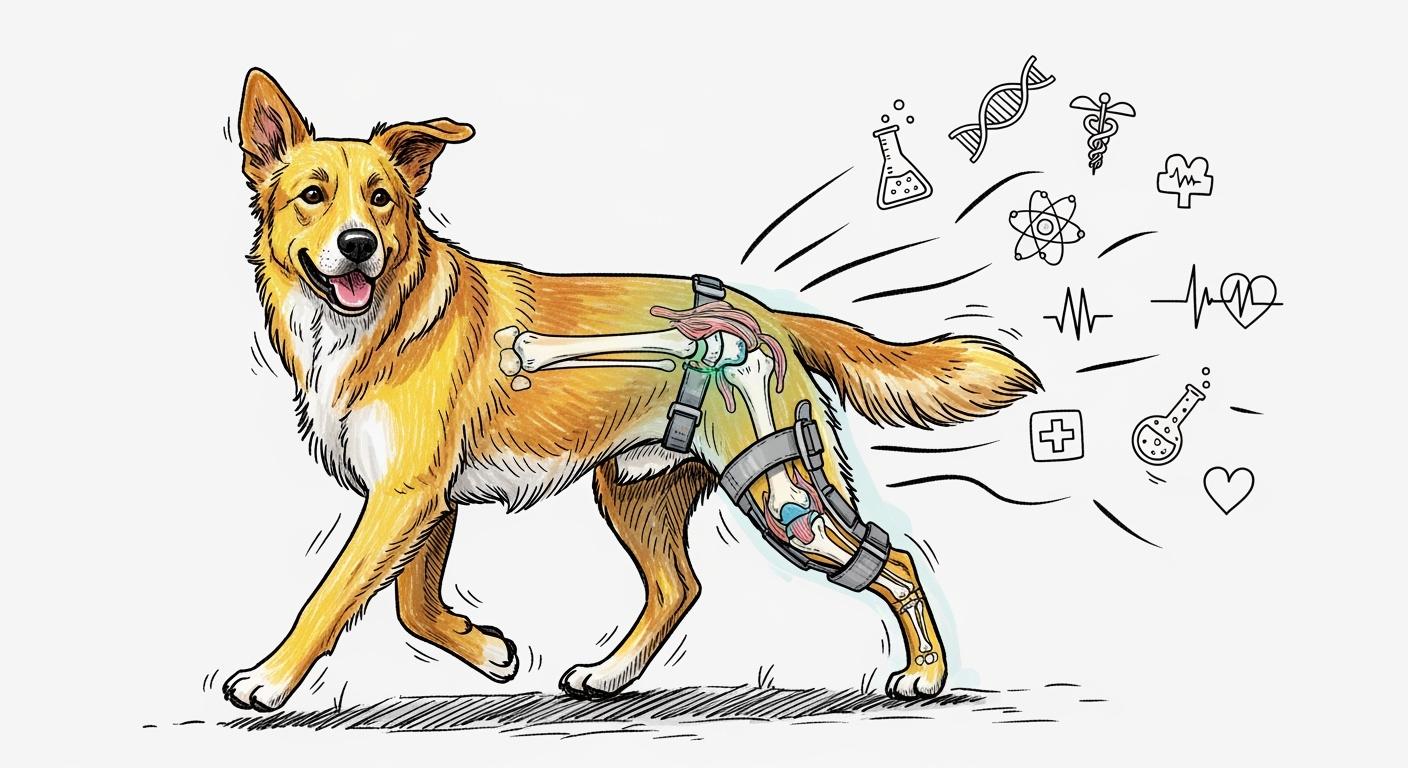
A stifle brace does not stabilize because it wraps the leg tightly. It stabilizes because its hinge tracks the joint's axis of rotation. When that alignment is right, force runs through the knee the way the anatomy expects. When it is off — even by a fraction of an inch — the same brace compresses soft tissue without controlling the joint. That difference is observable, and it determines whether a dog walks better or just walks with more hardware on its leg.
Why Hinge-to-Joint Alignment Decides Whether a Brace Supports or Just Squeezes
The canine stifle is a hinge joint with one dominant axis of rotation. Place a brace hinge directly over that axis and mechanical load travels in a straight line — femur through joint space through tibia. The articular surfaces stay evenly loaded. The cruciate ligaments, even partially damaged ones, avoid the shear forces that trigger pain and progressive tearing. The dog takes a more natural stride. That natural stride keeps the brace from shifting, which preserves the alignment through the next step. The loop reinforces itself.
This is why a dog stifle brace lives or dies on hinge placement, not strap tightness. The underlying mechanics are unpacked in how external hinge geometry interacts with the stifle's native biomechanics — but the short version is that a misaligned hinge bends the load path around the joint instead of through it. The brace becomes a compressive wrap. It squeezes. Squeezing can feel like support but it is not stabilizing the articulation.
The three-point pressure system that most hinged stifle braces use reinforces alignment — or betrays it. Three anchor points (above the joint, below it, opposite the hinge) are meant to distribute stabilizing force across the joint surface. When the hinge is on axis, all three points share the load evenly. When the hinge drifts off axis, one point carries most of the force. That is where skin irritation, brace migration, and eventual rejection start.
Observable check: after 15 minutes of walking, look at whether the brace hinge still lines up with the bony landmark of the stifle. A brace that tracks correctly stays centered. One that rides up the thigh or rotates inward has lost its alignment — and with it, its function. The hinge should remain within a finger-width of its starting position.
Where a Well-Aligned Stifle Brace Performs Best — and Where It Runs Into Limits
A hinged stifle brace built around joint-axis alignment performs best when the dog has partial ligament integrity and leg conformation close to breed norms. Those conditions let the hinge find the joint axis reliably, let the three-point system do its job, and let the dog's own movement maintain alignment rather than fight it.
Partial CCL tears are the strongest match. The ligament still provides some proprioceptive feedback and structural tethering. The brace augments what remains — it does not have to replace it. A brace configured for ACL and CCL support in this scenario controls the tibial thrust the weakened ligament can no longer handle, while the intact portions of the ligament continue to guide joint position. That division of labor — brace handles excess translation, ligament retains position sensing — is what makes the combination work.
Arthritic dogs with general joint laxity also tend to respond well. Here the brace supplies consistent alignment cues through repetitive daily movement, reducing the uneven joint loading that accelerates cartilage wear. The mechanism is not about immobilizing the joint. It is about keeping the load path straight so the remaining cartilage wears evenly rather than concentrating stress on one side of the joint space.
Post-surgical protection is a third scenario where alignment precision matters acutely. After a TPLO or lateral suture procedure, the joint benefits from guided, controlled loading — enough to stimulate tissue remodeling, not enough to stress the repair. A brace that tracks the joint axis can deliver that without introducing shear forces a misaligned brace would.
The design meets its limits with dogs whose leg conformation departs from the breed patterns the brace was patterned on. Angular limb deformities shift the true joint axis away from where a standard hinge expects to find it. Very deep-chested breeds with narrow hindlimb stance create strap paths that pull the hinge laterally. In both cases, the hinge cannot maintain axis alignment through a full stride cycle. The three-point system degrades into two-point or single-point loading.
Complete cruciate ruptures with gross instability present a separate boundary. When the tibia translates freely because no ligament remains to tether it, even a perfectly aligned external hinge can only do so much — the joint surfaces no longer have the internal guide cues the brace depends on to stay in position.
For conditions involving kneecap tracking rather than ligament stability, a different support configuration — such as a luxating patella dog brace .
Disclaimer: This positional check assumes a short-coated dog where the brace edge is visible during wear. Double-coated breeds may develop subtler rub marks that require hand-checking under the brace rather than visual inspection alone. If the dog's leg conformation falls outside breed norms — particularly angular limb deformities or very deep chests — the fit checks described here may not catch every pressure point. A hands-on assessment is the fallback.
Strap Width, Material, and Sizing — What These Details Actually Change
Joint alignment is the foundation. But a brace that aligns perfectly in a static fitting still fails if the dog refuses to walk in it after 20 minutes. Three material and configuration details determine whether the brace stays on the leg or ends up in a drawer.
Strap width controls force distribution at the simplest physical level. A two-inch strap spreads lateral load over roughly twice the skin area of a one-inch strap. Same force, larger contact patch, lower pressure per square inch. Lower pressure means less occlusion of superficial capillaries, less friction against the hair coat, and less of the dull ache that makes a dog stop, sit down, and chew at the brace.
Observable check: after 20 minutes of walking, flip back a strap edge and look at the skin underneath. A sharply demarcated red line exactly matching the strap width means pressure is too concentrated — the strap is too narrow for the force it carries, or it was tightened past what the design needs. A diffuse, light-pink impression that fades within a minute means strap width and tension are in balance. That is the pass signal.
Material choice governs the heat-versus-rigidity tradeoff. Neoprene-backed panels hold structural shape through repeated wear cycles — the material resists creasing and maintains consistent compression across the joint. The cost is heat retention. Under a neoprene panel, skin temperature climbs within minutes and moisture from perspiration has no exit path. Mesh-backed or perforated panels solve the ventilation problem but give up some rigidity. The practical dividing line: neoprene suits intermittent use during structured walks where the brace comes off afterward. Mesh-backed designs make more sense for dogs that need support through extended daily activity — the slight loss in structural stiffness is offset by the fact that the dog keeps the brace on.
Sizing beyond circumference is where most fitting failures originate. Two dogs can measure the same thigh girth and need completely different braces. A Greyhound's leg tapers sharply from thigh to hock. A Labrador's is more cylindrical. If the brace assumes a gradual taper but the dog's leg is straight-sided, the upper straps cinch tight while the lower ones gap — and the hinge tilts off axis. Sizing that accounts for breed-specific leg profile, not just girth at fixed measurement points, determines whether the alignment set during a static fitting holds through actual movement.
| Design Dimension | Performance Difference | Main Limitation |
|---|---|---|
| Hinge-to-joint axis alignment | Force travels straight through joint surfaces; dog moves with natural gait; brace stays put through stride cycles | Requires leg conformation within breed norms; angular deformities defeat standard hinge positioning |
| Strap width | Wider straps reduce pressure per square inch, lowering skin irritation risk and brace rejection | Wider straps add bulk; ultra-narrow legs in toy breeds may lack surface area for the widest option |
| Material backing | Neoprene holds shape through repeated use; mesh breathes — the right choice depends on whether wear is intermittent or extended | Neoprene traps heat during extended wear; mesh-backed panels lose some structural rigidity |
| Breed-specific sizing | Accounts for leg taper so all straps seat evenly, keeping the hinge on axis through movement | Dogs between breed-typical profiles may need a trial fitting to confirm |
FAQ
Can a stifle brace be worn during off-leash activity?
Off-leash movement introduces unpredictable direction changes and sudden acceleration that challenge hinge alignment more than controlled leash walking does. If the brace stays on-axis through a 10-minute off-leash session — confirmed by checking hinge position before and after — the fit and strap configuration are adequate. If the brace migrates, restrict it to leash-only activity until the fit is adjusted.
How do you tell whether the brace is stabilizing the joint or just sitting on the leg?
The pass signal: after a week of consistent use, the dog loads the braced leg with weight evenly during slow walking, and the hinge stays within a finger-width of the joint center after a 15-minute walk. The fail signal: the dog refuses to place full weight on the leg, or the brace has rotated 30 degrees or more from its starting position during a walk. Both fail signals mean the brace is not stabilizing — it is merely present.
Does a stifle brace replace the need for rehabilitation exercises?
No. The brace supplies passive alignment support. Rehabilitation exercises build the active muscle control that keeps the joint stable when the brace is removed. The two address different halves of the same problem — the brace handles the structural alignment the muscles cannot yet maintain, and the exercises develop the strength so the dog depends progressively less on the external support.
0 Comments