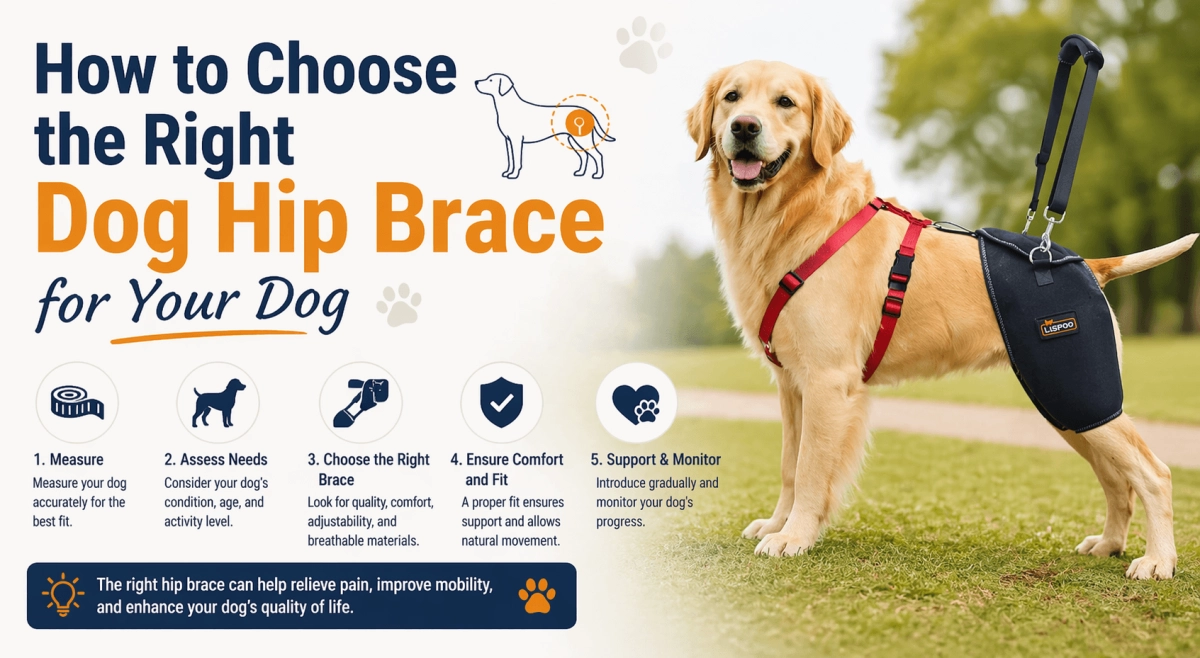
How to Choose the Right Dog Hip Brace for Your Dog
When you pick a dog brace, remember it is a medical device for your pet. You should get help from a veterinary therapist or orthotist. More than 30% of dogs get hurt from a bad fit. Look at these common risks:
| Risk Type |
Description |
|---|---|
| Skin Irritation |
Happens when the brace does not fit right |
| Pressure Sores |
Happen when the brace pushes too hard |
| Circulation Problems |
Happen when the brace fits wrong |
Dog Hip Dysplasia Braces work best when you care about your dog’s comfort and safety. Always try to pick the right brace, not just the cheapest one.
Key Takeaways
-
Talk to a veterinarian before picking a dog hip brace. The vet will check your dog and help you find the right support. This makes sure your dog gets what it needs.
-
Measure your dog's leg carefully to get the best brace size. If the brace fits well, your dog will feel comfortable. It also helps your dog move better.
-
Pick the right support level for your dog's problem. Some braces help mild hip dysplasia or arthritis. Others help more serious cases.
Assessing Your Dog’s Hip Needs
Identifying Hip Issues and Symptoms
You know your dog better than anyone. If your dog moves differently or acts strange, you should look for hip dysplasia signs. Dogs with hip dysplasia may not want to play as much. They might move slower than before. You could see your dog have trouble standing up. Some dogs do not want to go up stairs. Sometimes, your dog limps or their back legs feel stiff. These things can mean hip dysplasia or arthritis. Both are common problems in dogs.
Here is a quick list of what to look for:
| Symptoms of Hip Issues in Dogs |
|---|
| Slowing down or decreased activity levels |
| Limited range of motion in the hind legs |
| Struggles to stand up after laying down for an extended period |
| Reluctance to climb stairs or jump onto furniture |
| Leg stiffness |
| Shows signs of pain while moving |
| Noticeable change in hind leg strength |
| Hind leg limping |
| Muscle atrophy, especially in the thighs |
You might see your dog does not want to play or jump on the couch. These signs show your dog’s movement is changing. Hip dysplasia and arthritis can make life harder for your dog. If you act early, you can help your dog move better and feel less pain.
Consulting Your Veterinarian
If you see any of these signs, call your vet. The vet will check your dog’s hips for hip dysplasia and arthritis. They use different ways to find out what is wrong. A physical exam lets the vet see how your dog moves and if it hurts. X-rays show the shape of the hip joint and if there is arthritis. Sometimes, the vet will watch your dog walk or run. This helps them see how hip dysplasia changes movement.
Here is how vets check for hip dysplasia and arthritis:
| Diagnostic Method |
Description |
|---|---|
| Physical Examination |
Manual testing of joint mobility and pain responses through specific manipulation techniques. |
| Radiographs (X-rays) |
Images to evaluate joint conformation and assess the degree of arthritis present. |
| Gait Analysis |
Observation of the dog's movement to identify patterns indicative of hip dysplasia. |
| Orthopedic Evaluation |
Comprehensive testing of joint function, muscle strength, and range of motion. |
Your vet might use special tests like OFA or PennHIP to check hip laxity. These steps help your vet know if a dog hip brace is a good idea. Always get a diagnosis before picking a brace. This helps your dog move better and deal with hip dysplasia and arthritis the right way.
Dog Hip Dysplasia Braces and Grades of Support
Dog hip dysplasia braces can really help your dog move and feel better. There are many choices, but you can look at four main grades of support. Each grade is for a different level of hip dysplasia or arthritis. Picking the right grade helps your dog walk easier and keeps the joint safe.
Understanding Brace Types
There are four main types of dog hip dysplasia braces. Each one helps with a different stage of dysplasia or arthritis. Some braces give gentle support for mild problems. Others give strong support for serious joint issues. These braces keep the joint steady and help muscles stay strong. They also make your dog feel more confident. Braces are good after surgery or when hips are weak.
Here is a table that shows how common hip dysplasia is in some breeds:
| Dog Breed |
Prevalence Rate |
|---|---|
| German Shepherds |
~20% |
| Labrador Retrievers |
~12% |
| Great Danes |
High |
| Saint Bernards |
~50% |
| Bulldogs |
Comparable to larger breeds |
| Rottweilers |
~20% |
| Golden Retrievers |
~10% |
If your dog is one of these breeds, watch for hip dysplasia and arthritis. Early support can help your dog stay happy and active.
Grade 1: Neoprene Sleeve
A Grade 1 neoprene sleeve is best for mild hip dysplasia or early arthritis. Your dog might be a little stiff or slow to get up. This sleeve gives gentle pressure and keeps the joint warm. It helps with mild pain and supports the joint during short walks or play.
-
Use this sleeve for 2–4 hours each day.
-
It is soft, lets air through, and is easy to put on.
-
It helps your dog feel steadier and move better.
If your dog only needs a little help, this brace is a good choice. It is not for bad dysplasia or big joint problems.
Grade 2: Reinforced Neoprene
A Grade 2 reinforced neoprene brace gives more support than a sleeve. Pick this if your dog has moderate hip dysplasia or arthritis. The brace has extra straps and padding. It keeps the joint steady and helps your dog walk with less pain.
Here is a table with the pros and cons:
| Advantages |
Limitations |
|---|---|
| Provides compression and joint stabilization |
May degrade over time with excessive UV exposure |
| Maintains muscle warmth and improves circulation |
Regular inspection needed for optimal support |
| Water-resistant and resists mildew and odor |
Cost-effective but may not last indefinitely |
-
Use this brace for 4–6 hours a day, mostly during activity.
-
It helps your dog move better and keeps the joint from getting worse.
-
Check the brace often to make sure it fits well.
This type is good for dogs who need more than a sleeve but do not need a hard brace yet.
Grade 3: Thermoplastic
A Grade 3 thermoplastic brace is for dogs who need strong support. Maybe your dog had surgery or has bad hip dysplasia. This brace uses hard plastic that keeps its shape and gives steady support.
-
Thermoplastic is tough and lasts a long time.
-
The brace can be heated and changed as your dog heals.
-
It holds the joint in place and helps your dog recover.
Use this brace as your vet says, usually for 6–8 weeks. It is not as soft as neoprene, but it gives the joint the support it needs.
Grade 4: Custom Polypropylene Orthotic
A Grade 4 custom polypropylene orthotic is best for very bad hip dysplasia or big joint problems. Your vet or an orthotist will make this brace from a mold of your dog’s legs. The fit is exact, so your dog gets the best support.
-
The brace is stiff and gives strong support to the joint.
-
It is great for dogs who cannot have surgery or need help for a long time.
-
It takes a few weeks to make, but you can adjust it later.
Always get help from a pro for this kind of brace. Bad hip dysplasia and arthritis need custom help. A good fit keeps your dog safe and helps them move every day.
Tip: If your dog has a severe case, always get a custom brace and expert fitting. Do not try to fit a Grade 4 brace by yourself.
Here is a table to help you match your dog’s problem to the right brace:
| Dog's Condition |
Recommended Brace Type |
Key Features |
Expected Use Duration |
|---|---|---|---|
| Mild arthritis or stiffness |
Compression wrap or soft support (Grade 1) |
Breathable neoprene, adjustable straps |
Intermittent daily use (2–4 hrs) |
| Moderate hip dysplasia |
Dynamic support brace (Grade 2) |
Elastic support bands, padded lining |
4–6 hours daily, during activity |
| Post-surgery recovery |
Static immobilization brace (Grade 3) |
Rigid side supports, secure closures |
As prescribed (6–8 weeks) |
| Severe joint instability |
Heavy-duty hip and pelvic support (Grade 4) |
Reinforced frame, multi-point adjustment |
Long-term, supervised use |
Dog hip dysplasia braces give you choices for every stage of dysplasia and arthritis. You can help your dog stay safe, active, and comfortable by picking the right grade. Always talk to your vet before you choose. Your dog’s movement and joint health depend on it.
Brace Features and Fit
Choosing the best hip brace for dogs means looking at more than just the label. You want your dog to feel good, move well, and stay safe. Let’s break down what you need to check before you buy a brace for hip dysplasia or arthritis.
Sizing and Measurement
Getting the right size is the first step. A brace that fits well gives your dog the joint support they need. If you guess the size, you might hurt your dog’s mobility or even cause new problems. Here’s a checklist to help you measure your dog for a hip brace:
-
Measure the leg’s circumference halfway between the knee and the groin.
-
Measure from the floor by the back paw straight up to the top of the hip.
-
Measure the pelvic width at the widest point.
-
Measure the femoral circumference at the middle of the thigh.
-
Measure the trunk length from the back of the shoulder to the front of the pelvis.
Tip: Always use a soft tape measure. Write down each number. Don’t trust breed averages—every canine is unique.
If you want the best hip brace for dogs, you need these numbers. A good fit means less risk of pressure sores, better joint alignment, and more comfort for your senior dog hip support needs.
Comfort and Padding
Your dog will wear the brace for hours, so comfort matters. Padding keeps the brace from rubbing or pinching. Look for these materials:
-
Self-adhesive foam padding: You can cut it to fit and layer it for extra softness.
-
Thick memory foam: This helps cushion bony spots and adds comfort.
-
Soft fleece or sheepskin: These add a gentle touch and protect your dog’s skin.
Fabric braces feel light and let air flow. Plastic braces give more support for hip dysplasia and arthritis, but they need good padding to keep your dog happy. If your dog has sensitive skin or thin fur, extra padding helps prevent sores. The right padding keeps your canine moving and makes senior dog hip support easier.
Adjustability and Support Level
Dogs come in all shapes and sizes. Adjustable straps and closures let you fine-tune the fit. This means the brace stays in place, even when your dog runs or plays. You can loosen or tighten the brace as your dog’s body changes.
A brace with good adjustability gives steady joint support. It helps your dog’s mobility and keeps the brace from slipping. If your dog has hip dysplasia and arthritis, you want a brace that grows with them. Always ask your vet for help if you’re not sure how tight the brace should be. The best hip brace for dogs will let you adjust for both comfort and support.
Durability and Quality
You want a brace that lasts. Dogs move, play, and sometimes get messy. The right materials make a big difference. Here’s what to look for:
| Feature |
Why It Matters |
|---|---|
| Size and Fit |
A proper fit keeps the brace stable and safe. |
| Material |
Durable, breathable fabrics last longer. |
| Type of Brace |
Fabric for comfort, plastic for strong support. |
| Comfort |
No irritation, even with long wear. |
| Price |
Balance cost with quality for the best value. |
Fabric braces work well for mild dysplasia or arthritis. Plastic braces are better for severe joint problems. Both types can help with senior dog hip support. Make sure the brace feels sturdy and the seams are smooth. A high-quality canine orthopedic brace will stand up to daily use and keep your dog’s mobility strong.
Additional Features (e.g., Heat Therapy)
Some braces come with extra features. These can make life easier for you and your dog. Here are a few to consider:
-
Heat therapy pads: These can soothe sore joints and help with arthritis pain.
-
Removable liners: Easy to wash and keep clean.
-
Reflective strips: Good for walks at night.
-
Waterproof covers: Help if your dog likes to swim or play in the rain.
These features add value and comfort. They can make a big difference for senior dog hip support and for dogs with hip dysplasia and arthritis. If your dog needs extra help, look for supportive solutions that match their needs.
Note: Always check with your vet before adding new features. Some dogs need simple braces, while others need more advanced joint support.
Picking the right brace means looking at fit, comfort, adjustability, and quality. You want your dog to move with ease, stay active, and enjoy life—even with hip dysplasia or arthritis. The best hip brace for dogs is the one that fits well, feels good, and supports every joint. With the right choice, you give your canine the mobility and comfort they deserve.
Fitting Dog Hip Dysplasia Braces
Step-by-Step Measuring Guide
You want your dog to move with ease, so getting the right fit matters. If you wonder how to measure your dog for a brace, start with a calm setting. Ask a friend to help hold your canine still. This makes the process smoother and keeps your dog relaxed.
Here’s a simple guide to measuring for hip dysplasia braces:
-
Measure the circumference of your dog’s joint and just above and below it. This helps you capture the full range of motion.
-
Measure from the joint down to the ground. This gives you the right length for the brace.
-
Check the width of your dog’s pelvis. Breed and size can change these numbers.
-
Write down each number. Double-check for accuracy.
Tip: Use treats and gentle words. Your canine will feel more comfortable, and you’ll get better results.
Ensuring Secure and Comfortable Fit
A good fit keeps your dog’s mobility strong and protects the joint. The brace should feel snug but never pinch. Even pressure helps prevent sore spots and keeps the joint safe. Start with short sessions. Let your dog wear the brace for a little while, then slowly increase the time.
Check your dog’s skin every day. Look for redness, swelling, or slipping. If you see any problems, talk to your vet. Calm surroundings help your canine relax during fitting. Praise and rewards make the process easier.
Here’s a quick checklist for fitting:
-
The brace stays in place during movement.
-
The joint feels supported, not squeezed.
-
Your dog walks with better mobility and less pain from dysplasia or arthritis.
-
No signs of rubbing or discomfort.
With the right fit, your canine can enjoy life, even with hip dysplasia, arthritis, or other joint problems.
Acclimation and Monitoring
Acclimation Protocol
When you first put a brace on your dog, you want to help them get used to it slowly. Start with short sessions, about 30 to 60 minutes each day during the first week. Watch how your canine moves and reacts. If your dog seems comfortable, you can add 30 minutes every few days. By the end of the second week, your dog should wear the brace for several hours at a time. This slow process helps your dog adjust and keeps their joint safe. If your dog has hip dysplasia, patience is key. Some dogs may try to shake off the brace or walk funny at first. That is normal.
Tip: Use treats and praise to make wearing the brace a positive experience for your canine.
Monitoring Skin and Response
Check your dog’s skin every time you remove the brace. Look for redness, swelling, or sores near the joint. If you see any irritation, let your dog rest and call your vet. Daily checks help you catch problems early. You want your dog’s joint to stay healthy and their mobility to improve. Dogs with hip dysplasia need extra care, so never skip this step.
When to Seek Adjustments or Replacements
Sometimes, the brace may slip, rub, or seem too tight. If your dog limps more, loses mobility, or you see new sores, the brace may need an adjustment. Your vet or orthotist can help. As your canine grows or their joint changes, you might need a new brace. Always check the fit, especially if your dog has severe dysplasia.
Combining Braces with Other Treatments
Braces work best when you use them with other therapies. Many dogs with hip dysplasia benefit from a mix of treatments. You can try physical therapy, hydrotherapy, or massage to help the joint move better. Some owners use red light therapy or acupuncture. Medication can also help manage pain and keep your dog’s mobility strong. Braces give your canine support, especially if they cannot have surgery or need help while waiting for treatment. Every dog is different, so talk to your vet about the best plan for your dog’s joint health.
Braces vs. Surgery Context
When Braces Are Appropriate
You might wonder if a dog hip brace is the right choice for your pet. Braces work well for many dogs, but not every situation fits. You should think about a brace if your dog has mild or moderate injuries. These include ligament or tendon strains, partial tears, or muscle weakness. Braces also help older dogs with arthritis or joint instability. If your dog just had surgery, a brace can give extra support during recovery.
Here are some times when a brace makes sense:
-
Mild to moderate ligament or tendon injuries.
-
Partial tears in the cranial cruciate ligament (CCL/ACL).
-
Arthritis or joint instability from age.
-
Muscle weakness or strain.
-
Support after surgery.
Braces are also a good option if your dog cannot have anesthesia. Some dogs are too old or have health problems that make surgery risky. In these cases, a brace can help your dog move better and feel less pain.
Surgical Alternatives
Sometimes, surgery is the best way to fix a joint problem. If your dog has a complete ligament rupture, a fracture, or a dislocated joint, you need to talk to your vet about surgery. Surgery can also help if your dog has severe or long-lasting pain and lameness. These problems will not get better with a brace alone.
Your vet will help you decide what is best for your dog. Braces and surgery both have a place in treating joint issues. The right choice depends on your dog’s age, health, and the type of injury.
You want the best for your dog. Always treat hip braces like medical devices. Talk to your vet, measure with care, and check your dog’s skin often. Gradually increase brace time. For extra help, here are trusted resources:
| Resource Name |
Description |
|---|---|
| My Pet’s Brace |
Custom leg orthotics and prosthetics |
| Hero Dog Orthotics |
Get your dog up and playing again |
FAQ
How long should my dog wear a hip brace each day?
Start with 30–60 minutes. Slowly add more time every few days. Watch your dog for any signs of discomfort or skin irritation.
Can my dog sleep with the hip brace on?
No, you should remove the brace at night. This gives your dog’s skin a break and helps prevent pressure sores.
What if my dog tries to chew or remove the brace?
Try using treats and praise to distract your dog. If chewing continues, check the fit and talk to your vet for advice.
0 Comments