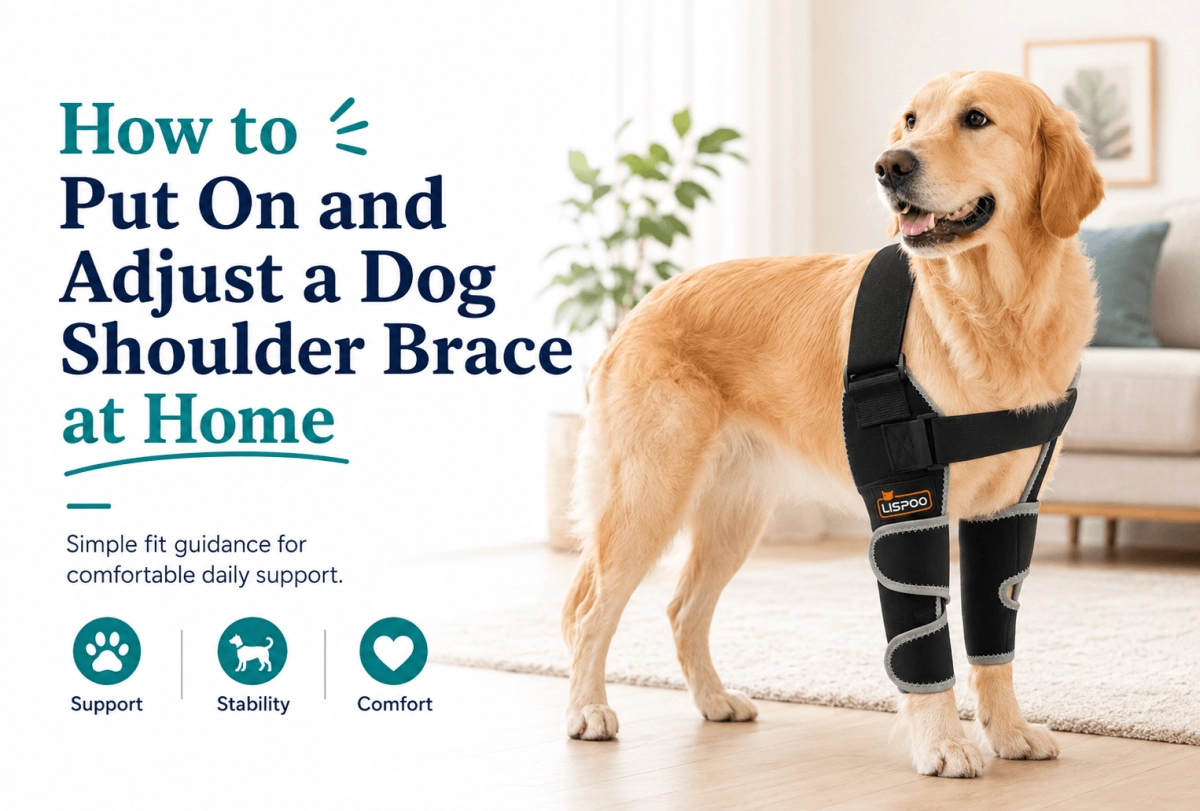
A dog shoulder brace that slides down the leg mid-walk is not supporting anything. Most fitting instructions focus on how tight to make the straps. But the real difference between a brace that stabilizes the shoulder and one that just adds bulk comes down to two design details: how the strap layout distributes force across the dog's chest and back, and whether the brace's support line tracks the shoulder joint axis. When either is off, the brace fights the dog's natural movement instead of working with it.
Why Strap Width Matters More Than How Hard You Cinch
Tightening a narrow strap feels like it adds control. It does not. What it adds is concentrated pressure on a small patch of skin.
The physics is straightforward: the stabilizing force a shoulder brace for dog needs to deliver does not change, but the area receiving that force does. A wide strap spreads the same load over more square inches—lower psi on the skin, less compression of superficial blood vessels, healthier skin under extended wear. A narrow strap doing the same job concentrates that force into a thin band. The skin signals irritation within minutes. The dog starts rubbing the brace against furniture. Compliance collapses, and the brace ends up in a drawer.
This is why strap width is a structural decision, not a comfort preference. Doubling the contact width roughly halves the pressure any single point of skin experiences. Broad chest and back panels convert point loading into distributed loading. The dog tolerates the brace for hours instead of minutes.
The crossing pattern matters just as much as the width. Straps that cross over the shoulder joint and anchor to the opposite flank create a triangular force lock—the brace resists rotation when the dog turns or leans. Parallel straps, by contrast, allow the entire brace to twist around the torso under lateral movement. A dog brace that rotates during use loses its support line immediately and becomes dead weight on the limb.
This is easy to verify without tools. After the first fitting, mark the strap edges on the dog's coat with a washable pencil. Walk the dog on a leash at normal pace for ten minutes. Check whether the marks still align with the strap edges. A shift beyond half an inch means the strap configuration is allowing migration—tightening further will not fix it and may make the pressure concentration worse. The geometry is wrong, not the tension.
Joint Alignment: Placement Decides Whether the Brace Works
The canine shoulder has the greatest range of motion of any joint in the dog's body—roughly 110 degrees of flexion and extension plus significant abduction and rotation. A brace that does not track the glenohumeral joint axis fights that movement on every single stride.
The brace's primary support element—whether a rigid stay, a hinge, or a compression panel—must sit directly over the joint line where the scapula meets the humerus. Position it too high, and the brace loads the scapula instead of the shoulder joint. Too low, and it loads the proximal humerus, creating a fulcrum that increases leverage on the joint rather than reducing it. A half-inch placement error changes the entire biomechanical equation.
When the support line aligns with the joint axis, stabilizing force travels along the natural load path through the joint. The joint capsule and surrounding soft tissues receive compression in the direction they are structured to handle. The dog's stride pattern stays closer to normal. Less compensatory movement travels down the limb.
This is why shoulder instability and everyday comfort depend more on brace positioning than on how firmly the straps are fastened. A precisely positioned brace with moderate strap tension outperforms a tightly cinched brace sitting half an inch off the joint line. The alignment determines whether stabilizing force reaches the right structure; strap tension only determines how much force is available to deliver.
The observable check is simple. After fitting, have the dog walk ten steps on a flat surface at a normal pace. Watch the top edge of the brace near the neck. If it rides upward by more than a finger's width, the support line is sitting too high and the chest anchor is failing to hold position. No amount of tightening the neck strap fixes this. The geometry is wrong, not the tension.
Misalignment at the shoulder also changes what happens at the elbow. When the brace forces the humerus into an unnatural angle, the elbow joint compensates by altering its own loading pattern. What starts as a shoulder support problem becomes an elbow strain problem downstream. The brace must follow the dog's existing joint axis rather than forcing the limb into a generic "supported" position.
Where a Shoulder Brace Works—And Where It Does Not
A shoulder brace with broad, crossed straps and a support line that tracks the joint axis serves a specific set of conditions well. It is not a universal shoulder solution, and recognizing the boundaries keeps expectations realistic.
The brace performs best for dogs with shoulder instability that flares during walking or light activity—conditions where the joint needs external proprioceptive feedback and mechanical restraint, not rigid immobilization. In these scenarios, the brace provides a physical boundary for the joint's safe range while still allowing the muscles around the shoulder to engage and maintain tone.
It is less effective in several situations:
- Acute fractures or complete dislocations that require full immobilization—a soft brace cannot deliver the rigid fixation these injuries demand.
- Dogs under roughly 15 pounds, where the bulk of even a well-designed brace can interfere with movement more than it assists.
- Dogs with very deep chests and narrow shoulders—breeds like Borzoi or Greyhound—where standard chest strap geometry may not anchor securely against the sternum.
- Double-coated breeds where visual strap checks are unreliable and pressure assessment requires hands-on verification after every wear session.
The strap anchoring principles that work for a dog with a moderately deep, broad chest do not automatically transfer to every body type. A brace's strap geometry is designed around a reference conformation. When a dog falls far outside that reference, the force distribution assumptions built into the strap layout no longer hold.
Disclaimer: The fit checks described here assume a short-coated dog where strap marks and brace position are visible. Double-coated breeds—Huskies, Malamutes, Shepherds, and similar—may show subtler rub marks that need hand-checking: run fingertips under each strap edge after wear rather than relying on visual inspection alone. Dogs with angular limb deformities or barrel chests that fall outside the conformational norms standard brace patterns are designed for may experience pressure points these fit checks will not catch.
FAQ
How long can a dog wear a shoulder brace continuously?
No single number applies across all braces because wear duration depends on liner breathability, not strap design. A brace with a moisture-wicking liner that moves sweat away from the skin can typically be worn longer than one where neoprene sits directly against the coat. The practical check: remove the brace after two hours of initial use, flip back the liner, and feel the skin underneath. Damp skin means moisture is trapped and wear duration should be reduced. Dry skin means the liner is doing its job and wear time can be extended gradually.
Does a shoulder brace restrict the dog's front leg movement?
A brace positioned correctly over the joint axis should not restrict the shoulder's normal range—it should resist the specific direction of instability. If the dog's stride visibly shortens or the front paw starts scuffing the ground, the support line is likely misaligned or the brace's range-of-motion limit is set too aggressively for that dog's anatomy. A correctly fitted brace allows the shoulder to extend and flex through a near-normal arc while resisting lateral or rotational movement that would stress the injured structures.
Can the brace be worn outdoors in wet conditions?
Most shoulder braces use materials that degrade with repeated water exposure. Neoprene absorbs moisture and loses some compressive properties when saturated. Foam padding can hold water against the skin, increasing irritation risk. If the dog must go out in rain, a waterproof cover layer over the brace helps—but the brace should be removed and dried thoroughly afterward. The brace is not designed for swimming or submersion.
0 Comments