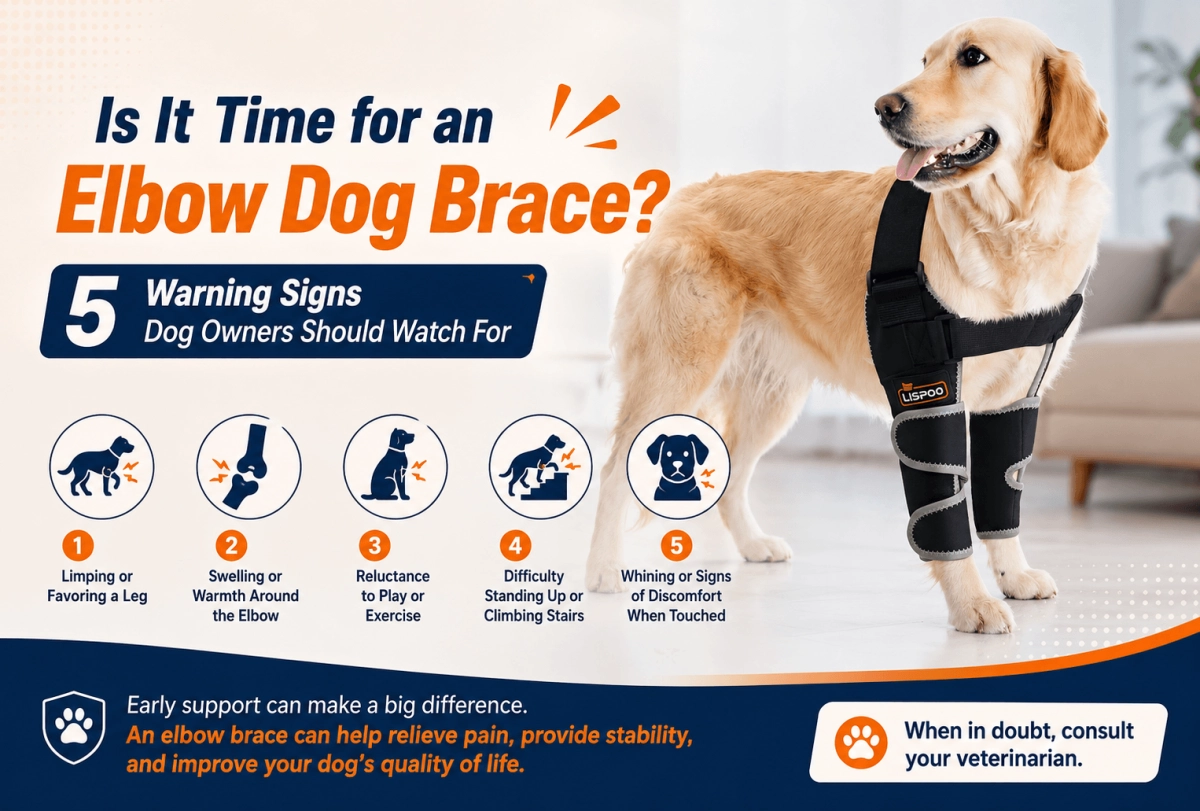
A dog elbow brace looks simple enough. A sleeve, some straps, a pad. But the gap between a brace that stays in daily rotation and one that ends up in the drawer comes down to two design calls most owners never evaluate: where the pressure goes when the dog lies down, and whether the straps hold position as the dog moves across the floor. Get either wrong, and the brace does the opposite of what it claims. It creates friction where there was none. It concentrates force on the very spot it is supposed to protect.
The design that gets this right is not the one with the most straps or the thickest padding. It is the one that redirects load away from the bony point of the elbow and keeps that redirection stable through motion. Understanding why that works — and when it stops working — is what turns a brace from a guess into a tool.
How Pressure Redistribution Works in an Elbow Brace
The elbow takes ground contact differently from every other joint. When a dog lies down on a hard floor, the olecranon — the pointed bone at the back of the elbow — presses directly into the surface. Body weight funnels through the upper leg and concentrates onto a contact patch no larger than a quarter. That sustained point pressure is what thickens skin into calluses and, when inflammation builds beneath, traps fluid into a hygroma.
Adding flat padding over the olecranon does not solve this. Flat padding compresses under load. The force still travels through the pad to the same bony point — it just arrives through a thicker layer. The physics have not changed. Pressure equals force divided by area. Same contact area, same pressure.
A donut-ring insert changes the equation. The ring — typically a dense foam or gel pad with a center cutout — sits around the olecranon, not over it. When the dog lies down, body weight transfers through the ring into the ring of soft tissue surrounding the elbow bone. The olecranon itself floats inside the hollow center, bearing near-zero direct load. The contact area jumps from roughly a quarter-sized spot to a ring several inches across. Same force, larger area, lower pressure. That is not extra cushioning. That is a different load path.
The ring must be firm enough to resist collapsing under weight. A ring that flattens out becomes, in effect, flat padding — it loses the hollow center and the pressure lands back on the olecranon. The density of the ring material and the diameter of the cutout together determine whether the design actually redirects force or just looks like it does. Too small a cutout and the ring edge presses against the sides of the olecranon, creating shear. Too soft a material and the ring bottoms out.
In practice: After 20 minutes of the dog lying on a hard floor with the brace on, remove it and feel the skin directly over the olecranon. It should be dry and roughly the same temperature as the surrounding skin. If the spot is warmer, damp with trapped moisture, or shows a defined red circle matching the ring edge, pressure is still concentrating there — the ring is either undersized, too soft for the dog's weight, or positioned too far from the joint center.
When Pressure-Redirecting Design Makes the Difference
The donut-ring approach is not equally relevant to every dog. Its value depends on the surface the dog rests on and the condition of the elbow tissue.
Hard-floor callus formation. Dogs that spend significant time lying on tile, hardwood, or concrete develop calluses as a mechanical response to point pressure. A brace with a functional donut ring breaks that pressure cycle. The callus does not vanish overnight — thickened skin takes weeks to remodel — but the driving force behind further thickening is removed. Owners often notice the callus softening within two to three weeks of consistent brace use during rest periods. The observable signal: the callus edge, which was sharp and raised, begins to feel less defined under a finger.
Hygroma management. A hygroma is a fluid-filled pocket that forms when inflammation beneath a callus fails to resolve. The fluid accumulates because the pressure that caused the inflammation never stops. A donut-ring brace can arrest this cycle by eliminating the point load. But the design of the ring matters even more here: the cutout must be wide enough that the ring edge clears the entire fluid pocket with margin. A ring that overlaps the hygroma edge applies shear at the tissue plane between the fluid pocket and healthy skin, which can worsen the condition. For a hygroma roughly the size of a walnut, the ring cutout should extend at least half an inch beyond the visible swelling in all directions.
Post-activity elbow soreness. Dogs with mild elbow instability or early joint changes often show stiffness after exercise rather than during it. The joint tolerates the activity itself but flares afterward. A brace worn during rest periods after walks or play can help by limiting the range of motion slightly and providing warmth that keeps the joint capsule more pliable. This is fundamentally different from compression-only wraps, which may restrict circulation if left on during rest.
The common thread: the brace is doing its most important work when the dog is not moving aggressively. During active motion, the joint's own musculature provides dynamic stabilization. During rest on hard surfaces, that musculature is offline, and the passive support of the brace takes over. A well-designed elbow brace is engineered for this resting-load scenario specifically — the donut geometry exists because lying down, not running, is what drives callus and hygroma progression.
Where an Elbow Brace Reaches Its Limits
A brace redirects surface pressure. It does not realign bone, repair cartilage, or stabilize a joint whose ligaments have failed. Recognizing that boundary prevents misuse.
When the design can help: callus prevention and softening on hard-surface sleepers, hygroma offloading when the ring clears the fluid pocket with adequate margin, mild post-activity stiffness where warmth and gentle compression reduce discomfort, skin protection against habitual licking of the elbow area.
When it cannot: elbow dysplasia with significant joint incongruity — the brace cannot close a step defect between radius and ulna; complete ligament ruptures where the joint subluxates under partial load; open wounds or active infections where covering the area traps bacteria; fractures or suspected fractures where immobilization needs to be rigid, not flexible.
The brace does not treat the underlying pathology. It changes the mechanical environment the elbow operates in. For some conditions — calluses, hygromas, mild instability — changing that environment is enough to break the symptom cycle. For structural joint disease, changing the environment helps but does not reverse the anatomy. A dog brace works within its mechanical scope; knowing where that scope ends is what keeps a brace from becoming a delay of necessary veterinary care.
Disclaimer: The pressure-redistribution checks described here assume a short-coated dog where skin changes are visible and palpable. Double-coated breeds may show subtler rub marks beneath the fur that require hand-checking rather than visual inspection — run fingers slowly over the olecranon area feeling for warmth asymmetry rather than relying on visible redness. Dogs with angular limb deformities or very deep chests may fall outside the conformational norms these braces are patterned for; the fit checks described may not catch every pressure point in those cases.
Design Choices That Shape Daily Wear
Beyond the donut ring, three design features determine whether the brace stays in the routine or gets abandoned after a week.
Strap layout and force dispersion. A single wide strap above the elbow can anchor the brace vertically but does nothing to prevent rotation around the leg. Two straps — one above and one below the joint — create a couple that resists twisting. The below-joint strap is the harder one to get right: it sits on the forearm where the leg tapers, so it needs either a contoured cut or a material with enough surface friction to prevent migration toward the paw. Straps that ride down during walking eventually bunch at the carpus and get chewed off. The observable test: after a 10-minute walk, mark the strap edge position with a piece of tape on the fur. Check again after another 10 minutes. A shift of more than half an inch means the below-joint anchor is not holding — the strap material, width, or tension needs adjustment.
Lining material and moisture management. The inner lining sits against the dog's skin for hours. Neoprene-faced fabric is common because it provides friction against the fur to resist migration, but unbacked neoprene traps heat and moisture. A lining with a wicking inner face — typically a polyester knit bonded to the neoprene — pulls sweat outward while the neoprene provides structure. This matters most in the elbow area because the dog's body weight compresses the brace against the floor, eliminating any air gap that might otherwise allow ventilation. A non-wicking lining in this position turns the brace interior humid within 30 minutes, which softens the skin and makes it more vulnerable to friction damage. The difference between a brace that can be worn for hours and one that must come off after 60 minutes often comes down to whether the lining moves moisture or traps it.
Sizing beyond the weight chart. Breed-based or weight-based sizing charts are a starting point, not a fit guarantee. Two dogs of the same weight can have meaningfully different leg circumference and elbow width depending on breed — a 60 lb Greyhound and a 60 lb Bulldog share almost no forelimb geometry. The measurement that matters most for an elbow brace designed for joint support is the circumference at the elbow crease with the leg in a relaxed standing position. If that measurement falls between two sizes on the chart, choose the larger size and use the strap adjustment to take up the difference. A brace that is slightly loose can be adjusted down; a brace that is too small creates a tourniquet effect that the dog will fight from the first wear.
Washability and daily hygiene. A brace worn during rest on floors picks up dust, dander, and skin oils. If it cannot be washed regularly without losing shape, it becomes a bacteria reservoir within days. Look for edge binding that prevents the neoprene or foam core from absorbing water during washing — exposed foam edges wick water into the core, where it dries slowly and degrades the material from the inside. A brace with bound seams and a quick-drying lining can be hand-washed and air-dried overnight, ready for the next day. This is not a convenience feature; it is what determines whether the brace can be part of a daily management routine or only an occasional intervention. The arthritis support products that stay in use longest tend to be the ones that fit into the owner's existing routine rather than demanding a separate maintenance ritual.
Product Recommendations:
FAQ
How do you know if your dog needs an elbow brace?
The clearest signals are visible and mechanical: a defined callus over the olecranon that thickens month over month, a fluid-filled hygroma that persists despite softer bedding, or a pattern of licking focused specifically on the elbow point after lying on hard floors. These are signs of sustained point pressure — the exact problem a donut-ring brace is designed to address. If the dog limps, holds the leg up entirely, or shows pain when the elbow is flexed rather than just when it is pressed from below, the issue is more likely intra-articular and a brace alone will not resolve it.
Can a dog wear an elbow brace all day?
During active hours on hard surfaces, yes — provided the lining breathes and the straps are not overtightened. Remove it at night when the dog sleeps on a soft bed, since the donut ring serves no purpose on a compliant surface that already distributes pressure. For dogs that move between hard floors and carpet throughout the day, wearing during floor-contact periods and removing during carpet rest is a practical rhythm.
What separates a functional donut ring from decorative padding?
Firmness under load and cutout diameter. Press the ring against a tabletop with roughly the force of the dog's front-leg weight. If the ring collapses flat — center hole closes — it will not redirect pressure in use; it becomes ordinary padding. If the cutout is smaller than the dog's olecranon, the ring edge presses on the bone instead of clearing it. Both failures look fine on the product page and reveal themselves only under load.
How do you clean an elbow brace for dog without damaging it?
Hand-wash in cool water with mild soap, focusing on the lining surface. Do not submerge if the brace has exposed foam edges — water wicked into the core degrades the material and extends drying time. Roll the brace in a dry towel to pull out excess moisture, then air-dry away from direct heat. Machine washing, even on gentle cycles, tends to separate the lining from the neoprene backing over repeated cycles.
0 Comments