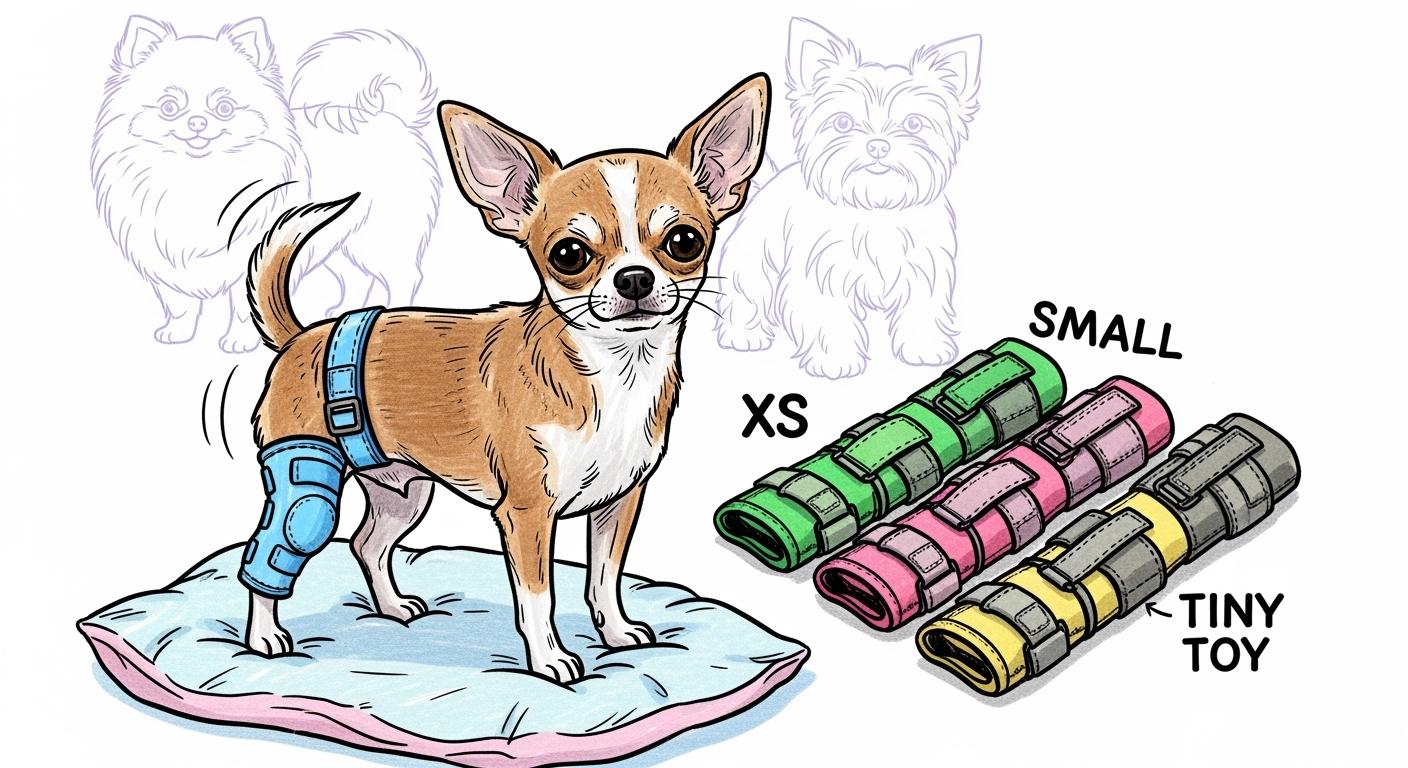
A knee brace built for a 60lb dog gets scaled down, and the straps get shorter. The materials get thinner. But the design logic rarely changes. That is the problem. A leg that measures four inches around does not just need a smaller version of the same brace — it needs a different set of priorities. On a thin limb, strap placement overtakes strap tightness as the dominant variable. Hinge alignment stops being a nice-to-have and becomes the difference between stabilization and a plastic sleeve that slides down mid-stride.
This is what separates a knee brace that works on a small dog from one that does not. Not more features. Not tighter straps. The right design choices in the right places.
Why Strap Placement Matters More Than Strap Tightness on a Thin Leg
On a large dog, a knee brace strap wraps around a limb with substantial surface area. The strap can be wider — two inches, sometimes more — and still leave room above and below the joint. That width distributes stabilizing force across a broad contact patch. Even if the strap shifts slightly, enough of it stays anchored to maintain the brace position.
On a Chihuahua or a Toy Poodle, that same two-inch strap would cover nearly the entire thigh. There is nowhere for it to go. So the design has to do something counterintuitive: use narrower straps placed at more anchor points, not wider straps cranked tighter.
Here is why. Force transmitted through a strap follows a simple relationship: the narrower the strap, the more concentrated the pressure per linear inch of contact. Tighten a narrow strap enough and it bites into soft tissue. Loosen it and the brace rotates. The solution is not finding some magical middle tension. It is splitting the stabilizing load across multiple narrow straps, each at a mechanically distinct anchor point — above the knee, below the knee, and at the hock. Each strap does less work individually. Together they resist rotation in three planes without any single strap needing to be uncomfortably tight.
You can observe this directly. After ten minutes of leashed walking, check whether any strap edge has drifted more than half an inch from its original position. A strap that stays put without excessive tension passes. One that held only because it was overtightened leaves a visible compression ring on the skin when removed — that is a fail signal, not a fit signal.
A dog knee brace designed with this multi-point strap logic spreads retention force the way a large dog's single wide strap does naturally — just through configuration rather than surface area. The physics is the same. The design route to get there is not.
Material Weight vs. Stabilization — The Trade-off Small Dogs Cannot Afford to Ignore
A brace that weighs four ounces is trivial on a Labrador. The dog does not alter its gait to accommodate it. On a five-pound dog, four ounces is five percent of body weight strapped to one leg. That is proportionally equivalent to a human wearing an eight-pound knee brace. Gait changes are not optional at that ratio. They are biomechanically guaranteed.
The dog shortens its stride on the braced side. The hip on the opposite side drops slightly to compensate. Over weeks, the uninjured leg takes on asymmetric loading patterns that the original injury never caused. The brace did not fail to stabilize the knee. It succeeded — and created a new problem through its own mass.
So the trade-off is real. Thinner neoprene reduces weight but provides less rigid containment. Removing a hinge saves ounces but sacrifices rotational control in the sagittal plane. Mesh panels improve breathability and cut weight but introduce stretch points that can accumulate over a long walk. A brace built for ACL and CCL support on a small dog has to solve this trade-off differently than the large-breed version of the same product category.
Two material strategies tend to work. One: using a thinner-gauge neoprene with a denser weave — the reduced thickness cuts weight, the tighter weave recovers some of the tensile stability lost. Two: placing rigid structural elements only where the load path requires them and leaving the rest of the brace flexible. A hinge at the joint axis controls flexion and extension. Everything else can be fabric. That selective rigidity approach keeps total brace mass under two ounces on most toy-breed sizes while preserving the mechanical function that matters.
To verify that material weight is not altering gait, watch your dog walk ten strides without the brace, then ten strides with it on. If stride length on the braced side visibly shortens with the brace on — even before any signs of discomfort — the brace mass is doing work it should not be doing. The dog is compensating. That compensation accumulates.
When a Knee Brace Works and When It Does Not
A knee brace stabilizes the stifle joint against unwanted lateral and rotational motion. For a small dog with mild patellar luxation — where the kneecap slips but returns — that external constraint can keep the patella tracking within its groove during walks. For a dog recovering from a partial CCL tear, the brace limits the anterior drawer motion that stresses the healing ligament. For a senior dog with arthritic stiffness, the light compression and warmth can improve comfort during short, supervised activity.
These are real use cases. They are also bounded ones. A brace designed for luxating patella support provides external guidance for the kneecap — it does not deepen the trochlear groove. That distinction matters when deciding whether the brace alone is sufficient.
A knee brace is not a substitute for surgical stabilization when the cranial cruciate ligament is fully ruptured. No external device can restore the internal joint integrity that a torn CCL removes. The brace can support the leg during pre-surgical waiting periods and post-surgical rehabilitation. It cannot replace the ligament.
Brace support also assumes the dog tolerates wearing something on the leg. Some dogs never adjust. That is not a design failure. It is a compatibility boundary.
Disclaimer: The fit checks and gait observations described here assume a short-coated, straight-legged small breed. Double-coated breeds like Pomeranians may show subtler rub marks that require hand-checking rather than visual inspection — parting the coat and feeling for warmth or texture changes along the strap line catches pressure points that eyes miss. Dogs with angular limb deformities or unusually deep chests relative to leg length fall outside the conformation this brace category is patterned for, and the standard strap-anchoring logic may not hold.
Design Details That Change Daily Use
Three design choices show up not in spec sheets but in how the brace actually behaves across a week of use.
Hinge position relative to the joint axis. A hinge placed half an inch above or below the knee's center of rotation introduces a lever arm. Every time the dog flexes the stifle, the hinge and the joint fight each other. The brace migrates. The dog shortens its stride. Placing the hinge precisely at the joint axis — which on a toy breed means measuring from the lateral femoral condyle, not guessing — lets the brace track with the leg rather than against it. This is why a brace that asks for the vertical span from hock to upper anchor point, not just circumferences, tends to fit better. That vertical measurement locates the hinge.
Lining breathability and moisture tolerance. A neoprene-lined brace worn for thirty minutes on a warm day traps heat. On a short-coated dog, you see the result: damp skin, pinkness, sometimes a faint heat rash pattern following the strap edges. A moisture-wicking inner layer — thin polyester mesh or perforated neoprene — changes that outcome. After the same thirty-minute walk, the skin underneath should feel no warmer or wetter than the unbraced leg. If it does, the lining is not moving moisture fast enough for that dog's activity level and coat type.
Closure design for one-handed adjustment. A small dog moves during fitting. A closure system that requires two hands to secure means one hand is chasing the dog while the other fumbles with a strap. Wide-grip Velcro tabs with a clear left-right marking let you seat the brace, pull the strap, and press it down in one motion. This sounds minor. It is not minor when you do it twice a day.
For small breeds and senior dogs with mobility issues, brace selection turns on these details more than on broad product categories. A brace that gets the hinge position right and the strap configuration right on a thin leg will outperform a more expensive brace that gets neither right — regardless of what either one claims on the packaging.
FAQ
How do you know if a knee brace fits a small dog correctly?
Walk the dog on a leash for ten minutes with the brace on. Remove the brace and check three things: no compression marks that last more than thirty seconds, no strap shifted more than half an inch from its original position, and no change in stride length compared to walking without the brace. All three pass — the fit is functional.
Can a small dog wear a knee brace all day?
No. Braces work during supervised activity — walks, controlled play, rehabilitation exercises. They should come off during rest, sleep, and any unsupervised time. Extended continuous wear increases the risk of skin breakdown at contact points, especially on thin-skinned toy breeds.
What is the difference between a soft brace and a hinged brace for a small dog?
A soft brace provides compression and light proprioceptive feedback. It works for mild arthritis discomfort and minor instability. A hinged brace adds a mechanical pivot at the joint axis that limits flexion-extension range and blocks rotational movement. For a partial ligament tear or moderate patellar luxation, the hinge is doing structural work the soft brace cannot replicate. The trade-off is weight — a hinged brace on a toy breed needs the hinge assembly to be proportionally smaller and lighter than what works on a medium-sized dog.
How do you measure a small dog for a knee brace?
Three measurements matter: thigh circumference one inch below the groin, stifle circumference at the joint center, and the vertical distance from that stifle point down to the hock. The vertical measurement locates the hinge. Circumferences alone do not. Measure with the dog standing and weight-bearing — a seated or lying measurement shortens the leg and throws off the vertical span.
0 Comments