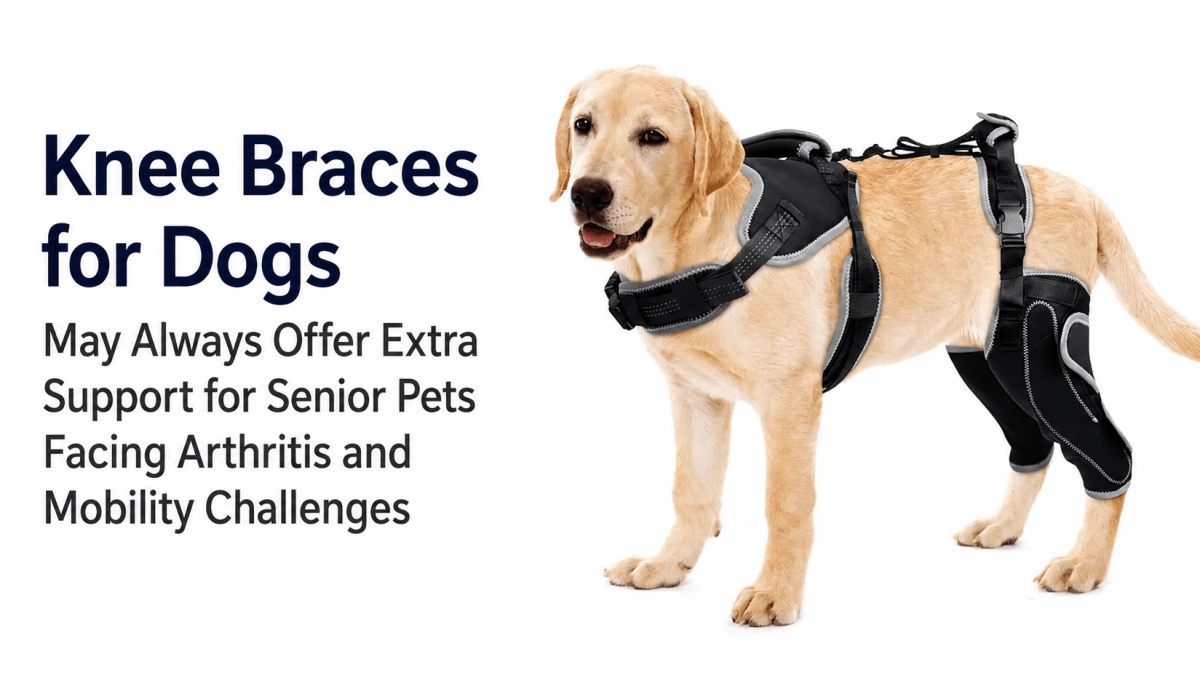
A dog walking with a limp shifts more weight onto the good leg. That is the first thing anyone notices. What is less visible is why: the stifle joint is not tracking along its natural axis, so every step sends load through a wobbling path. A knee brace is not a cast. It does not immobilize the joint. What it does—when it works—is guide the femur and tibia back into a straight load line by placing a hinge precisely over the joint's rotational center.
That hinge position is the single design variable that separates a dog knee brace that holds from one that migrates down the leg within minutes. If the hinge sits even a half-inch forward or aft of the stifle joint axis, the brace converts every stride into a lever that pushes itself out of place. The tighter you crank the straps to compensate, the more that redirected force concentrates under the strap edges. The dog moves less. The brace rubs more. That is not a fitting problem. It is a hinge alignment problem.
Why Hinge Position Matters More Than Strap Tension
The stifle joint in a dog is the equivalent of a human knee: the articulation between the femur above and the tibia below. When a dog stands, the joint's rotational axis runs roughly side-to-side through the femoral condyles. A brace hinge that sits on that axis allows the joint to flex and extend along its natural arc. The force path stays straight—from the hip, through the knee, into the paw. The brace stabilizes by guiding, not by squeezing.
Move the hinge forward by half an inch and the geometry changes. During extension, the hinge now sits ahead of the joint center. The femur pushes backward against the upper strap while the tibia pushes forward against the lower strap. The brace becomes a seesaw with the misaligned hinge as the fulcrum. Each step rocks the brace up or down the leg. The dog feels this as pressure where it should not be—typically along the front edge of the thigh strap and the back edge of the calf strap. Tightening the straps does not fix the seesaw. It just makes the pressure points sharper.
This is why hinge placement is a manufacturing precision problem, not an adjustment problem. In production, the hinge axis must be positioned relative to the brace shell so that when the shell is strapped to a correctly measured leg, the hinge window sits over the joint. A design that uses a wider hinge housing with some medial-lateral play can tolerate small measurement errors. A design with a tight, narrow hinge housing cannot. The former costs more to tool but produces fewer fit failures across a broader size range. That trade-off—precision of alignment versus tolerance for measurement variation—is one of the core decisions embedded in every stifle brace design.
An observable check: after the dog walks for ten minutes, find the hinge pin on each side of the brace. Place a finger on it. Have someone else gently flex and extend the dog's leg. Your finger should stay centered over the joint space throughout the motion. If it wanders forward during extension or backward during flexion, the hinge is off-axis. The brace is not stabilizing the joint—it is redirecting force into the skin.
What Strap Width and Anchor Position Do to Support Feel
If hinge alignment controls the direction of force, strap configuration controls its distribution. A force of 15 pounds directed through a strap that is an inch wide produces roughly twice the pressure per square inch as the same force through a two-inch strap. That is not a small difference. It is the difference between a dog tolerating the brace for a two-hour walk and the dog refusing to move after twenty minutes.
Wide straps spread side-to-side load across a larger contact patch. But width alone is not enough. Where the strap anchors on the brace shell determines whether that spread load stays spread. A strap anchored at a single point concentrates tension along a line toward that anchor. A strap anchored along a continuous bar distributes tension across its full width. In practice, a dog with a narrow, single-point anchor strap who lies down and then stands up creates a pressure spike at the anchor side that can break skin after repeated cycles. A bar-anchored strap under the same movement sees a more gradual pressure ramp that peaks lower and for less time.
The muscle bellies the straps sit against matter just as much. The thigh strap of a knee brace for dogs crosses the quadriceps group. On a muscular dog, that belly provides natural padding and grip—the strap bites into soft tissue that compresses and rebounds, keeping the brace in place without needing to be cinched tight. On a dog with significant muscle atrophy from weeks of favoring the leg, that same strap sits against a thinner muscle profile with less compressive give. The strap must be narrower or shaped differently to avoid pinching the femur directly against the brace shell. A design that ships with interchangeable strap pads for atrophied versus conditioned legs solves this. A design with one fixed strap width for all users does not.
Strap material affects the same equation from the other direction. Neoprene stretches when wet—from rain, from puddles, from the dog's own skin moisture. A strap that is primarily neoprene will loosen during a long walk in damp conditions. A strap with a non-stretch nylon core bonded inside the neoprene maintains its set tension regardless of moisture. In manufacturing terms, the bonded construction adds a lamination step and edge-sealing requirement that single-material straps avoid. The production cost is higher. The real-world difference is a strap that holds its fit through a wet morning walk versus one that needs retightening halfway through.
To check strap distribution at home: remove the brace after a typical activity session and look at the dog's leg under good light. A properly distributed strap leaves a uniform, faint impression that fades within a few minutes. A strap concentrating force leaves a distinct red line at the edge or a deep impression that takes noticeably longer to fade. If you see a darker mark on one edge of the strap path and nothing on the other, the anchor geometry is tilting the tension distribution. That is a design characteristic, not something adjustable at the strap buckle.
When a Knee Brace Is the Right Support, and When It Is Not
A stifle brace is built to stabilize a joint that still has some degree of controlled motion. It guides. It does not lock. That distinction determines where the brace works and where it does not.
Dogs with partial ligament tears often respond well to a hinged knee brace. The intact portion of the ligament still provides some passive restraint; the brace adds the missing share by limiting the tibia's forward slide during weight-bearing. The dog can still flex and extend, but the end range that stresses the tear is blocked by the hinge stop. This works because the joint still has a functional envelope of motion—the brace just narrows it at the extremes.
Dogs with complete CCL ruptures are different. With no ligament at all, the tibia is free to translate forward until something else stops it. A brace can limit that translation, but the stopping force now goes entirely through the straps and shell, not through any remaining ligament. The brace-hinge-stop relationship becomes much more demanding. A stop that is too soft lets the tibia slide far enough to cause pain. A stop that is too hard delivers a jarring impact at each step's end range. The design problem is not whether to include a stop but how to tune its stiffness and engagement angle so the dog can walk without hitting a wall. A brace with an adjustable hinge stop—where the angle and resistance can be changed as the dog's condition changes—addresses this. A fixed stop cannot.
Dogs with angular limb deformities, very deep chests, or leg conformation that falls far outside the breed norms a given brace was patterned for are unlikely to get a reliable fit from a standard shell. The hinge may not sit over the joint. The straps may not find a stable anchor zone. In these cases, the design assumptions baked into the shell geometry no longer hold.
Disclaimer: This check assumes a short-coated dog where skin marks are visually obvious. Double-coated breeds may show subtler rub marks that need hand-checking rather than visual inspection—run your fingers along the strap path and feel for warmer skin or slight swelling rather than relying on visible redness. If the dog's leg conformation falls outside the breed norms this brace was patterned for, particularly dogs with angular limb deformities, the fit checks described here may not catch every pressure point.
Dogs using a brace as part of arthritis support often benefit from a different approach to tension than post-injury bracing. Arthritic joints tend to stiffen when stationary for long periods. A brace worn too tight restricts the small, frequent movements that pump synovial fluid and keep the joint lubricated. A moderate tension—enough to feel supported, not enough to feel restrained—tends to work better for daily wear. Many dogs with arthritis wear a brace during walks and active hours, then have it removed during rest, which balances support with natural joint movement.
Post-surgical bracing follows yet another pattern. Here the brace is often used to protect a surgical repair during the early healing phase. The fit requirements are different because the leg may be shaved, slightly swollen, or bandaged under the brace. A brace used after CCL surgery must accommodate changing leg dimensions across the recovery timeline without losing hinge alignment—a design challenge that braces with adjustable strap length but fixed shell geometry handle better than designs where the shell itself changes shape under tension.
The boundary conditions matter. A knee brace is a biomechanical tool with specific design constraints. Where the dog's condition fits within those constraints, the brace adds meaningful stability. Where it does not, no amount of strap adjustment bridges the gap. Understanding which is which comes down to the hinge, the straps, and the match between the brace geometry and the individual dog's leg.
FAQ
How do you tell if a brace hinge is actually aligned with the joint?
After the dog walks for ten minutes, locate the hinge pin on each side and flex the leg gently. The pin should stay centered over the joint space through the full range of motion. If it shifts forward during extension, the hinge is sitting ahead of the joint axis. If the brace slides down within those ten minutes regardless of strap tension, the hinge alignment is the first thing to suspect—not the strap tightness.
Why does the brace migrate down the leg even with tight straps?
Brace migration is usually a hinge-alignment problem disguised as a strap-tension problem. When the hinge sits off the joint axis, each stride pushes the brace in the direction of the offset. Tightening the straps fights the symptom but not the cause. The fix is verifying the hinge position relative to the stifle joint—and if the shell geometry cannot be adjusted to bring the hinge on-axis, a different size or shell shape is the next variable to change.
Does a wider strap always mean better comfort?
Wider straps lower peak pressure, which generally improves comfort, but only if the anchor distributes tension evenly across the full width. A wide strap anchored at a single point still concentrates load toward that point. For dogs with muscle atrophy, a narrower strap with a bar anchor may actually produce more even pressure than a wide strap with a point anchor, because the narrow strap can seat into the reduced muscle contour rather than bridging over it.
Can a knee brace be worn during wet conditions?
The material construction determines this. A brace with neoprene-only straps will loosen as the neoprene absorbs moisture and stretches. A brace with neoprene straps that have a non-stretch nylon core bonded inside maintains set tension through damp conditions. After exposure to rain, wet grass, or puddles, the brace should be removed, wiped down, and air-dried before the next use to prevent skin maceration under the straps. How easily the inner liner dries depends on whether it is open-cell foam, which holds moisture, or a closed-cell or mesh structure that wicks and evaporates faster.
How the brace is introduced also shapes how reliably it stays in place during activity. Starting with short indoor sessions lets the dog learn to move with the hinge guiding the joint rather than fighting against an unfamiliar object on the leg.
Making Sense of Fit: What Actually Matters
Three things decide whether a knee brace works in practice. First, whether the hinge sits over the stifle joint axis—not approximately, but precisely enough that the brace does not migrate during a walk. Second, whether the straps distribute force evenly across their width rather than concentrating it along one edge. Third, whether the shell and strap geometry match the individual dog's leg shape closely enough that these first two conditions can be met simultaneously.
Everything else—strap color, shell finish, whether the brace looks supportive in product photos—is secondary to these three mechanical relationships. A brace with perfect hinge alignment and well-distributed strap pressure works even if it looks plain. A brace with poor alignment and edge-concentrated pressure fails no matter how robust it appears. The way to tell the difference is to watch the dog move, check the hinge position after activity, and look at the skin under the straps. What the leg shows after twenty minutes of walking says more about brace design quality than any spec sheet.
Measuring the leg correctly sets the starting point for all three conditions. A dog's thigh and calf circumference, plus the distance from the top of the thigh to just above the hock, determine which shell size can place the hinge over the joint. Skipping the length measurement is the most common source of hinge misalignment—a shell that fits the circumference but is too long or too short for the leg segment pushes the hinge off-axis regardless of strap adjustment.
For dogs with arthritis, the balance between support and freedom of movement matters differently than for injury stabilization. An arthritic joint benefits from guided motion that keeps the joint surfaces moving—too much immobilization can increase stiffness. The right tension for a given condition and activity level tends to sit in a zone where the dog moves naturally but with visibly less wobble in the affected leg. If the dog's gait looks stiff or robotic, the brace is likely restricting more than guiding—loosen slightly and watch the movement pattern change.
Sizing also accounts for changes over time. A leg that has been favored for weeks loses muscle mass; as the dog regains strength with the brace, the thigh circumference can increase, changing how the straps seat. A brace with adjustable strap length and interchangeable pads can accommodate this progression. A fixed-fit brace cannot, and what fit well at week one may fit poorly by week six.
Surface traction under the paw is often overlooked as part of the brace system. A dog wearing a knee brace on a slick floor still struggles if the paw cannot grip. The brace stabilizes the joint above; the paw still needs to hold the ground below. Non-slip surfaces or paw grips complete the support chain. A brace that keeps the stifle aligned but leaves the dog slipping on hardwood floors solves only half the problem.
In the end, choosing a knee brace dog is not about finding the tightest fit or the most feature-packed design. It is about matching the brace geometry to the dog's leg so the hinge sits on-axis and the straps distribute rather than concentrate. These are mechanical facts, not opinions. A dog that walks with less limp and keeps the brace in place through a full walk has both conditions met. A dog that limps more with the brace on or shakes it off after five minutes has at least one condition failing—and the fix is almost never just tightening the straps.
| Check | Pass signal | Fail signal |
|---|---|---|
| Hinge alignment | Hinge pin stays centered over joint space through full range of motion after 10 min of walking | Pin shifts forward/back during flexion; brace migrates down leg regardless of strap tension |
| Strap distribution | Uniform, faint impression fades within minutes after brace removal | Deep red line at strap edge or uneven mark that lasts longer than several minutes |
| Gait quality | Dog places more consistent weight on affected leg; stride length evens out compared to unbraced walk | Gait looks stiffer or more uneven with brace than without; dog refuses to move |
| Skin condition | No heat, swelling, or broken skin under any strap or shell contact point | Warm spots, redness, swelling, or hair loss at contact zones |
0 Comments