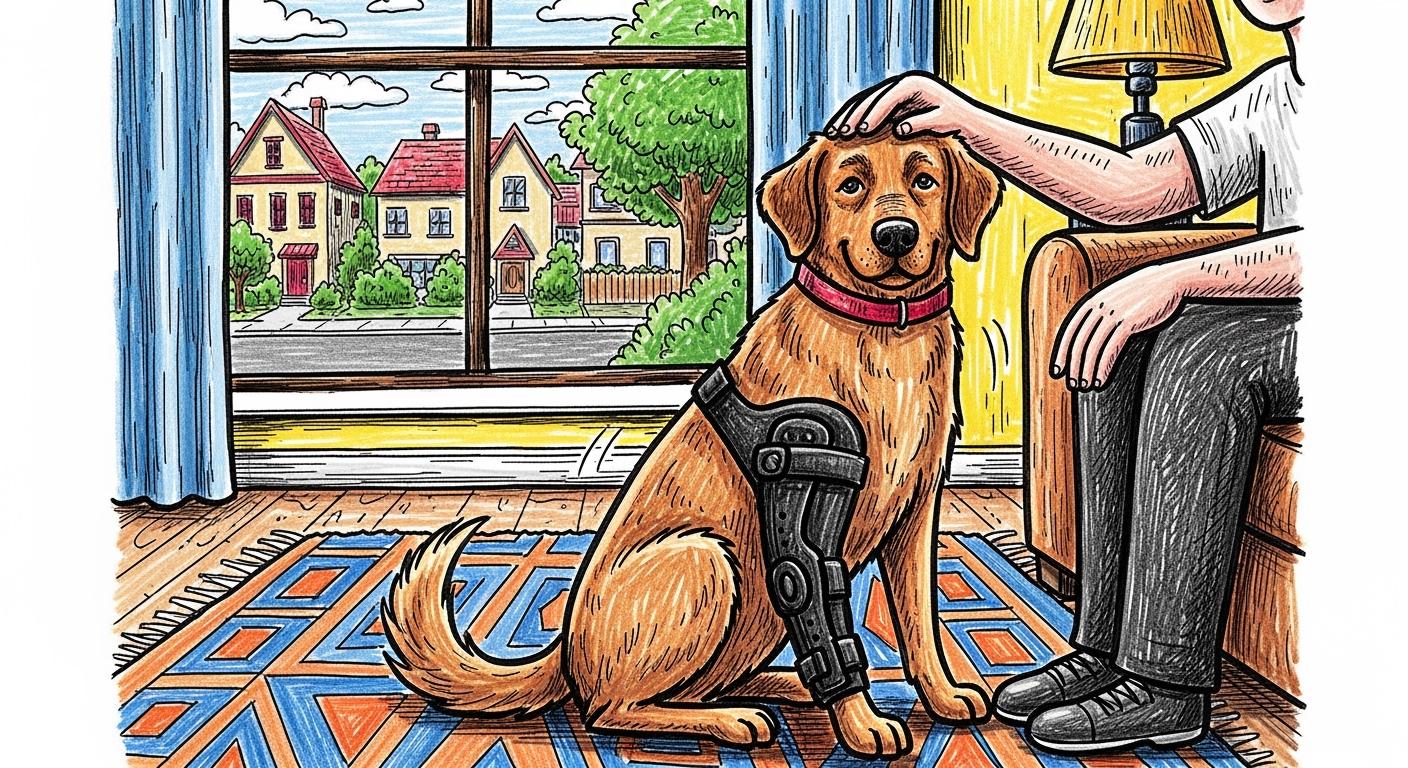
A dog knee brace either does its job or it does not. There is no middle ground. The joint is either stabilized through the stride or the brace shifts, the straps loosen, and the leg keeps taking the same damaging motion it took before. What tips the balance is not how tight you crank the straps. It is three design details that most product pages skip right past.
What Makes a Knee Brace Actually Stabilize the Joint
A knee brace stabilizes by controlling the relationship between the tibia and femur through each phase of a stride. Stripped down, it means the brace has to resist one specific motion — the tibia sliding forward relative to the femur — without blocking the knee from bending the way a dog naturally bends it when walking.
Hinge placement decides whether this works.
A hinge positioned over the joint's rotational axis transmits force straight along the bone. Push down through the femur, and the load travels through the hinge, into the tibia, and into the ground the way a healthy leg channels it. The dog loads the leg, the brace shares the load, the joint surfaces stay evenly pressed together. The dog moves naturally because nothing is fighting the joint's preferred path.
Move that hinge a quarter-inch forward or back. The brace now creates a lever arm. Each step applies a small rotational torque to the joint instead of a clean axial load. Over hundreds of strides — a ten-minute walk — that misalignment accumulates. The dog compensates by shortening the stride on the braced side or shifting weight to the other leg. The brace is still on. It is just not doing what it was designed to do.
You can verify this at home. After twenty minutes of leash walking on flat ground, watch the dog from behind. Does one hip drop more than the other? Does the dog consistently place the braced leg wider or narrower than the unbraced leg? Both hind legs taking even strides is the pass signal. A dog that shortens one side or drifts toward the unbraced leg is telling you the hinge alignment is off.
This is why off-the-shelf braces with fixed hinge positions work well for dogs whose leg proportions fall within a predictable range — and why breeds with unusually long tibias or deep chest angles sometimes need the hinge axis adjusted. The design is not wrong. The fit geometry changed.
Why Strap Width and Liner Material Decide Whether Your Dog Accepts the Brace
Stabilization is half the equation. The other half is whether the dog tolerates wearing the brace long enough for the stabilization to matter.
Two straps at the same tension produce wildly different results depending on width. A narrow strap concentrates force into a thin band. Pounds of pressure spread across a half-inch strip of skin. That strip compresses, circulation slows, and within fifteen or twenty minutes the dog starts fussing — licking the brace, shaking the leg, refusing to plant weight. A wide strap spreads the same total force across two or three times the surface area. Same stabilization. Lower pressure per square inch. Higher tolerance.
This is not a comfort detail. It is a use-duration lever. A dog that fights the brace after ten minutes gets almost no stabilization benefit regardless of how well the hinges are aligned. A dog that forgets the brace is there gets hours of controlled joint loading — which is what tips recovery and mobility in the right direction.
The liner material pulls in the same direction. Neoprene grips and stretches, but it traps heat. After thirty minutes of activity the skin underneath gets damp. Damp skin softens and becomes more vulnerable to friction. A perforated liner or one with a moisture-wicking backing changes the thermal equation: less trapped heat, drier skin, fewer friction issues over the same wear duration. Across dog brace categories, the same liner trade-off shows up — thicker padding improves initial comfort but holds more heat, thinner perforated liners run cooler but provide less cushion against the brace shell.
An easy at-home check takes five seconds. Remove the brace after a thirty-minute wear session and press the back of your hand against the skin that was under the liner. Cool and dry — the liner is managing heat adequately. Warm and damp — moisture is accumulating, and the risk of skin breakdown increases with every additional hour of wear. That check tells you more about long-term wearability than any product spec sheet.
The right liner choice depends on how the brace will actually be used. Short indoor rehab sessions favor one material. Hours of daily outdoor activity favor another. The dog's coat matters too — thin-coated breeds dissipate heat through the liner faster; double-coated breeds trap it regardless of material choice. Neither liner type is universally better. The usage pattern picks the winner.
When a Knee Brace Helps — and When It Does Not
A knee brace is a mechanical stabilizer. It works by restricting the range and direction of joint motion. That mechanism makes it useful in specific conditions and useless in others.
Where the design makes sense:
- Partial CCL tears where the ligament still provides some native stability. A dog ACL/CCL knee brace fills the gap between what the damaged ligament can handle and what daily movement demands. It shares the load rather than replacing the structure entirely.
- Post-surgical recovery where controlled movement protects healing tissues — understanding what a brace can and cannot do for an ACL injury helps set realistic expectations. The brace sets a mechanical boundary the dog cannot exceed, even when the leg feels good enough to overdo it.
- Chronic knee instability from arthritis or age-related ligament laxity. The brace provides predictable support day after day, which matters more for long-term comfort than peak stabilization numbers.
Where the design falls short:
- Complete ligament ruptures with gross instability. No external brace replicates the multi-directional constraint of an intact CCL. The knee will still translate under load — the brace only reduces how far.
- Dogs whose leg conformation falls outside the pattern the brace was built around. Deep-chested breeds with steep tibial angles, dogs with angular limb deformities — the hinge axis will not align, and the brace fights the dog's natural movement rather than guiding it.
- Dogs that will not tolerate any leg-worn device regardless of fit. A brace sitting in a drawer stabilizes nothing.
Disclaimer: If the dog's leg conformation falls outside the breed norms this brace was patterned for — particularly dogs with angular limb deformities or very deep chests — the fit checks described here may not catch every pressure point. Double-coated breeds may show subtler rub marks that need hand-checking rather than visual inspection after brace removal.
FAQ
How soon can a dog adjust to wearing a knee brace?
Most dogs adapt within three to five short sessions if the brace fits well. Start with five-minute indoor sessions on a non-slip surface, then add five minutes per session as the dog stops paying attention to the brace. A dog still fussing after the third session almost always has a fit problem — check strap pressure distribution and hinge position before assuming the dog just needs more time.
Does a knee brace weaken the leg muscles over time?
A brace that fits correctly and allows near-normal range of motion does not cause meaningful muscle loss in most dogs. The risk runs the other direction. A dog that avoids loading a painful, unstable knee loses muscle rapidly through disuse — often within two to three weeks of favoring the leg. The brace enables loading, and loading preserves muscle through controlled joint motion. The design variable that matters here is whether the hinge allows enough flexion for a full stride rather than a stiff, guarded shuffle.
Can a knee brace be worn during off-leash activity?
Most braces are designed for controlled, on-leash movement where stride forces are predictable. Off-leash running, sharp turns, and jumping introduce rotational forces that a single-hinge brace is not designed to manage. The brace may stay on but the joint loading pattern changes enough that the stabilization benefit drops. For off-leash activity, a brace with a wider shell and dual-strap anchoring tends to hold position better than a minimalist sleeve-style design — but controlled movement remains the condition the product was engineered for.
A knee brace is not a cast. It does not immobilize. It guides — and whether it guides well or poorly comes down to hinge alignment, strap width, and liner breathability. Those three details matter more than brand, more than price, and more than how tight the Velcro feels at first. Check them. The dog will tell you the rest.
0 Comments