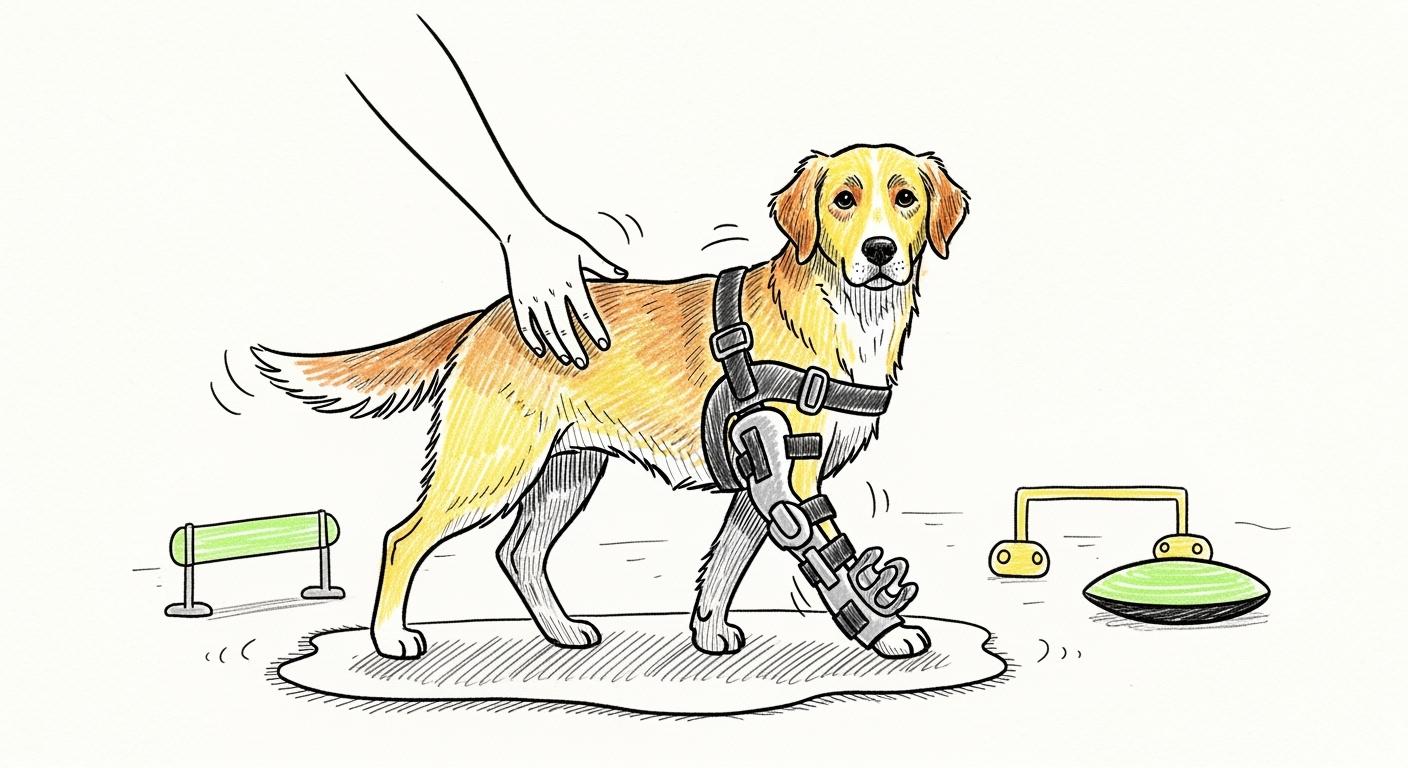
A dog dragging a paw across pavement with each step. You watch the top of the paw scrape the ground instead of the pads landing flat. The instinct is to look for something that wraps tighter. But the difference between a knuckling brace that helps and one that does not has almost nothing to do with how hard you cinch the straps. It comes down to where the lift force hits the paw and how that force spreads across the leg.
This article walks through the design details that separate a brace that guides paw position from one that just adds bulk to the limb. A brace adjustment period shares common ground across device types—short supervised sessions, gradual time increases, and daily skin checks. The design-specific details below are what determine whether those sessions produce a smoother gait or a frustrated dog.
Where the Toe-Lift Mechanism Makes the Difference
A knuckling brace works through a simple mechanical chain: an elastic cord applies upward tension to the front of the paw, the toes clear the ground, and the paw lands pad-down instead of knuckled over. When the lift point sits directly above the paw's centerline, the force vector runs straight—the paw rises evenly and lands flat. Move that lift point half an inch to either side, and the paw rotates as it lifts. The dog compensates by twisting the leg outward or inward. A brace that looked fine at a standstill becomes a gait problem after fifty steps.
That is the alignment problem. It is why a toe-up design with an adjustable elastic cord can perform differently from a fixed-loop sock—not because one material is better, but because adjustability lets the lift point be tuned to a specific dog's paw geometry rather than assuming a one-size position.
Why Multi-Point Attachment Changes the Outcome
Single-point attachment concentrates all the lift force through one anchor on the leg. That anchor becomes a pressure hotspot. The brace twists around it as the dog steps. Multi-point attachment—typically a loop around the paw plus an anchor higher on the lower leg, sometimes with a secondary strap—spreads the same lifting force across a larger contact area. The physics is straightforward: same force, more square inches of distribution, lower pressure per square inch. Less pressure means less skin irritation and less brace migration during a walk.
Here is how the three mechanisms compare in use:
| Mechanism | Performance Difference | Why It Matters | Main Limitation |
|---|---|---|---|
| Toe-lift cord | Lifts paw from front, preserves ankle freedom | Dog retains proprioceptive feedback from the paw—balance and coordination stay intact | Lift angle must be tuned; too steep pulls the paw backward, too shallow fails to clear |
| Multi-point attachment | Resists twisting by anchoring at paw and lower leg | Brace stays aligned during turns, uneven ground, and sudden direction changes | More straps mean more contact areas to monitor for rubbing |
| Padding configuration | Multi-density foam absorbs shear forces at strap edges | Reduces the hot-spot effect where strap edges dig into skin during repeated flexion | Thicker padding traps more heat; breathability becomes the limiting factor on longer walks |
In practice: Walk the dog for ten minutes on a flat surface, then check whether the paw still lands pad-down. If the paw has begun to rotate—landing on the outer edge or knuckling over—the lift point has migrated and needs repositioning. If the paw lands flat but the brace straps have shifted more than half an inch from their starting position, the attachment configuration is not distributing force evenly enough for that dog's movement pattern.
Three Design Approaches, Three Tradeoffs
Not every knuckling brace solves the same problem. The core tradeoff sits between paw protection and ground-feel—and the right choice depends on which matters more for a specific dog in a specific setting.
Toe-Up Sling: Maximum Ground Feel, Minimal Coverage
A toe-up sling lifts the paw via an elastic cord while leaving the paw itself exposed. The dog feels the ground under the pads. Proprioception—the sense of where the paw is in space—stays intact, which matters for balance on uneven surfaces. This design works well for a dog that has some voluntary ankle control and knuckles mainly due to weakness rather than complete loss of nerve function. The tradeoff: an exposed paw is vulnerable to scrapes on rough pavement or gravel. If the dog drags enough to wear down nails or abrade the top of the paw, a toe-up sling alone is not enough protection.
Boot-Style Brace: Maximum Protection, Reduced Feedback
A boot-style brace combines toe-lift support with a covered shell around the paw and lower leg. The shell blocks scrapes, protects nails, and prevents the paw from folding under entirely. This design matters when the dog has little to no voluntary paw placement—severe weakness, post-surgical recovery where the limb needs guarding, or a dog that drags hard enough to draw blood on pavement. The tradeoff: the shell mutes ground feedback. A dog that cannot feel the surface underfoot tends to step more hesitantly and may fatigue faster because it cannot micro-adjust paw angle with each step.
Soft Sock and Splint Designs: Gentle Guidance, Less Structure
Soft adjustable dog braces and training socks use fabric tension rather than rigid cord lift. They guide the paw into a better position without locking any joint. For a dog with mild, intermittent knuckling—say, the paw rolls only when the dog is tired or walking on an incline—this lighter approach keeps the paw oriented without restricting the ankle. The tradeoff: a soft design cannot correct a paw that collapses fully under weight. If knuckling is severe enough that the paw folds every step, a soft brace adds warmth but not enough guidance.
| Design Type | Performance Difference | Where It Works | Main Limitation |
|---|---|---|---|
| Toe-up sling | Lifts paw, preserves ground feel | Mild-to-moderate knuckling with some ankle control; smooth surfaces | No scrape protection; paw remains exposed to abrasion |
| Boot-style | Lifts paw and encloses for protection | Severe dragging, post-surgery guarding, rough terrain | Reduced proprioception; more heat buildup inside the boot |
| Soft sock / splint | Fabric tension gently guides paw orientation | Mild intermittent knuckling; indoor and supervised use | Insufficient for full paw collapse under weight |
In practice: After twenty minutes of wear, lift the brace and feel the skin underneath. If the skin is warm but dry, the material is breathing adequately for that dog in that temperature. If the skin is damp with sweat, the brace is trapping too much heat for the conditions—a boot design may need to be swapped for a sling on warmer days, or wear sessions shortened.
Fit Precision: Why Sizing Outweighs Strap Tension
A common assumption is that a tighter brace provides more support. The opposite is often true. A brace works by aligning lift forces with the paw's natural geometry. That alignment depends on where the brace sits on the leg—its anchor height, the loop position around the paw, the angle of the elastic cord. Cranking straps tighter cannot fix a brace that is sitting in the wrong place. It only concentrates pressure at the wrong points.
What matters for a rear leg brace is the same thing that matters for any lower-limb support: the distance from the paw loop to the leg anchor, the circumference at both points, and whether the leg's taper between those two points matches the brace's geometry. A dog with a very straight lower leg—common in some sighthounds and larger breeds—distributes force differently than a dog with a more tapered leg, seen in many terriers and small breeds. The same brace in the same size will fit these two leg shapes differently even when measurements technically match the size chart. The same alignment principle applies to dog knee braces, where hinge-to-joint positioning matters more than how firmly the straps are fastened.
This is why mobility rehabilitation routines that incorporate brace use often start with shorter sessions—not only to acclimate the dog, but to identify whether the brace is maintaining its position under real movement. A brace that stays put during a standstill measurement can shift dramatically once the dog breaks into a trot.
Pass/fail check for fit: Mark the strap edges with a small piece of tape. Walk the dog for five minutes at a normal pace. If any strap has migrated more than half an inch, the fit needs adjustment—either a different anchor height or a different strap configuration—regardless of how secure the brace felt when first put on.
When a Brace Helps—and When the Design Hits Its Limit
A knuckling brace is a paw-positioning tool. It guides. It does not restore nerve function, rebuild lost muscle, or reverse spinal cord compression. Understanding this boundary matters because using a brace in a scenario it was not designed for can create new problems—pressure sores from a brace strapped onto a non-responsive limb, or a false sense of security that delays the veterinary evaluation a progressing condition needs.
Where the Design Performs
- Mild-to-moderate paw dragging where the dog retains some voluntary leg movement and ankle control
- During supervised walks and rehabilitation sessions, where the brace lets the dog practice a more natural paw strike
- As a protection layer for paws that scrape intermittently—the brace prevents abrasion during activity while the underlying cause is being addressed
- Short-duration use on smooth terrain where the dog can focus on gait quality rather than navigating obstacles
Where It Does Not
- Complete paralysis with no voluntary leg movement—a brace cannot generate movement; it can only guide movement that exists. A dog wheelchair or cart addresses mobility when the limb cannot bear weight at all
- Open wounds, active infections, or unhealed surgical sites on the paw or lower leg—the brace can trap moisture and bacteria against damaged tissue
- Severe neurological deficits where the dog cannot feel the paw at all—without sensation, the dog cannot respond to the brace's guidance, and pressure points go undetected
- Progressive conditions that are actively worsening—a brace supports the current level of function; it does not slow disease progression
Disclaimer: This fit and positioning guidance assumes a dog with leg conformation that falls within typical breed norms. Dogs with angular limb deformities, very deep chests, or significant asymmetry between left and right legs may show pressure patterns that visual checks miss—a hand-check along the full strap path after each session is more reliable than a visual scan for these dogs. If the leg shape deviates substantially from the brace's patterning, the fit checks described here may not catch every pressure point.
A knuckling brace supports paw placement. It does not replace a veterinary diagnosis or treat the underlying cause of the knuckling. Used within its design limits—supervised, on a dog with some voluntary movement, with fit checked each session—it can keep a paw off the pavement and let the dog move with less scraping and more confidence. Used outside those limits, it adds weight to a leg it cannot guide.
Frequently Asked Questions
What separates a knuckling brace that works from one that does not?
The lift point's alignment with the paw's centerline. A brace where the elastic cord pulls straight up through the paw's midline lifts evenly; a brace where the lift point sits off-center rotates the paw with each step. Check this by watching the paw from directly in front after five minutes of walking—if the paw lands flat rather than on its outer or inner edge, the lift alignment is correct. More specific questions about fitting and use often come down to this same geometry.
Can a dog wear a knuckling brace during unsupervised time?
No. A brace is a guided-use tool. Left unsupervised, straps can shift into pressure points, the dog may chew or hook the brace on furniture, and skin irritation under the straps goes unnoticed. Sessions should be supervised, and the brace removed during rest, sleep, or any time the dog is not directly observed.
Does the material matter more than the design?
Design determines whether the brace works. Material determines whether the dog tolerates it. A well-aligned toe-lift mechanism made from basic nylon will outperform a poorly aligned mechanism wrapped in premium neoprene—but material breathability sets the ceiling on how long a session can last before skin moisture becomes a problem. Early knuckling signs are easier to manage with a lighter, better-ventilated brace than with a heavier one, because the dog can still feel and respond to the ground underfoot. The full range of available mobility support options spans from lightweight training socks to full-support braces—matching the design to the severity of paw dragging determines whether the tool helps or hinders.
0 Comments