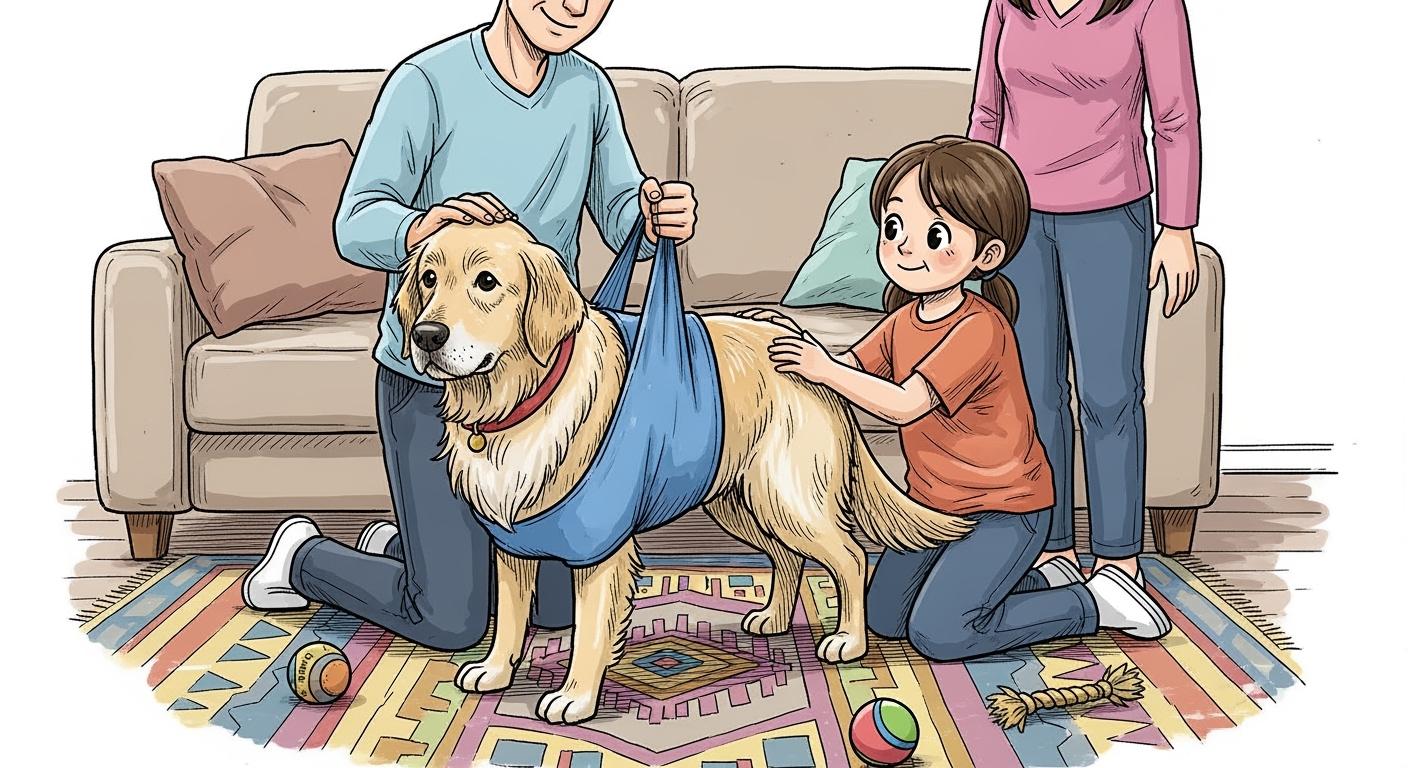
A dog losing strength in the hind legs shifts weight forward, drags paws, and hesitates before steps that used to be automatic. The owner reaches for a back leg support device. And the difference between one that helps and one that gets returned to the closet is rarely about how much it costs. It is about where the support lands on the dog and how that placement transfers force through the body.
The same harness design can stabilize one dog and chafe another — not because one owner tightened it more, but because the lift points hit different anatomy. Understanding why that happens changes which device you reach for.
How Support Point Placement Determines Real-World Effectiveness
The support a dog feels from a rear lift harness does not come from how tightly the straps are cinched. It comes from where the device makes contact and how that contact transfers load into the dog's skeletal structure rather than soft tissue.
When a rear harness positions its support straps under the groin and behind the ribcage, the lift force travels upward along a nearly vertical path. The dog's weight settles into the straps instead of pulling them forward or backward. This vertical load path means the harness does not need to be tight to stay in position — the force vector itself keeps the device anchored.
Shift that same strap two inches forward or back, and the load path tilts. The harness now pulls at an angle relative to the dog's center of mass. The strap slides. The owner tightens it. The cycle of adjustment and readjustment begins, and the dog learns to brace against the harness rather than trust it.
With a rear leg brace, the principle tightens further. The brace hinge must sit directly over the joint's axis of rotation — typically the stifle or hock. When hinge and joint axis align, the brace moves with the leg. Force travels along the joint's natural load line. The brace stabilizes without restricting normal range, and the dog tolerates wearing it through hours of activity.
A hinge placed even a quarter-inch off-axis resists the joint's natural motion on every step. The dog compensates by altering its gait. That shifts load to the opposite hip and the spine. What was meant to support one leg now stresses structures that were not the problem.
In practice: after a 15-minute walk with a rear harness, check where the support straps sit relative to where you positioned them. Drift of more than half an inch means the load path is fighting the dog's anatomy — the placement is wrong, not the tightness.
Strap Width, Contact Area, and the Pressure Problem
Force distributed across a larger contact area means lower pressure at any single point. That physics is straightforward. The design tradeoffs are not.
A wide chest strap on a rear harness spreads lift force across the sternum and ribcage. For a deep-chested breed, this works because the chest geometry provides a stable, relatively flat surface for the strap to press against. The same wide strap on a barrel-chested dog or a small breed with a narrow ribcage wraps around a convex surface. The strap touches in the middle but gaps at the edges, concentrating all the force onto a strip half its measured width. The wide strap performs like a narrow one — with extra material that traps heat and rubs.
Multi-point strap configurations solve this differently. Instead of one wide band, two or three narrower straps anchor at separate anatomical points. Each contacts a smaller area, but the total contact area can equal or exceed a single wide strap. More importantly, each anchor point adjusts independently. A dog with a deep chest and narrow waist gets different tension on the chest strap versus the belly strap. The fit adapts to the dog rather than forcing the dog into the strap's shape.
For a knee brace, strap width follows similar logic with an added constraint: the strap must not compress working muscle against bone. The thigh and calf muscles change shape with every stride — they bulge and flatten. A stiff wide strap over the muscle belly restricts this shape change. The dog feels it as discomfort within minutes. A narrower strap placed in the groove between muscle groups, or a wider strap made from material with enough elasticity to move with the muscle, preserves both circulation and tolerance.
| Strap Configuration | Where It Works | Main Limitation |
|---|---|---|
| Multi-point narrow straps | Dogs with uneven proportions — deep chest, narrow waist, or pronounced tuck-up | More buckles mean more setup time; one missed adjustment can create a pressure point |
| Single wide strap | Dogs with uniform barrel chests or broad, flat ribcages | Gaps on convex or narrow body shapes; trapped heat under full-width contact |
| Elastic-panel straps | Active dogs who wear support through full range of motion; all-day indoor use | Less stabilizing for acute joint instability where rigid constraint is needed |
Tip: after 20 minutes of wear, remove the harness or brace and run your hand over the skin under each strap. Redness matching the full strap width that fades within 5 minutes is normal pressure response. Redness in narrow lines that persists past 10 minutes means the contact patch is too small for the force it carries — the strap is functionally too narrow regardless of its labeled width.
Where Back Leg Support Helps and Where It Does Not
Back leg support devices work within a specific range of conditions. The boundaries are sharper than most product descriptions suggest.
A rear lift harness performs best when the dog retains some ability to bear weight and coordinate hind-limb movement. The harness reduces the vertical load the legs must carry, but it does not control joint motion. For a dog recovering from stifle surgery who can place the foot but needs assistance through the push-off phase, a harness with correctly positioned lift points takes just enough weight off to let the leg move through a near-normal pattern without collapsing.
The same harness becomes the wrong tool when the dog cannot place the foot at all. Without weight-bearing intent, the harness suspends the hindquarters. The legs dangle. The dog drags them. The device functions as a transport sling rather than a support aid. At this point, a rear-leg wheelchair replaces the ground-contact function entirely rather than assisting it — a different support category for a different set of mechanical demands.
Leg braces have a parallel boundary. A stifle brace stabilizes the knee against excessive rotation and hyperextension by restricting the joint's range to a controlled arc. This makes sense for a partially torn CCL where the joint benefits from protection during healing, or for arthritic changes where limiting end-range motion reduces pain signals.
A brace cannot restore a joint that has lost all ligamentous stability. If the CCL is fully ruptured and the tibia translates forward with every step regardless of external support, the hinge cannot replicate the ligament's function — it can only limit how far the consequence travels. The brace may still help as part of a broader management approach, but expecting it to perform like an intact ligament misunderstands what external support can physically achieve.
Disclaimer: These fit and performance checks assume a dog with typical breed conformation. Dogs with angular limb deformities, very deep or very shallow chests, or significant one-sided muscle atrophy may show pressure patterns and strap drift that do not match the observations described here. In those cases, hand-checking for heat, moisture, and tenderness under every contact point is more reliable than visual inspection alone.
Material and Adjustment Design — What Keeps a Device in Daily Use
A support device that stays on a shelf helps no dog. The design details that determine daily compliance are rarely the ones featured in product headlines.
Strap adjustment mechanisms shape the experience more than any other single feature. Three straps that require unbuckling and rethreading for every on-off cycle means the device gets used once. Quick-release buckles with memory-lock sliders — where the owner sets each strap length once and the buckle remembers it — take seconds to put on and seconds to remove. Same support function. Different compliance outcome.
The hardware material itself creates tradeoffs. Metal D-rings and buckles hold their shape under repeated load and resist corrosion in wet conditions, but they add weight and transfer cold to the dog's skin in winter. Injection-molded acetal buckles weigh less and maintain consistent friction across temperature ranges, but their spring tabs fatigue faster — a buckle that releases too easily after months of daily use fails at the moment the dog needs support most. Indoor daily assistance tolerates lighter hardware. Outdoor use in variable weather demands corrosion-resistant metal.
Lining material determines skin tolerance over hours of contact. Neoprene conforms to body contours and cushions well, but it traps heat. After 30 minutes, a neoprene-lined brace creates a warm, humid layer against the skin — comfortable in cold weather, problematic in summer or for dogs prone to skin fold issues. A mesh-lined device breathes better at the cost of less padding, which works for shorter wear sessions or lower-tension applications where cushioning is secondary to airflow.
Washability is not a convenience feature. It is a compliance feature. A brace that cannot be cleaned accumulates oils, dander, and bacteria over weeks. The owner stops putting it on the dog. Devices with removable, machine-washable liner sleeves solve this directly. For sewn-in liners, closed-cell foam keeps moisture on the surface where it can be wiped away — open-cell foam absorbs it, and the odor eventually wins.
FAQ
Does a tighter harness give better back leg support?
No. Tightness compensates for poor fit but does not create support. A harness shaped to the dog's body distributes lift force across the intended contact points without being cinched down. If you find yourself overtightening to stop the harness from shifting, the strap placement is wrong — adding tension only concentrates pressure onto smaller areas and makes the dog resist wearing it.
Can a rear lift harness replace a leg brace?
They serve different mechanical functions and are not interchangeable. A harness reduces the vertical load the legs carry. A brace restricts joint motion within a controlled range. A dog with joint instability may need both — the brace to protect the joint, the harness to offload weight. Using one where the other is needed leaves the primary problem unaddressed.
How can I tell if the brace hinge is aligned with my dog's joint?
Watch the dog take 10 to 15 steps at a slow walk with the brace on. If the brace shifts up or down the leg with each stride, or if the dog flicks the leg outward during the swing phase, the hinge and joint axis are not aligned. A correctly aligned hinge moves with the leg so smoothly that the dog stops paying attention to the brace within minutes.
What makes a back leg support device tolerable for hours of wear?
Three factors dominate: lining breathability, strap edge finishing, and weight relative to the dog. Rolled or padded strap edges prevent the sharp pressure lines that irritate skin fastest. Mesh linings or perforated neoprene let moisture escape. And a brace weighing more than roughly three percent of the dog's body weight causes fatigue over hours, even if it fits perfectly — the dog lifts that weight with every single step.
0 Comments