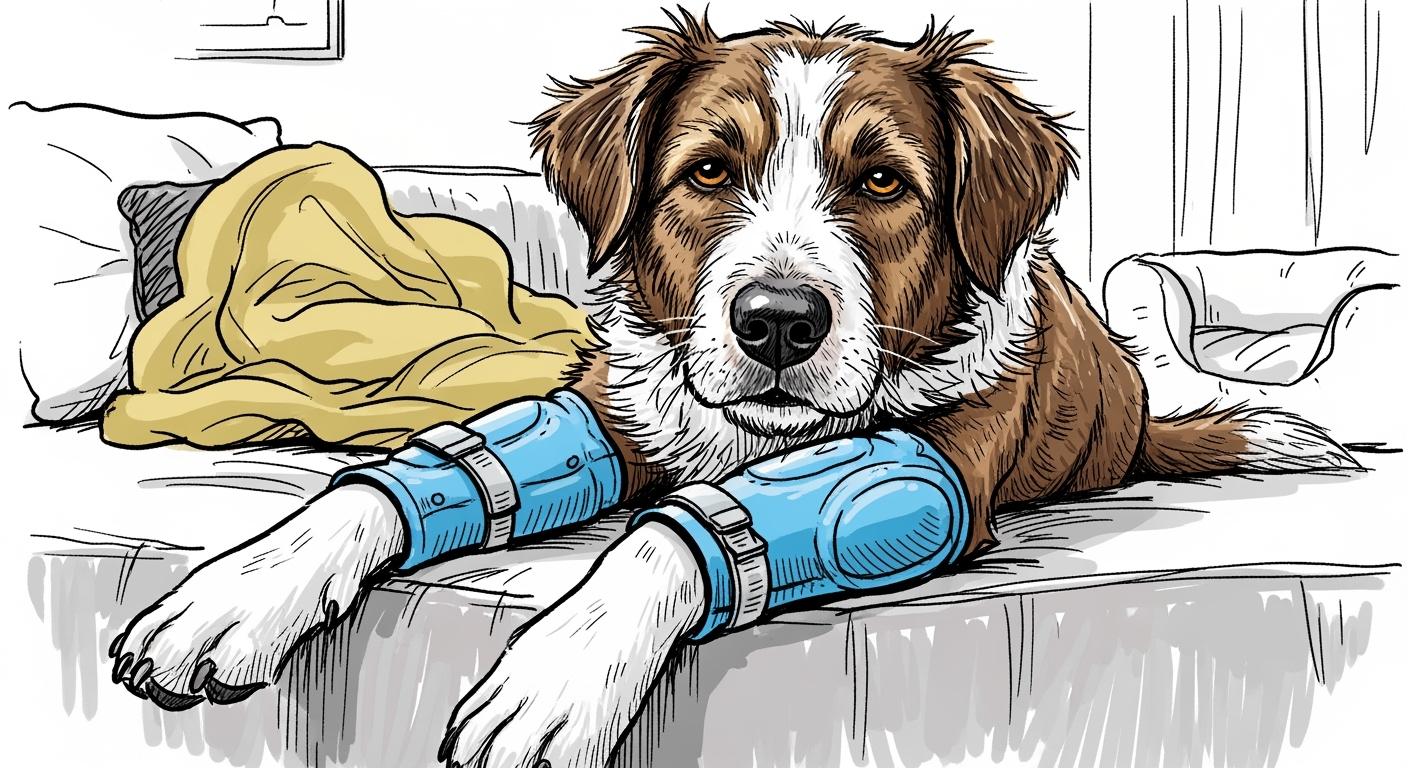
A sleeve slips a quarter inch off the elbow, and the padding sits on muscle instead of bone. The dog still rests on the same hard floor. Nothing has changed except the owner feels better. The problem is not the idea of an elbow protector. It is the assumption that any sleeve works as long as it covers the general area.
The joint at the tip of a dog's elbow—the olecranon—is where body weight meets the ground. When a dog lies on tile, concrete, or hardwood, that small bony point carries concentrated load. The skin over it thickens into a callus. Fluid can accumulate underneath, forming a hygroma. A protector works when its padding stays locked over that exact point. It fails when the padding drifts.
What keeps padding in place is not how tightly you cinch the straps. It is where the straps anchor and how wide they are.
Strap Placement Decides Whether Padding Stays on the Joint
Think of the strap as a force line. A narrow strap concentrates anchor tension across a short segment of the leg. The sleeve pivots around that narrow band during movement—the dog stands, lies down, shifts weight—and the pad walks off the elbow. A wide strap spreads the same anchor tension across a larger contact area. The unit pressure under the strap drops. The sleeve resists pivoting because the anchor force distributes across a broader surface, giving friction more territory to work with.
This chain matters: wider strap → larger contact patch → lower pounds per square inch under the strap → less tendency for the sleeve to rotate around a single pressure line → padding stays over the olecranon longer.
Strap placement relative to the elbow joint is equally consequential. A strap anchored too close to the elbow crease bunches when the leg flexes. The bunching creates a lever point that lifts the pad away from the bone. A strap placed above the elbow—anchoring on the upper arm where the limb diameter is more consistent through the range of motion—avoids this. The sleeve moves with the leg instead of fighting it.
You can check this yourself. Put the sleeve on. Walk the dog for ten minutes on a hard surface. Then slide your finger under the pad and feel whether the thickest part of the padding still sits directly over the bony tip of the elbow. If it has drifted more than half an inch, the strap configuration is not holding. The padding is now decorative.
Single-strap designs that wrap only above or below the elbow tend to pivot. Two-strap designs—one above the joint, one below—create two anchor points that resist rotation. But adding a second strap also adds a second pressure line, which means the material under each strap needs to be broad enough that the combined pressure does not simply create two concentrated bands instead of one.
Why Padding Shape Matters More Than How Thick It Is
Stacking more foam under the elbow seems logical. More material equals more cushioning. The logic breaks when you consider what the foam rests against.
The olecranon is a point. A flat foam slab pressed against a point creates a pressure cone: the force concentrates at the tip and fans out through the foam thickness. Make the foam twice as thick, and the cone base gets wider—but the peak pressure at the bony tip barely changes. The extra thickness is absorbing weight the dog is not putting there.
A contoured pad with a relief cutout—often called a donut or ring pad—changes the geometry. The cutout surrounds the olecranon so the bony point sits in a low-pressure pocket. The surrounding foam ring bears the load through the soft tissue around the joint, which has natural padding of its own. The force path shifts: instead of bone → thin skin → foam → floor, it becomes bone → surrounding muscle and skin → foam ring → floor.
| Design Difference | Why It Matters | Main Limitation |
|---|---|---|
| Flat slab padding | Simple to manufacture; provides baseline cushioning if the dog does not shift position | Creates a pressure cone at the olecranon tip; pad migration uncovers the joint entirely |
| Contoured donut pad | Surrounds the bony prominence, shifting load to surrounding soft tissue; stays effective even with minor position shifts | Cutout must match the dog's elbow size—too large and the bone sinks through; too small and it pinches |
| Gel-filled insert | Conforms to irregular bone shapes better than foam alone; dissipates shear as well as compression | Heavier; retains heat more than open-cell foam; may degrade faster with repeated washing |
| Multi-layer foam (dense base + soft top) | Dense layer resists bottoming out; soft layer reduces surface friction against skin | Layer bond can delaminate over time if adhesives are not moisture-resistant |
An observable check: after the dog wears the sleeve for twenty minutes on a hard floor, lift the pad and feel the skin over the olecranon. Dry and cool—the pad is doing its job. Damp or warm—the material is trapping heat, and the dog's skin is working harder to stay cool than the pad is working to protect it. Either the foam is too dense and non-porous, or the inner lining is not wicking moisture.
Thickness alone is a poor proxy for protection. A quarter-inch contoured pad that holds position outperforms a half-inch flat pad that slides off in ten minutes. The design question is not "how much padding" but "where the padding sits and whether it stays there."
Where an Elbow Protector Helps—and Where It Does Not
The protector is most useful when the mechanism of injury is repeated low-grade pressure—the kind that accumulates over weeks and months on hard floors. Large breeds with heavy frames, short-coated dogs with less natural elbow padding, and dogs that favor one side when resting all concentrate force on a smaller contact patch. In these conditions, a well-fitted sleeve that keeps shaped padding over the olecranon can interrupt the pressure cycle that turns normal skin into callus and callus into hygroma.
Early-stage calluses—where the skin is thickened but intact, without cracking or discharge—respond to consistent pressure offloading. The skin remodels once the repetitive load is removed. A dog elbow brace with a contoured pad gives the tissue that chance.
The protector is not a treatment device for infected wounds, open sores, or hygromas that have already hardened and organized. Once a hygroma develops a fibrous capsule, offloading pressure may prevent it from worsening, but the fluid pocket itself typically requires drainage or surgical intervention. Covering an infected wound with a sleeve traps bacteria against the skin. If the skin is broken, weeping, or smells foul, the problem has moved past what padding alone can address.
Fit also imposes a boundary. Dogs with angular limb deformities or very deep chests—conformations that deviate significantly from the breed norms a given sleeve was patterned for—may find that standard strap placements create pressure points the design did not anticipate.
Disclaimer: This check assumes a short-coated dog where rub marks are visible. Double-coated breeds may show subtler friction signs that need hand-checking rather than visual inspection—run your fingers along the strap line after the first few wear sessions. If the dog's leg conformation falls outside typical breed proportions—particularly with angular limb deformities or unusually deep chests—the fit checks described here may not catch every pressure point.
For a dog recovering from elbow surgery, a protective sleeve can shield the incision site from floor contact during rest. But post-surgical use should follow the specific guidance of the veterinarian who performed the procedure—incision care, wear duration, and cleaning frequency are clinical decisions, not design decisions.
Material Choices That Shape Daily Wear Tolerance
The best pad geometry in the world means nothing if the dog will not tolerate wearing the sleeve. Two material properties determine tolerance: the inner lining's breathability and the outer shell's flexibility.
An inner lining of perforated neoprene or open-cell mesh lets air circulate and pulls moisture away from the skin. A non-perforated lining—especially a rubberized or coated fabric—traps heat and humidity against the elbow. The dog feels damp and warm. It licks. It chews. The sleeve comes off. A well-designed dog brace treats the inner lining as a skin-contact surface, not an afterthought.
The outer layer faces a different set of demands. It meets the floor repeatedly—tile, concrete, carpet, patio stone. Abrasion-resistant woven fabrics hold up longer than knit or fleece exteriors, which pill and thin with friction. But abrasion resistance often comes at the cost of stiffness. An outer shell that is too rigid resists the natural fold of the elbow when the dog lies down, creating a leverage point that lifts the pad. The best compromise found in production is a woven nylon or polyester outer bonded to a flexible foam core—the shell takes the abrasion, the core takes the flex.
| Material Layer | What to Look For | Pass Signal | Fail Signal |
|---|---|---|---|
| Inner lining | Perforated, wicking, soft against short fur | Skin under pad feels dry after 20 minutes of rest | Damp, warm, or red skin under the pad |
| Padding core | Contoured foam or gel with a relief cutout over the olecranon | Bony point sits in a low-pressure pocket; surrounding ring takes the load | Pad bottoms out or the dog's elbow sinks through the cutout |
| Outer shell | Abrasion-resistant woven fabric; flexible enough to fold with the elbow | Fabric shows minimal pilling after two weeks of daily use | Frays, thins, or stiffens after repeated floor contact |
| Straps and closures | Wide hook-and-loop straps anchored above and below the joint | Straps stay at original position after 10 minutes of walking | Straps shift more than half an inch or bunch at the elbow crease |
Cleaning affects how long the material properties hold. Machine washing on a gentle cycle with cold water preserves foam structure better than hot water, which can break down adhesives between foam layers. Air drying prevents the heat damage that machine drying inflicts on hook-and-loop closures and elastic strap fibers. A sleeve washed weekly and air-dried tends to maintain its padding geometry and strap grip far longer than one tossed in a dryer.
The mobility support products that hold up in daily use share a common thread: the design accounts for the fact that a dog does not stay still. The dog stands, circles, flops, shifts. Every one of those movements tests whether the strap configuration can hold the pad in place. If it cannot, the material quality of the pad becomes irrelevant.
A sleeve is only as good as its worst interface—the one where the pad meets the bone. Understanding how elbow braces function across different conditions clarifies why two sleeves that look similar in a product photo can perform completely differently on a living dog. The differences are in strap width, pad geometry, lining breathability, and shell flex—design decisions that are invisible in a catalog shot but obvious after ten minutes of wear on a hard floor.
FAQ
How do I know if the padding is shaped right for my dog's elbow?
Place the sleeve on the dog and feel for the olecranon through the pad. The bony tip should sit in the center of the relief cutout, not pressed against foam. If you cannot feel a distinct low-pressure zone around the bone, the pad geometry is not matching the dog's anatomy.
Will a tighter strap fix a sleeve that keeps sliding off?
Usually not. Migration is typically caused by narrow straps that create a pivot point, not by insufficient tension. Tightening a narrow strap increases pressure under the band without fixing the geometry problem—the sleeve still rotates, and now it also pinches. A wider second strap anchored at a different position on the leg is the structural fix.
Can an elbow protector prevent a hygroma from forming?
By keeping contoured padding over the olecranon during rest on hard surfaces, a properly fitted sleeve reduces the repetitive pressure that drives fluid accumulation. It can interrupt the mechanism that leads to hygroma formation. Once a hygroma has fully formed and organized, however, the protector's role shifts to preventing worsening rather than resolving the existing fluid pocket.
How often should the sleeve be washed?
Weekly for a dog that wears it daily indoors. More often if the dog goes outside in the sleeve or has skin that tends toward irritation. The inner lining collects dead skin cells, hair, and moisture—letting it build up turns the lining into an irritant.
0 Comments