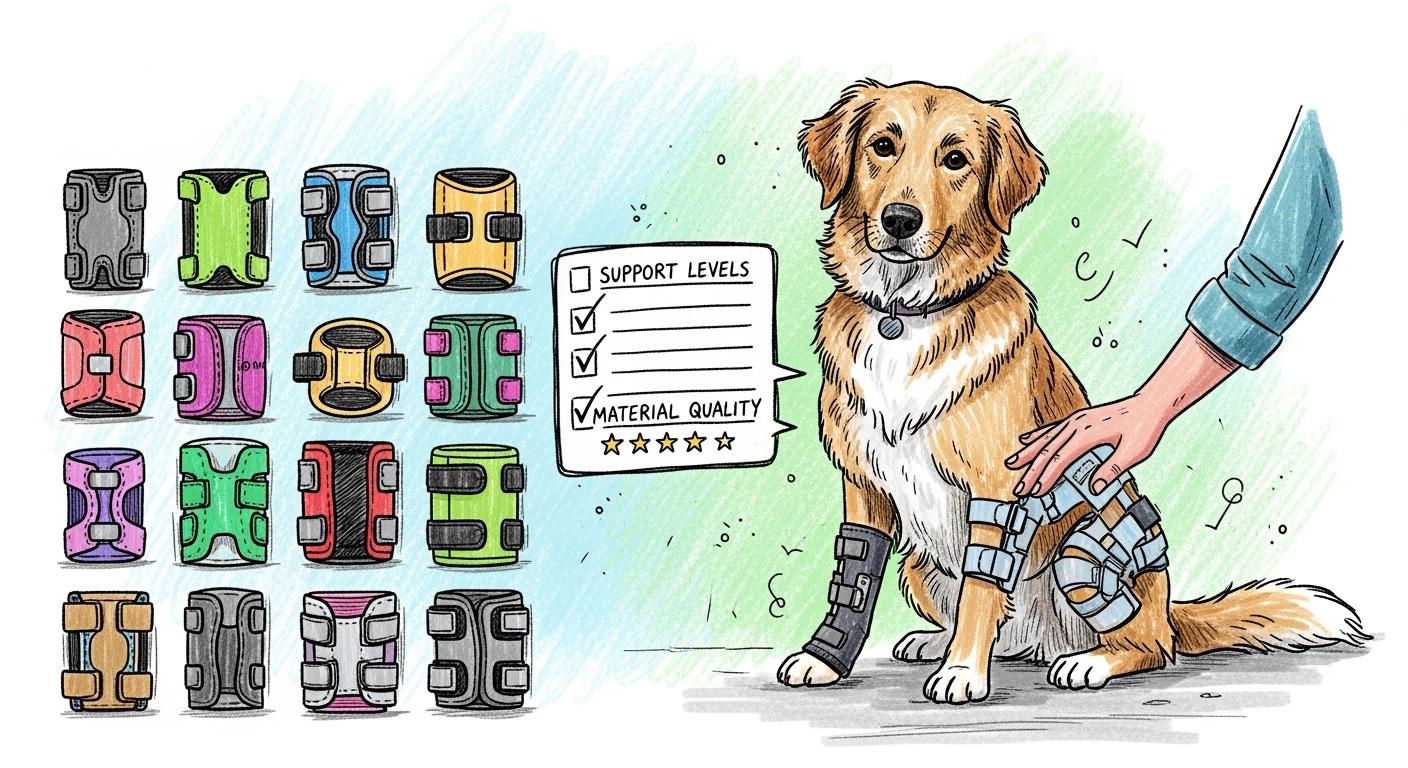
A knee brace does not stabilize a joint by squeezing harder. It stabilizes by keeping force traveling along the joint's natural axis. When the hinge sits half an inch above or below the knee's center of rotation, every step creates a lever arm that twists the joint instead of bracing it. Alignment is what separates a brace that works from one the dog fights.
Material choices and strap configuration then decide whether the dog tolerates that brace for ten minutes or ten hours. These two factors — hinge alignment and interface design — explain most of the gap between a brace that performs and one that ends up in a drawer.
Hinge Alignment — Why It Determines Whether a Brace Stabilizes or Just Squeezes
A dog's knee does not move like a simple door hinge. The stifle joint rolls and glides as it flexes; the instantaneous center of rotation shifts slightly through the range of motion. A brace hinge fixed at a single point cannot perfectly replicate this. But it can come close — and how close it gets determines whether the brace transmits force along the joint's natural load path or vectors it sideways.
Here is the chain. The hinge is the brace's mechanical anchor — the point around which all support forces resolve. When that hinge sits aligned with the knee's rotational axis, compressive forces travel straight through the femoral condyles into the tibial plateau. The joint surfaces share the load the way they were built to. The surrounding soft tissue — what remains of the CCL, the collateral ligaments, the joint capsule — absorbs only its normal share. The dog loads the leg more willingly because the feedback feels familiar.
Now shift that hinge a half-inch proximal. The same step now creates an eccentric load. The femur gets pushed slightly forward relative to the tibia on each weight-bearing moment — exactly the tibial thrust the damaged CCL is supposed to resist. The brace is not just failing to help; it is adding a small but repetitive anterior shear with every stride. The dog shortens its stance phase on that leg. Muscles fatigue faster. The owner notices the brace "isn't working" — but the problem was never the tightness of the straps.
An aligned hinge turns the brace into a mechanical checkrein. An offset hinge turns it into a nuisance. That is not a metaphor. It is the difference between force traveling straight and force traveling at an angle.
Check this yourself. Put the brace on the dog, walk for ten minutes on flat ground, then stop and look at the hinge from the side. The hinge center should still sit directly over the bony prominence on the outside of the knee — the fibular head. If it has drifted upward or downward by more than a quarter-inch, the alignment is off, and the brace is working against the joint rather than with it.
This is why the hinge design on a knee brace built for daily support matters more than how many straps it has. A single well-aligned hinge brace outperforms a double-hinge brace with poor axis matching every time. The number of mechanical features is not the scorecard. Force path quality is.
What Strap Width and Liner Material Decide About All-Day Wear
If hinge alignment controls joint-level forces, strap width and liner material control skin-level forces. Both matter. A perfectly aligned hinge is useless if the dog chews the brace off after twenty minutes because the skin underneath is hot and irritated.
Strap width determines pressure distribution in a straightforward way: pressure equals force divided by area. A half-inch strap cinched tight concentrates the brace's stabilizing force onto a narrow band of skin. That band experiences high unit pressure — enough to compress capillaries, trap heat, and create a hot spot within the first hour. A one-and-a-half-inch strap spreads the same force across three times the surface area. Unit pressure drops proportionally. Capillaries stay open. Heat dissipates instead of accumulating under the strap edge.
This is not about comfort in the soft sense. It is about whether the skin under the strap stays perfused. Unperfused skin under sustained pressure breaks down — first as redness, then as superficial abrasion, then as open sore. A dog that develops a sore under the brace is out of the brace until it heals, which means the knee loses support exactly when consistency matters most.
Liner breathability governs the moisture variable. Neoprene provides compression and thermal retention — useful for joint warmth during rest, less useful during a summer walk. Bamboo-blend liners wick moisture away from the skin surface and resist bacterial colonization in the warm, damp environment a brace creates. The practical test is simple. After twenty minutes of wear, open the brace and touch the skin underneath the liner. Dry skin suggests the liner is managing moisture adequately. Damp or clammy skin means the liner is trapping humidity against the surface — and humidity plus friction equals maceration over repeated wear cycles.
From a manufacturing standpoint, liner attachment method matters as much as liner material. A liner sewn with flatlock stitching sits flush against the leg and avoids ridge lines that concentrate pressure along seam tracks. A liner bonded with adhesive can delaminate at the edges after repeated moisture exposure — the curl creates a raised edge that digs into the skin on every flex cycle. These are not consumer-preference details. They are production decisions that show up on the dog's leg three weeks in.
Between hinge placement (joint-level) and strap-liner design (skin-level), the core engineering of a brace is defined. Everything else — color, branding, accessory pockets — is packaging. When evaluating a brace designed for ACL and CCL support, these two layers of load management determine whether the brace can be worn consistently enough to matter.
| Design Element | Performance Difference | Main Limitation |
|---|---|---|
| Hinge alignment with joint axis | Force travels straight through condyle-to-plateau contact; eccentric shear is minimized; stance phase lengthens naturally | No fixed-pivot hinge can perfectly track the shifting center of rotation through a full stifle range of motion |
| Wide strap (≥1.5 in) | Unit pressure under strap edge stays below capillary occlusion threshold; hot spots develop more slowly or not at all | Wider straps add bulk; may interfere with the opposite leg in narrow-stance breeds |
| Breathable liner (bamboo-blend or moisture-wicking textile) | Skin stays drier across wear cycles; bacterial growth slows; maceration risk drops | Wicking liners are typically thinner than neoprene and provide less compressive warmth |
| Flatlock seam stitching | Seam sits flush against skin; no raised edge to concentrate pressure during flexion | Requires more precise manufacturing tolerance than overlock seams; cost penalty at production scale |
When the Design Performs — and When It Reaches Its Limit
The hinge-and-strap design described above works within a specific window. It performs best when the CCL is partially intact — enough ligament remains to provide some native proprioceptive feedback and passive restraint. The brace then augments what the ligament can still do: it catches the anterior tibial translation the damaged ligament can no longer fully block, and it does so without creating the eccentric shear an offset hinge would add.
This same design also works as post-surgical support, where the goal shifts from restraint to controlled protection. After a TPLO or TTA, the bone has been mechanically stabilized but the soft tissue envelope needs time to adapt. A well-aligned hinge brace limits the range of motion to the safe arc — typically blocking hyperextension while allowing controlled flexion — and the wide straps protect the incision line from direct pressure during early weight-bearing.
For conservative management of partial tears in dogs that are not surgical candidates — older dogs, dogs with comorbidities that raise anesthetic risk — the brace provides the external stability that the degraded ligament can no longer supply internally. It does not heal the tear. Scar tissue may bridge the gap over months, but the brace's job is to keep the joint stable enough that the dog uses the leg, maintains muscle mass, and avoids the downward spiral of disuse atrophy.
Where this design reaches its limit: complete ruptures with gross instability. If the tibia translates forward by more than a few millimeters on every weight-bearing step — the classic cranial drawer sign — a non-custom brace hinge cannot fully restrain that movement. The forces exceed what external straps can transmit through skin and soft tissue without causing skin breakdown at the strap interface. This is a physics problem, not a design flaw. The brace depends on the leg's soft tissue envelope to transmit stabilizing force; when the required force exceeds what skin can tolerate as sustained pressure, the equation breaks.
Other conditions push the fit envelope. Dogs with angular limb deformities — valgus or varus angulation at the stifle — present a leg shape that standard brace shells were not patterned for. The hinge may align at one point in the stance cycle but drift off-axis during swing phase. Very deep-chested breeds with narrow pelvic limbs sometimes lack the soft tissue bulk that wide straps need to anchor without slipping. These are not reasons the design is bad. They are conditions under which the design assumptions no longer hold.
Disclaimer: This hinge-alignment check assumes a short-coated dog where the fibular head is visible and palpable through the skin. Double-coated or heavily muscled breeds may present subtler landmarks; in these dogs, alignment drift may not be visually obvious, and fit should be verified by checking for strap migration and gait changes rather than relying on visual hinge position alone. If the dog's leg conformation falls outside the breed norms this brace shell was patterned for — particularly dogs with angular limb deformities or very deep chests — the fit checks described here may not catch every pressure point.
A well-designed dog brace is not defined by how many conditions it claims to address. It is defined by how honestly its design limits are drawn — and by whether the features it does include are the ones that matter inside those limits.
FAQ
Does hinge type — single-axis vs. polycentric — change how the brace stabilizes the knee?
Yes, and the difference shows up most at the extremes of flexion. A single-axis hinge pivots around one fixed point. It tracks the knee well through mid-range — roughly 30 to 70 degrees of flexion — where the stifle's center of rotation is relatively stable. At deep flexion or full extension, the knee's instant center shifts, and a single-axis hinge begins to create mild shear. A polycentric hinge uses two or more pivot points to approximate this shifting center. The difference is subtle during walking but becomes more relevant during activities that demand end-range motion — sitting, stair-climbing, getting into a vehicle. The tradeoff: polycentric hinges add bulk and complexity. For dogs whose daily movement stays within mid-range, a well-placed single-axis hinge provides most of the benefit with fewer parts that can loosen or wear.
How do you know if the strap tension is right — not too loose, not too tight?
After securing the straps, slide one finger flat between the strap and the dog's skin. You should feel light contact on both sides — the strap against your finger and your finger against the leg — but no compression that makes it difficult to slide the finger through. Then walk the dog for five minutes and re-check. If the brace has shifted more than a quarter-inch in any direction, the straps need repositioning or tightening. If the skin under the strap edges shows deep impression marks that do not fade within thirty seconds of removing the brace, the straps are too tight regardless of how secure the brace felt during the walk.
What changes when a dog wears the brace on two legs instead of one?
Bilateral bracing changes the load path through the entire hind end. Each brace provides unilateral stability, but the dog now loads both hind limbs simultaneously through two external frames. Gait tends to become more upright — less crouched — because neither leg is being favored. The tradeoff is heat and weight: two braces double the surface area covered and the mass the dog carries. Breeds with thin coats and lean builds typically tolerate bilateral bracing better than heavily muscled or thick-coated breeds, where heat buildup under dual liners can become the limiting factor before support quality does. For more on what to expect during brace use, the practical experience of dogs wearing ACL braces across different injury grades offers a clearer picture than specifications alone can provide.
Does the brace material degrade differently in wet conditions?
Neoprene's closed-cell structure resists water absorption through the material body, but the fabric facing bonded to its surface can hold moisture at the skin interface. Bamboo-blend liners wick liquid water away faster than neoprene facings but dry more slowly once saturated — the fibers hold water within their structure rather than releasing it to the surface. For dogs walked in rain or wet grass, the practical difference is that a neoprene brace feels damp against the skin sooner, while a bamboo-lined brace stays comfortable through light moisture but takes longer to fully dry between uses. Neither material performs well when submerged or saturated. If a brace gets soaked through, removing it and allowing it to dry completely before reapplication prevents the fungal and bacterial conditions that sustained moisture encourages in any enclosed skin environment.
0 Comments