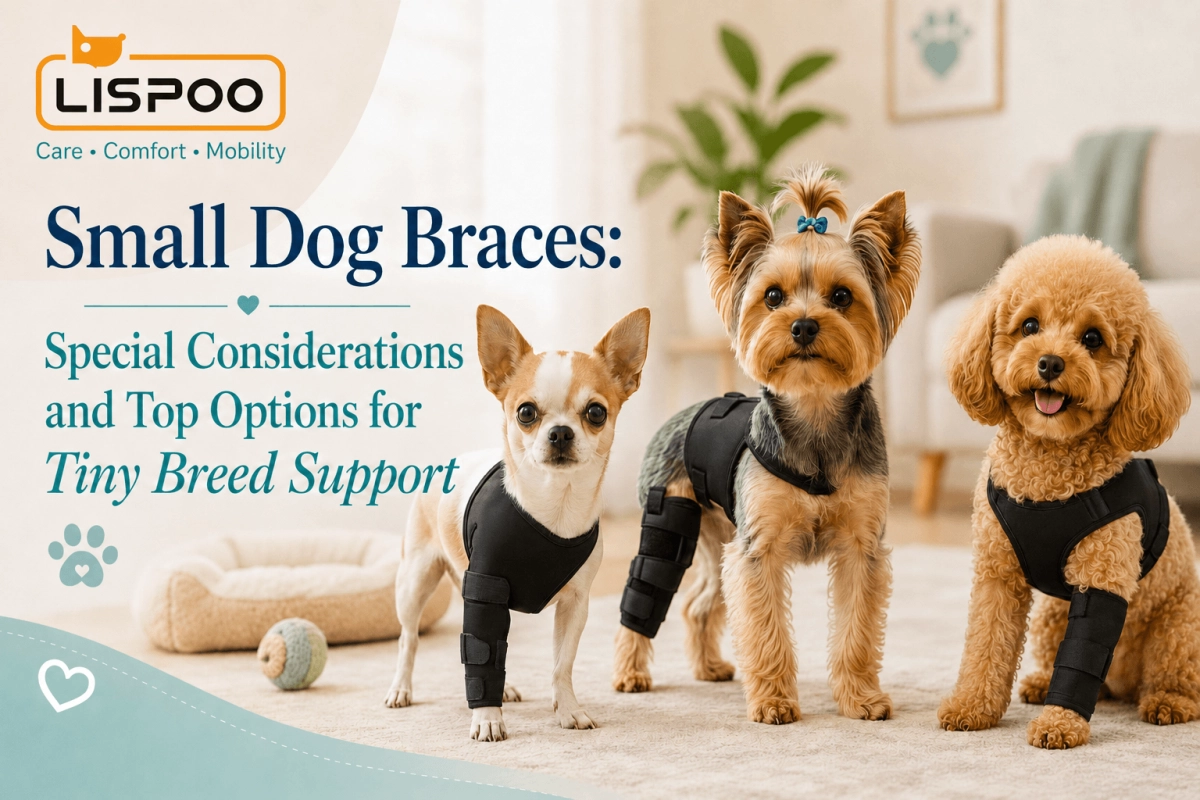
A small dog brace that slips, rotates, or makes the dog move differently than without it has already failed. On a narrow small-breed leg, the margin between support and interference is measured in millimeters. The common assumption is that tighter straps fix everything. They do not. What keeps a brace functional on a Chihuahua or Yorkshire Terrier is not how hard you cinch it down. It is whether the hinge axis lines up with the joint axis underneath, and whether the brace itself weighs little enough that the dog does not alter its gait to compensate.
This is about the physics between the brace and the leg, not about brand comparisons or shopping checklists.
What Actually Keeps a Brace Stable on a Narrow Leg
Joint-Axis Alignment vs. Strap Tension
Strap tension creates friction. Friction resists sliding. That sounds like stability. But friction alone cannot prevent rotation around the joint axis, and rotation is the failure mode that actually matters.
Here is the causal chain. A knee brace has a hinge. That hinge is designed to pivot around a single axis. The dog's stifle joint also pivots around an axis — the femoral condyles. When those two axes are aligned within a few millimeters, the brace hinge and the dog's joint move in the same plane. Force travels along the joint's natural axis. The brace tracks with the leg through flexion and extension. The straps only need to prevent the brace from migrating up or down the limb — a light job.
When the hinge sits even a quarter-inch off the joint line, every step creates a torque. The hinge wants to pivot around its own axis. The joint wants to pivot around a different one. The mismatch forces the brace to rotate around the leg. The dog feels this as resistance. It alters its stride to avoid the conflict. The owner tightens the straps to fight the rotation. That adds pressure without solving the alignment problem. The brace is now tighter and still rotating.
For small breeds, this alignment window shrinks with leg circumference. A 3-inch-circumference leg leaves almost no room for hinge positioning error before torque appears. General-purpose dog braces built around average leg dimensions rarely hold this tolerance on very small limbs. The design features that matter most are hinge adjustability, strap path geometry that does not drift under motion, and shell contours scaled to the shorter bone lengths of small breeds. For knee-specific support where stifle alignment drives most of the outcome, the design priorities on knee brace hinge placement and strap configuration become even more critical.
To separate an alignment problem from a tension problem, try this: loosen each strap by one notch from your normal setting, then walk the dog for five minutes. If rotation worsens sharply, alignment or contour is the root issue — the straps were masking a geometry mismatch. If rotation stays roughly the same, the straps were overtightened and the shell was already holding position on its own.
Width, Contour, and the Problem of Spiral Slip
Wider straps spread force over more surface area. That reduces pressure points. But on a leg that is only a few inches long, a wide strap eats up valuable real estate between the joint above and the joint below. If the strap sits too close to the hock or the elbow, it catches during flexion and either restricts range or slides toward the joint. Narrower straps with targeted padding under the load-bearing edge can distribute force adequately without occupying space the joint needs.
The shell or sleeve contour matters equally. A brace with a straight internal profile on a curved leg creates contact gaps. Those gaps become rotation paths — the brace finds the path of least resistance and turns. A contoured shell that matches the taper from thigh to calf resists rotation mechanically, not through strap friction. The design win is not "more straps." It is a shape that wants to sit in one orientation.
Tip: On a small-breed leg, shell contour does the work that extra straps do on a large-breed leg. Weight and bulk are saved by letting geometry replace tension.
Material Weight and What It Does to a Small Dog's Movement
Why Brace Weight Hits Small Dogs Harder
A brace that weighs 4 ounces is a non-issue on a 70-pound Labrador. On a 7-pound Toy Poodle, those same 4 ounces represent roughly 3.6% of body weight strapped to one leg. The dog must swing that extra mass with every step. Over hundreds of steps, the hip flexors and quadriceps fatigue. Gait compensations appear: shorter stride on the braced side, more hip hike, less knee flexion. The brace was meant to support the joint, but its weight is now changing how the joint moves.
Muscle mass scales with body size, but not linearly. Small breeds carry proportionally less muscle mass per pound of body weight in their limbs compared to large breeds. A given brace weight therefore demands a higher percentage of available muscle output. The dog adapts by recruiting muscles differently. Over weeks, that adaptation can create secondary strain in the opposite leg or in the lower back. The design priority is not just "lighter materials." It is a weight budget calculated against the dog's limb muscle capacity, not its total body weight.
Material Choices That Reduce the Weight Penalty
Neoprene at 2–3mm thickness provides compression and light structural support at roughly 30–40% less weight than the 5mm neoprene common in braces built for larger dogs. Flexible mesh panels replace solid fabric in non-load-bearing zones, cutting additional grams without reducing joint coverage. Spacer mesh used as a liner rather than as the primary structural layer adds breathability without adding structural mass.
The trade-off is durability. Thinner materials abrade faster. A brace built to a tight weight budget may need replacement sooner than a heavier one. For a dog that wears the brace daily for months, that trade-off may be acceptable — the gait preservation from lower weight outweighs the replacement interval. For a dog wearing the brace only during walks, the heavier more durable option may be fine because weight matters less in short bursts. Neither choice is wrong. The design thinking is about matching the weight budget to the usage pattern.
| Material | Weight Profile | Main Limitation | Where It Works |
|---|---|---|---|
| 2–3mm neoprene | Light, flexible compression | Less structural support than thicker neoprene; shorter lifespan under daily use | Mild instability, daily wear on dogs under 15 lb |
| Flexible mesh with foam padding | Very light, high breathability | Minimal torsional resistance; not for dogs that need rigid joint control | Warm climates, dogs prone to overheating, mild support needs |
| Nylon blend shell with spacer-mesh liner | Moderate weight, good durability | Heavier than pure mesh options; liner can compress and lose loft | Active dogs, moderate instability, brace worn mainly during activity |
Note: Brace weight should be evaluated as a percentage of the dog's limb muscle capacity, not as an absolute number. A 3-ounce brace can be too heavy for one 8-pound dog and fine for another, depending on muscle condition and activity level.
Fit Checks That Catch Rotation Before the Dog Compensates
Two Tests That Reveal Fit Problems Early
A brace can look centered and still rotate under load. Visual inspection while the dog stands still misses the failure mode because rotation happens during movement, not at rest. Two checks catch the problem before the dog starts altering its gait.
First, the 10-minute walk check. Put the brace on. Walk the dog on a flat surface for 10 minutes at its normal pace. Stop. Look at the brace without adjusting anything. Is the hinge still centered over the joint line, or has it drifted? Has the top edge rotated inward or outward relative to where it started? Mark the starting position with a small piece of tape on the brace edge so you have a reference point. If the hinge has moved more than a half-inch off the joint, the alignment was wrong or the shell contour does not match the leg. Tighter straps will not fix this.
Second, the post-removal skin check. Remove the brace after a wearing session. Run a finger along the leg where each strap edge and shell edge sat. Feel for heat — a warm line means sustained pressure. Look for a defined red line that does not fade within 5 minutes. A line that fades quickly is normal contact. A line that persists means the edge is digging in, and that spot will break down with repeated wear. On short-coated dogs this is visual. On double-coated breeds, part the fur and check the skin directly — visual-only checking misses pressure marks hidden under undercoat.
| Check | Pass Signal | Fail Signal | Action If Failed |
|---|---|---|---|
| 10-minute walk | Hinge stays within 1/2 inch of joint line; top edge has not rotated | Hinge drifts off joint; brace rotates visibly; dog shortens stride on braced leg | Recheck hinge placement; try a different shell contour; do not compensate with strap tension |
| Post-removal skin | No lasting marks; skin temperature even across leg; no fur breakage at edges | Red line persists beyond 5 min; warm line at strap edge; broken fur or abrasion | Reduce strap tension first; if red line remains, add edge padding or change brace profile |
In practice: Small dogs with very short coats show pressure marks faster than coated breeds. On a smooth-coated Chihuahua, a fit problem is visible within one session. On a long-haired Yorkie, the same problem may be hidden until the skin is already irritated. Hand-check, do not rely on sight alone for coated breeds.
Getting Measurements That Match the Brace Sizing
Sizing charts assume a cylindrical leg of uniform taper. Real small-breed legs are not cylinders. The thigh circumference on a Toy Poodle may be 5 inches at the top and 3.5 inches just above the stifle — a 30% taper over a short span. A brace sized to the thigh measurement may gap at the lower edge. A brace sized to the lower measurement may be too tight at the top. The measurement that matters most is the circumference at the joint line itself, because that is where the hinge must track. Secondary measurements at the thigh and lower leg confirm whether the taper falls within the brace's contour range.
Measure with the dog standing, weight evenly distributed. A soft tailor's tape avoids compression errors. Measure three times and use the middle value. If the dog's leg tapers more than 25% over the brace's coverage zone, off-the-shelf sizing may not accommodate the shape regardless of measurement accuracy. Patella support braces designed for the shorter bone lengths and steeper tapers of small breeds address this fit challenge more directly than braces scaled down from large-dog designs. For a broader look at how brace sizing interacts with small-breed leg geometry and joint conditions, the comparison of knee brace designs for small breeds and senior dogs walks through the fit variables that separate braces that stay put from those that do not.
When a Small Dog Brace Works and When It Does Not
Conditions Where Bracing Makes Sense
A brace supports a joint by restricting motion in a specific direction while allowing motion in others. That mechanical description defines its useful range. Medial patellar luxation, common in small breeds, involves the kneecap slipping medially out of its groove. A brace that resists medial displacement while permitting flexion and extension addresses the specific mechanical failure. Mild to moderate joint instability where ligaments are stretched but not fully ruptured benefits from external support that reduces the load on the compromised tissue. Post-injury activity management — keeping a recovering joint within a safe range of motion during gradual return to activity — is another scenario where a brace adds mechanical value.
Where Bracing Hits Its Limits
A brace cannot reconstruct a fully torn ligament. A complete CCL rupture leaves the joint with no internal stabilizer; a brace can limit extreme motion but cannot restore the structural connection that surgery repairs. Severe angular limb deformities create leg shapes that no off-the-shelf brace contour can follow — the contact gaps are too large and the rotation forces too high. Open wounds, active skin infections, or areas with significant swelling that changes shape throughout the day defeat the fit consistency that a brace depends on.
Dogs that will not tolerate any external device despite gradual conditioning are not candidates regardless of how well the brace is designed. A brace left in a corner is not providing support. The design does not fail in these cases — the use condition does.
Disclaimer: The fit checks described here assume a dog with breed-typical leg conformation. Dogs with angular limb deformities, very deep chests that alter weight distribution through the forelimbs, or significant muscle atrophy on one side may show fit failure patterns that the standard checks miss. If the leg shape falls outside breed norms, a custom-contoured brace evaluated by a veterinarian familiar with orthopedic bracing is the safer path than off-the-shelf sizing.
Daily Monitoring Without Overcorrecting
Check brace position before and after each use session. A shift of less than a quarter-inch that does not worsen over days is usually acceptable — the brace is settling, not failing. A shift that grows session over session means the contour or sizing is wrong. Skin checks matter, but do not reflexively loosen straps for every pink mark. A mark that fades in under 5 minutes is normal tissue response to compression. A mark that persists, darkens, or feels hot is a pressure injury in progress. The distinction is time. Fading = contact. Persisting = damage.
Watch the dog's willingness to move. A dog that was active and becomes hesitant is communicating that something changed. It might be the brace. It might be the underlying condition progressing. Either way, the brace is now part of a system that is not working, and the response is to reassess, not to push through.
FAQ
How tight should the straps be on a small dog brace?
Tight enough that the brace does not migrate during a 10-minute walk. Not tighter. You should be able to slide one fingertip under each strap without forcing it. If you cannot, the strap is compressing soft tissue, not just holding position. Strap tension is a secondary stabilizer — if you find yourself needing more and more tension to prevent rotation, the primary problem is hinge alignment or shell contour, not strap tightness.
Can a small dog wear a brace all day?
Most small dogs should not wear a brace continuously without removal and skin checks. Start with 30-minute sessions. If skin checks are clean, extend to 1–2 hours. Remove the brace at least every 4–6 hours during extended use to let the skin breathe and to check for developing pressure points. Overnight wear is generally not recommended unless specifically directed for post-surgical immobilization, because the dog cannot signal discomfort while sleeping.
What material holds up best for a small dog that is active outdoors?
Nylon blend outer shells with a smooth interior liner resist abrasion from grass, dirt, and pavement better than pure neoprene, which can snag and tear on rough surfaces. The trade-off is weight — nylon blends are heavier. For a dog under 10 pounds that runs through brush, a lightweight mesh brace that gets replaced more often may preserve gait better than a heavy-duty brace the dog struggles to swing. Match the material to the dog's weight first, then to the terrain.
Why does the brace keep rotating even after adjusting the straps?
Persistent rotation despite strap adjustment means the hinge axis is misaligned with the joint axis, or the shell contour does not match the leg's taper. Adding strap tension fights the symptom, not the cause. Check whether the hinge sits directly over the joint line when the dog stands. If it does, the problem is likely the shell contour — the brace does not have enough contact area on the tapered section of the leg to resist rotation. A different brace profile is the fix, not tighter straps.
0 Comments