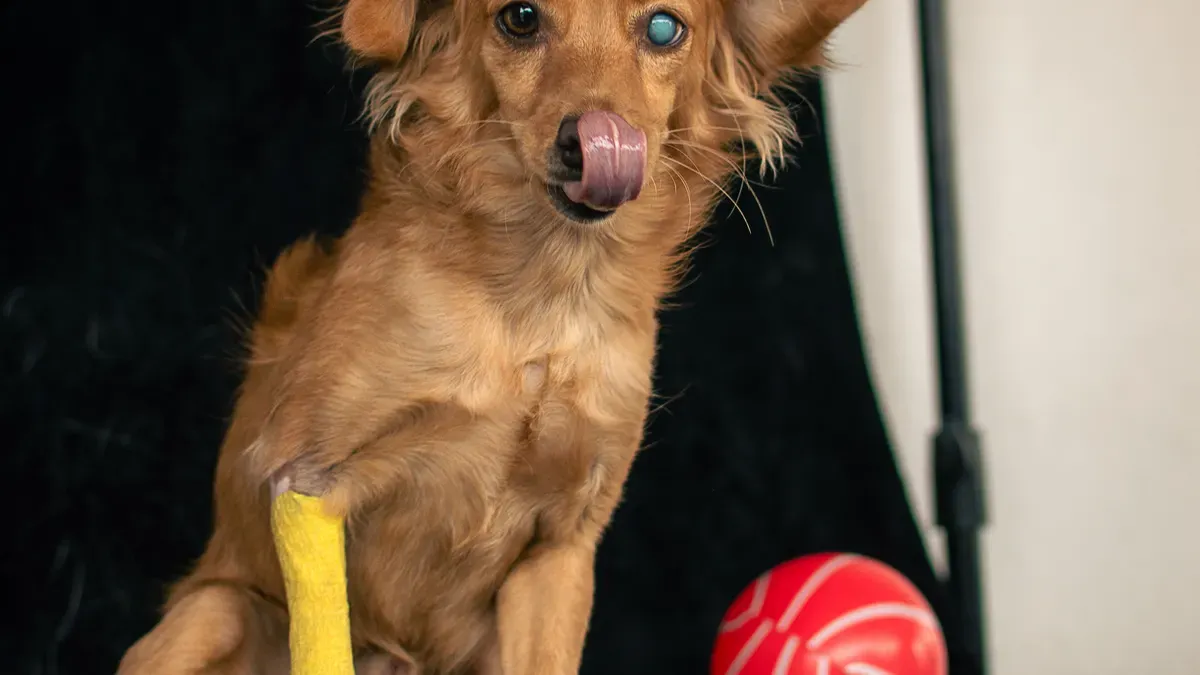
A front leg splint either stabilizes the joint or it wraps the leg. The difference comes down to two design decisions: where the hinge sits relative to the joint axis, and how the straps spread force across the limb. Neither has much to do with how tight the splint feels.
Joint Alignment — Why Hinge Position Determines Whether the Splint Stabilizes
When a front leg splint includes a hinge — at the elbow or the carpus — that hinge must pivot along the same axis as the joint it supports. This is not a preference. It is a mechanical requirement.
A hinge aligned with the joint axis lets the limb flex and extend along its natural arc. Force travels in a straight line through the bone column — from the humerus through the radius and ulna to the paw — without introducing a bending moment at the joint. The joint surfaces stay evenly loaded because the splint does not ask the joint to deviate from its anatomical motion path. The dog walks with a gait closer to normal, and the splint stays in place because it moves with the limb rather than fighting it. That is the physics of it.
Shift that hinge half an inch above or below the joint line, and the mechanics reverse. The splint forces the joint to pivot around a point it was not built to pivot around. Joint surfaces load unevenly — one side compresses, the other gaps. Muscles around the elbow or wrist tense against the unnatural arc. That tension pulls the splint out of position. The dog adjusts its gait to compensate. The splint migrates further. It becomes a cycle.
This is why dog elbow brace hinge placement matters more than how firmly the straps are cinched — and the same principle applies to a dog wrist brace supporting a hyperextended carpus. In both cases, alignment determines whether the splint stabilizes or merely wraps. For dogs with carpal hyperextension, the hinge axis must match the natural flexion point of the wrist — a mismatch here lets the joint collapse into extension even while the splint is on.
In practice: After 10 minutes of walking, look at the splint from the side. The hinge pivot should still sit directly over the joint line. If it has drifted up the humerus or down toward the paw, the alignment is failing — and no amount of strap tightening will fix it. The splint needs repositioning, not more tension.
Strap Width and Anchor Placement — How Force Distribution Shapes Daily Wear
Straps do two jobs at once: they anchor the splint to the limb, and they transmit force from the splint shell into the leg. The width of each strap and where it sits on the limb determine whether that force spreads across muscle or concentrates on a narrow band of skin and underlying tissue.
A wide strap — roughly two inches or more on a medium-to-large dog — spreads lateral force across a larger surface area. Pressure per square inch drops. Blood flow under the strap stays closer to normal, skin tolerates longer wear, and the splint does not slowly dig a groove into the leg. Narrow straps concentrate the same anchoring force onto a smaller strip of tissue. The result: red lines that deepen over hours, hot spots where the strap edge bites, and a dog that starts licking or chewing at the brace within the first wear session.
Anchor placement matters equally. Straps positioned above and below the joint — on the muscle bellies of the upper forelimb and the lower forearm — create a stable two-point lock that resists rotation around the limb's long axis. A single wide band wrapped directly over the joint provides none of that rotational resistance. The splint twists with every step, the hinge drifts out of alignment, and the support becomes inconsistent.
The design principle is straightforward: multi-point wide-strap anchoring keeps the splint oriented to the joint axis. Single-point or narrow-strap configurations let it wander. Front leg braces that use at least two wide anchor straps — one proximal, one distal to the joint — maintain alignment through a full walk cycle better than designs that rely on a single mid-joint wrap.
| Strap Design Feature | Performance Difference | Main Limitation |
|---|---|---|
| Wide strap (2 in+) over muscle belly | Force spread across larger area; lower pressure per square inch; less skin irritation over hours of wear | May not conform as closely to very narrow forelimbs in toy breeds |
| Narrow strap over bony prominence | Concentrates anchoring force on a small contact patch; higher risk of pressure points and strap migration | Easier to manufacture; lower material cost |
| Two-point anchor (above and below joint) | Resists rotational drift; keeps hinge aligned to joint axis through gait cycle | Requires accurate measurement of two separate anchor circumferences |
| Single mid-joint wrap | Simpler to apply; fewer adjustment points | No rotational resistance; splint twists with each step; hinge alignment degrades rapidly |
Remove the splint after 20 minutes of walking and run your fingers along the skin where the straps sat. Warm, slightly indented skin that rebounds within a minute is normal. Red lines that stay visible after two minutes signal pressure concentration — the strap is too narrow for the load it carries, or it sits over a bony point rather than muscle. Skin that feels cold or looks pale indicates the strap is restricting circulation and needs immediate loosening.
When a Front Leg Splint Fits the Problem — and When It Does Not
A well-designed front leg splint works within a specific mechanical envelope. Knowing where that envelope ends is as important as knowing what is inside it.
Where Joint-Aligned Splinting Works
Front leg splints with hinge alignment and multi-point strap anchoring perform best for carpal hyperextension — where the wrist collapses downward under weight and needs controlled range-of-motion limitation rather than full immobilization. They also suit elbow instability during low-to-moderate activity, where the goal is to prevent the joint from reaching the extremes of its motion arc while still allowing the muscle engagement that maintains limb strength.
For chronic conditions like arthritis in the carpus or elbow, a splint that maintains joint warmth and limits end-range loading can reduce the mechanical stress that flares inflammation — not by treating the arthritis itself, but by changing the loading pattern the joint experiences during daily movement.
Where the Envelope Closes
A front leg splint is not a substitute for rigid fixation. Complete fractures that require absolute immobility for bone healing need casting or surgical stabilization — a hinged splint allows too much motion. Dogs with extreme angular limb deformities, where the joint axis itself deviates significantly from the anatomical norm, may not achieve hinge alignment with a standard splint shell. The hinge will force the joint to track an arc it cannot follow. Deep-chested breeds with very narrow forelimb profiles can present a different challenge — the proximal anchor strap may land on a part of the limb too narrow to seat a wide strap without slippage.
Disclaimer: The fit checks described here assume a short-coated dog where pressure marks are visually detectable. Double-coated breeds may show subtler rub marks that need hand-checking rather than visual inspection — run fingertips under the coat to feel for warmth or indentation at strap lines. If a dog's leg conformation falls outside the breed norms the splint was patterned for — particularly dogs with angular limb deformities or very deep chests — standard fit checks may not catch every pressure point. Adjust the splint position and check more frequently under these conditions.
What Daily Use Reveals About Material and Liner Quality
Design features that look good on a product page reveal their actual performance only after hours of wear. Three material properties matter most once the splint is on the dog.
Liner breathability. A closed-cell foam liner traps heat and moisture against the skin — within 20 to 30 minutes, the leg inside feels damp. Damp skin softens and becomes more vulnerable to friction damage. An open-cell or mesh-lined splint allows moisture to escape and air to circulate. The test is simple: wear the splint for half an hour, remove it, press a dry paper towel against the inner liner. A wet spot on the towel means the liner is holding moisture against the skin. A dry towel means ventilation is working.
Padding compression set. Padding that compresses and stays compressed — a high compression set — loses thickness after repeated wear. A liner that started at 5 mm can become 2 mm in the high-pressure zones within days. That lost thickness changes the fit: the splint shell sits looser, the hinge drifts, and the straps must be tightened further to compensate — which then concentrates more pressure on less padding. A low-compression-set liner rebounds to near its original thickness between wears and maintains consistent shell-to-limb spacing over weeks.
Shell material. Rigid plastic shells provide the most structural resistance to hyperextension but transfer more ground-impact force up the limb. Semi-rigid composites flex slightly under load, absorbing some shock before it reaches the joint — useful for dogs that still bear weight during walks. Neither material is universally better. The choice turns on whether the primary need is rigid hyperextension blocking or impact attenuation during active weight-bearing.
| Material Choice | Performance Difference | Main Limitation |
|---|---|---|
| Open-cell or mesh liner | Moisture escapes; skin stays drier over hours; friction damage risk drops | Less initial cushioning feel than thick closed-cell foam |
| Closed-cell foam liner | Plush initial feel; conforms closely to limb contour | Traps heat and moisture; compression set degrades fit within days to weeks |
| Rigid plastic shell | Maximum hyperextension resistance; maintains structural shape under load | Transmits more ground-impact force; less forgiving on hard surfaces |
| Semi-rigid composite shell | Flexes to absorb some impact; gentler during active weight-bearing walks | Less absolute extension blocking; may not suffice for severe carpal collapse |
Fit signals also emerge during wear. A splint that stays in its original position through a 20-minute walk — hinge still on the joint line, straps unmoved — is sized and strapped correctly. One that rides down the leg within minutes, or twists so the hinge rotates to the side of the limb, signals an anchor failure: either the strap width is insufficient to resist migration, or the anchor point lands on a tapered section of the leg that cannot hold position. A dog brace that fits correctly does not need to be tightened repeatedly during a single wear session — if straps keep loosening, the underlying anchor geometry is the problem, not the tension setting.
FAQ
What makes a front leg splint stay in place during a walk?
Two things. First, hinge alignment with the joint axis — when the splint pivots along the same line the joint naturally follows, it moves with the limb instead of against it. Second, multi-point wide-strap anchoring — straps above and below the joint lock the splint's orientation and resist the rotational force that every step generates. A splint held by a single mid-joint wrap twists with each stride regardless of how tight that wrap is.
Does a stiffer splint shell always mean better support?
Not always. A rigid shell blocks hyperextension most effectively, which is what a collapsed carpus needs. But that same rigidity transfers more ground-impact shock up the bone column — on hard surfaces, a semi-rigid shell that flexes slightly may keep the dog more comfortable during active walks. The tradeoff is between absolute extension blocking and impact comfort. The right choice depends on whether the dog is bearing weight through the leg or keeping it elevated.
How can I tell if the liner is causing skin problems under the fur?
Remove the splint after 30 minutes of wear. Press the back of your hand against the inner liner — if it feels damp, moisture is trapped. Run your fingertips through the fur against the grain along the strap lines and joint area. You are checking for persistent warmth, a tacky feel to the skin, or raised bumps that were not there before the splint went on. On double-coated breeds, separate the fur to inspect the skin directly rather than relying on what is visible at the surface. Any of these signals means the liner is not managing moisture well enough for the wear duration — shorten sessions or switch to a more breathable liner material.
0 Comments