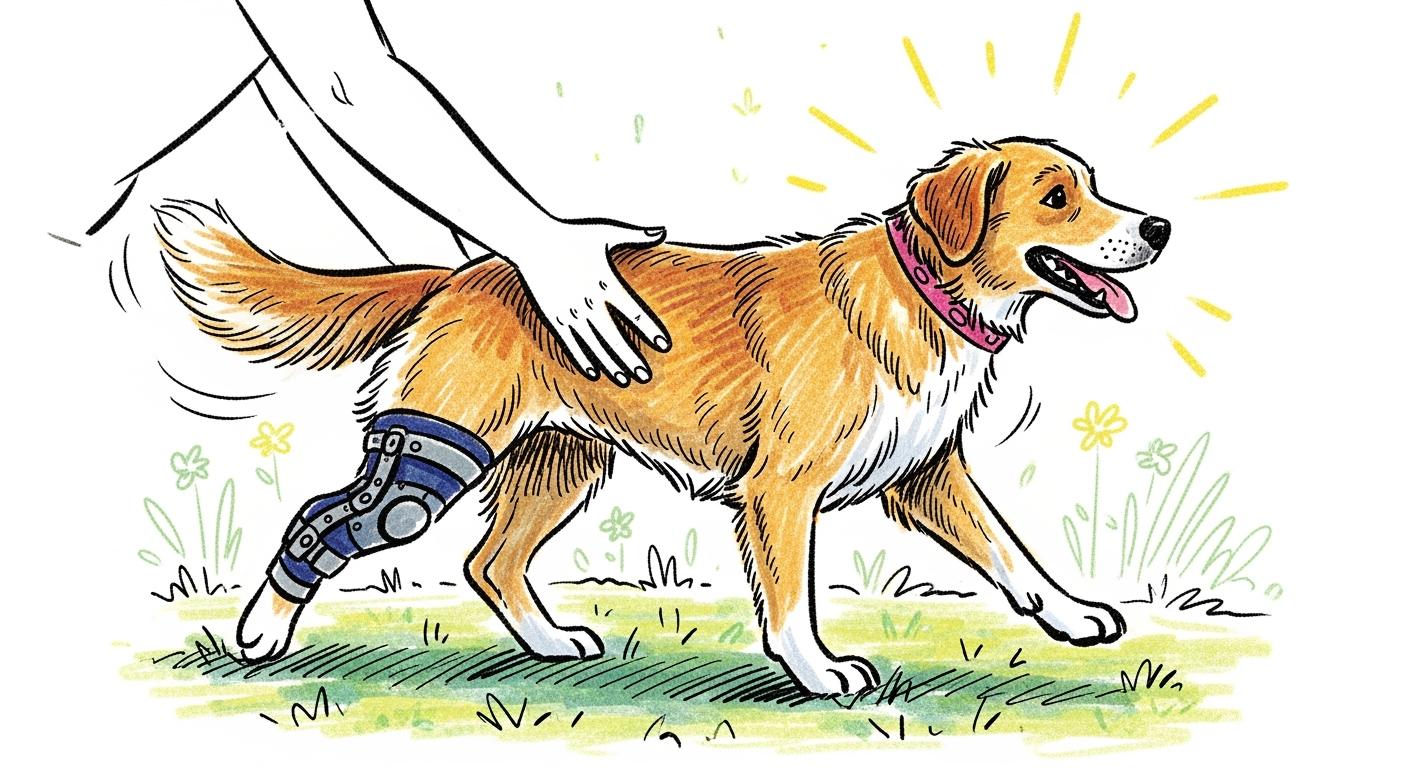
A knee brace for a dog stabilizes the stifle joint by controlling how much the tibia shifts forward during weight-bearing. That is the mechanical job. Whether a given brace actually does it comes down to two design details that are easy to overlook: where the hinge sits relative to the joint axis, and how the straps distribute force across the leg. Get either one wrong and the brace becomes an expensive sleeve.
This article walks through those design differences — not which brand to pick, but what to look for in the structure itself and why those details change how a brace performs during real daily use.
Hinge Alignment — Why It Decides Whether a Knee Brace Stabilizes or Just Wraps
A sleeve wraps. A brace controls. The difference is the hinge.
In a dog's stifle joint, the femur and tibia rotate around a shared axis — an invisible line running through the joint center, side to side. When a knee brace for a dog places its hinge directly over that axis, the mechanical connection is clean: as the dog walks, the hinge pivots in sync with the joint, and the rigid side bars channel force along the natural load path of the leg. Joint surfaces are loaded evenly. The tibia is blocked from sliding forward under body weight. The dog moves with something close to its natural gait, which matters because a dog that moves naturally tends to keep wearing the brace — and a brace that stays on through a full walk is the only kind that does any work.
Move that hinge half an inch forward or back, and the load path bends. The brace fights the joint's natural motion instead of guiding it. The dog compensates by shifting weight to the other leg, which is exactly what the brace is supposed to prevent. Over hours of wear, a misaligned hinge creates a torque at the skin interface — the brace twists against the leg with every step. That torque translates to rubbing, hot spots, and a dog that tries to chew the brace off.
This is why the hinged-versus-non-hinged distinction is not about "more features vs. fewer." It is about whether the brace has a directional control mechanism at all. A non-hinged sleeve provides compression — which can help with swelling — but compression alone does not block tibial translation. It cannot. There is no rigid element to arrest forward shear.
| Design Feature | Hinged Brace | Non-Hinged Sleeve |
|---|---|---|
| Joint-axis control | Blocks tibial thrust through rigid side bars aligned to the joint | Provides circumferential compression only — no directional shear resistance |
| Movement pattern | Guides flexion and extension within a controlled range | Does not differentiate between natural and harmful motion |
| Main limitation | Hinge positioning is sensitive — a sizing error shifts the pivot point off-axis | Cannot arrest the drawer motion that defines CCL insufficiency |
| Where it works | Partial tears, post-surgical protected loading, arthritic instability | Mild soft-tissue support, post-exercise compression, short-term use |
In practice: After 15 minutes of leash walking, check whether the hinge pivot still centers on the bony prominence at the side of the stifle. If it has drifted up toward the thigh or down toward the shank, the hinge is off-axis — and the brace is working against the joint rather than with it.
Strap Configuration — Force Distribution vs. Force Concentration
Tighter is not better. That is the single most counterintuitive fact about how a knee brace for a dog holds position.
A strap cinched tight over a narrow band of contact concentrates body-weight forces into a small area. Pressure per square inch climbs fast. Beneath that strap, soft tissue compresses, circulation slows, and within 20 to 30 minutes the skin signals discomfort — the dog licks, chews, or simply refuses to move. Meanwhile, the narrow contact patch has low surface friction, so the strap begins to migrate with each stride. The result is a brace that is simultaneously too tight and too loose: tight enough to irritate, loose enough to shift.
Wide straps with a multi-point anchor system invert this problem. By spreading the same force across three to four times the surface area, pressure per square inch drops proportionally — the skin and underlying muscle tolerate hours of contact instead of minutes. Multiple anchor points create a cage geometry: the brace is held in position from above and below the joint, not just at one circumferential ring. That cage resists migration in both directions — up the thigh and down the shank — without requiring high strap tension.
An ACL brace for dogs with a two-strap system above the stifle and one below creates this cage by triangulating the brace body against the leg's taper. The thigh strap anchors upward. The calf strap anchors downward. The middle strap sets rotation. No single strap carries enough tension to create a pressure point, and the geometry means gravity and motion cannot walk the brace down the leg.
In practice: After 10 minutes of walking, check each strap's position against the fur line or a small marker line drawn on the strap edge. A well-configured strap system will not have drifted more than half an inch from its starting position. If one strap has moved significantly more than the others, that strap's anchor point is bearing disproportionate load — widen the contact surface or adjust the adjacent strap to share the load.
When a Knee Brace Helps — and When It Does Not
A knee brace for a dog is a mechanical stabilizer. It controls joint motion. That is the full scope of what it does — and understanding that scope is what separates effective use from disappointment.
The brace performs best in conditions where joint instability is the primary problem: partial CCL tears where some ligament function remains, arthritis-related laxity where the joint capsule has loosened over time, and post-surgical recovery where controlled-range motion protects a healing repair. In each case, the mechanical problem is unwanted joint translation, and the brace provides a mechanical answer — a rigid external constraint that substitutes for the internal constraint the joint has lost.
It does not perform well where the primary problem is not mechanical instability. A complete CCL rupture with gross joint laxity exceeds what a brace can constrain — there is effectively no internal restraint left, and the forces transmitted through the brace arms exceed what external straps can anchor against skin and soft tissue. Neurological gait deficits — knuckling, proprioceptive loss, uncoordinated placement — are not joint-stability problems and a brace does nothing to address the nerve signaling that causes them. Angular limb deformities create joint geometry that falls outside the sizing range a standard brace is patterned for; the hinge will be off-axis regardless of adjustment.
Design limitations worth knowing before fitting:
- A brace does not regenerate ligament tissue or cartilage. It controls motion while the body's own repair processes run their course — or do not.
- Muscle atrophy can accelerate if the brace is worn continuously without structured off-brace exercise. The external support removes some of the load that maintains muscle mass.
- A brace that fits a 60-pound Labrador at week one of recovery may fit differently at week six — swelling subsides, muscle mass redistributes, and the leg's contour changes.
Disclaimer: If the dog's leg conformation falls outside the breed norms this brace was patterned for — particularly dogs with angular limb deformities or very deep chests — the fit checks described here may not catch every pressure point. In those cases, hand-check the skin beneath each strap edge after the first 15-minute wear session rather than relying on visual inspection alone.
Disclaimer: The rub-check method described above — running a finger under each strap edge after wear — assumes a short-coated dog where skin contact is directly visible. Double-coated breeds hide early friction marks beneath the undercoat. For these dogs, check for localized warmth rather than redness; a hot spot under a strap that otherwise looks fine is an early pressure signal.
Liner Materials and Daily Wear — What Keeps a Brace in Position Through Motion
The hinge and straps do the structural work. The liner does the endurance work. A brace that slips after 20 minutes is not a hinge failure — it is a liner failure.
Liner material choice affects brace performance through two mechanisms: moisture management and surface friction. A liner that absorbs sweat and holds it against the skin creates a slick interface within half an hour — the brace slides, strap tension changes, and the carefully positioned hinge drifts off-axis. A liner that wicks moisture outward and maintains a dry contact surface preserves the original strap tension and hinge position across a full walk. The performance difference is not about comfort in the abstract. It is about whether the brace is still doing its mechanical job at minute 40 of a 45-minute walk.
Seam construction matters for the same reason, at a smaller scale. A liner with raised internal seams concentrates pressure along a narrow ridge — functionally a tiny strap buried inside the brace. Over hours, that ridge creates a linear friction mark on the skin. Flat-seam or bonded-seam construction eliminates that ridge. In production terms, this is a cost-choice: flat-seaming adds a manufacturing step, and that step is invisible in a product photo. But under fur, after three hours of wear, the difference between a flat seam and a raised seam is the difference between a dog that accepts the brace and one that does not.
A dog arthritis support brace often sees daily use over months, not weeks. In that context, liner durability and cleanability start to matter as much as fit. A removable, washable liner — or a wipe-down surface that does not degrade with repeated cleaning — determines whether the brace maintains consistent contact friction across its service life. A liner that pills, stiffens, or loses grip after a dozen washes changes the brace's fit without changing any strap setting.
In practice: After cleaning the brace, check the liner surface by running a dry hand across it. If the texture feels different from when the brace was new — slicker, stiffer, or rougher — the liner-to-skin friction has changed, and strap tension may need rebalancing to compensate.
How a knee brace supports recovery over weeks and months depends as much on these material-level details as on the structural design. A well-hinged brace with a poor liner gets abandoned. A well-lined brace with properly distributed strap tension gets worn — and a brace that gets worn is the only kind that does anything at all.
FAQ
How long can a dog wear a knee brace in a single session?
Session length depends far more on liner performance and strap configuration than on any fixed time limit. A brace with a moisture-wicking liner and wide, force-distributing straps can often stay in place for a full 45-minute walk without skin stress. A sleeve-style brace with narrow straps may cause irritation inside 20 minutes. The practical check: remove the brace, run a finger under each strap zone, and look for indentations that do not fade within 60 seconds. If they persist, reduce the session and recheck strap tension distribution.
Does a knee brace work for a complete CCL tear?
A brace stabilizes by providing external constraint against tibial translation. With no ligament remaining, the forces transmitted through the brace arms can exceed what skin-anchored straps can reliably resist. The brace may reduce the severity of the drawer motion but cannot eliminate it. This is a mechanical limitation of external bracing, not a design flaw — the rigid internal constraint a ligament provides cannot be fully replicated from outside the joint.
Why does my dog's brace slide down during walks?
Brace migration is almost always a strap-configuration problem, not a size problem. If the brace slides down, the upper anchor point — typically a thigh strap — is either too narrow (concentrating force and losing grip) or too loose relative to the lower straps. A multi-point system where the thigh strap carries the primary anti-migration load, the calf strap sets rotational alignment, and the middle strap fine-tunes position will resist migration better than a single wide strap at any tension.
0 Comments