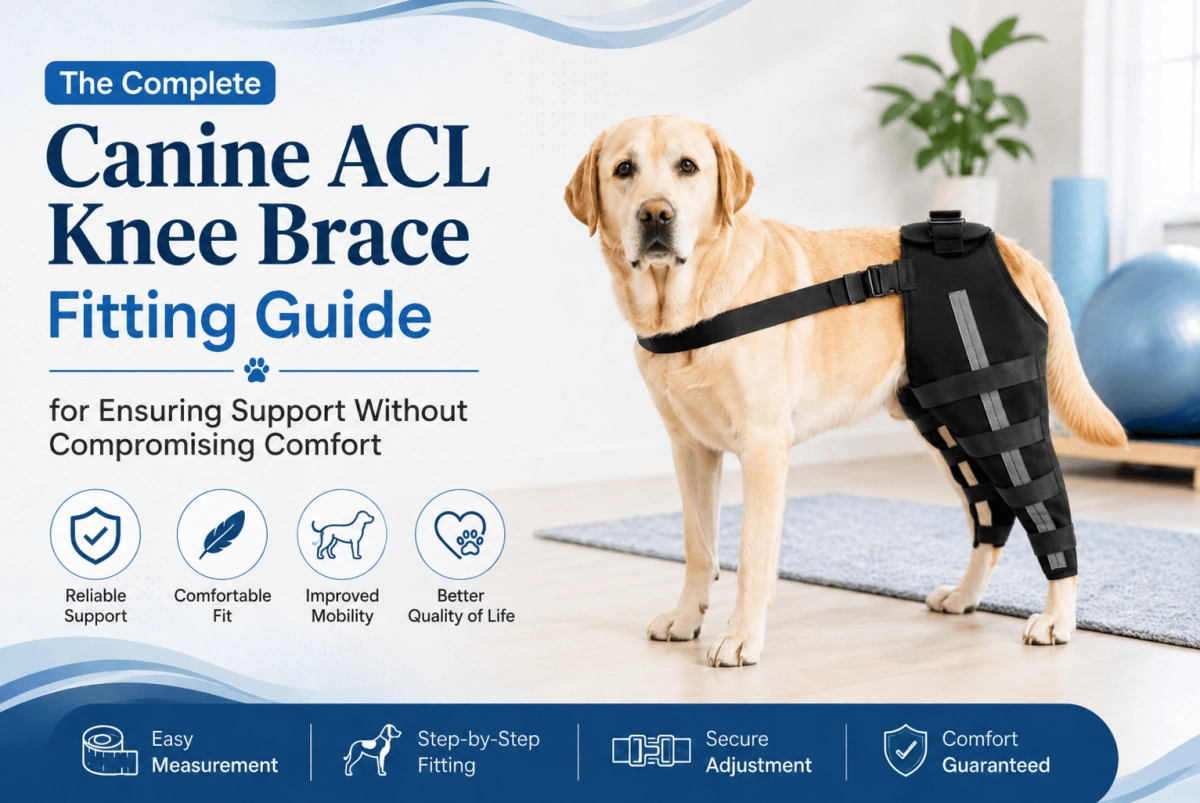
A knee brace either stabilizes the stifle joint or it does not. The difference rarely comes down to how tight the straps are. It comes down to two design details: where the hinge sits relative to the joint axis, and how the straps distribute retention force across the leg. Get either one wrong and the brace becomes dead weight — or worse, a source of pressure sores and compensatory gait changes that strain the other leg.
Why Hinge Alignment Determines Whether a Brace Stabilizes
The stifle joint is not a simple hinge. It rolls and glides as the femur moves over the tibial plateau, and the cranial cruciate ligament normally keeps the tibia from sliding forward during weight-bearing. When that ligament is compromised, the joint loses its anterior constraint. A brace steps into that gap — but only if its hinge tracks the joint's actual axis of rotation.
Here is the mechanical chain. The brace hinge sits lateral to the stifle. When the dog bears weight and the knee flexes, the hinge rotates around its own pivot point. If that pivot sits directly over the anatomical joint center, the rotation is coaxial — the brace moves with the leg, and the rigid shell transfers stabilizing force along the natural load path through the tibia and femur. The joint surface sees even pressure. The dog's gait stays close to normal.
If the hinge sits half an inch too high or low, this chain breaks. The brace pivot and the joint pivot describe two different arcs. As the knee flexes, the brace shell pulls against the leg in one part of the range and pushes into it in another. This misalignment creates a lever arm — the brace is no longer transferring force along the joint axis but torquing against it. The result: the shell rides up or down, the tibia still translates forward at certain angles, and the dog compensates by shifting weight to the other leg or shortening stride on the affected side.
You can verify hinge alignment at home. Have the dog stand square on a non-slip surface. Palpate the bony landmarks — the lateral femoral condyle and the fibular head — and mark the midpoint between them with a piece of tape. Fit the brace and check whether the hinge center lines up with that mark. Ask the dog to take three slow steps. Watch the brace from the side: the hinge should stay centered over the joint through the full stride. If it migrates up toward the groin or down toward the hock by more than a finger-width during those three steps, the pivot is off-axis and the brace is not stabilizing the joint — it is levering against it.
Strap Width and How Retention Force Reaches the Leg
Straps do one thing mechanically: they convert tension into normal force against the skin. How that force spreads across the leg depends on strap width, the number of anchor points, and whether the backing shell is rigid or flexible.
A wide strap — two inches or more across a medium-to-large dog — spreads the same tension over a larger contact area. Force per unit area drops. The skin and underlying soft tissue see lower peak pressure, which means less risk of focal ischemia under the strap line. A narrow strap, half an inch of webbing cinched tight, concentrates that same tension into a thin band. High unit pressure. The skin compresses, capillary flow slows, and after sustained wear — sometimes as little as 30 minutes — redness and indentation marks appear.
Multi-point anchoring changes the equation further. A three-strap system — one above the stifle, one below, one mid-shell — anchors the brace at three independent points along the leg. When the dog flexes the knee, each strap takes a different share of the load depending on muscle belly shape and joint angle at that instant. No single strap bears the full retention load through the entire range of motion. A two-strap brace puts more demand on each strap, and a single-strap design forces all retention force through one narrow contact patch. That patch fatigues first. The skin under it breaks down faster than skin under a distributed system.
Check strap force distribution after the first wear session. Remove the brace and run your fingers along the skin under each strap line. The impression left by a wide strap should be faint and even — a diffuse reddish mark that fades within a few minutes is normal. A deep groove that stays visible after 10 minutes signals excessive unit pressure. If one strap line shows a deeper groove than the others, that strap is carrying disproportionate load and needs to be loosened relative to the rest. Uneven impressions are a pressure map — they tell you which strap is doing too much work.
Where This Design Works — And Where It Does Not
Hinge-based rigid-shell braces perform best on dogs with straight-legged conformation and a clearly palpable stifle joint — breeds like Labrador retrievers, German shepherds, and most medium-to-large mixed breeds where the bony landmarks are easy to locate and the leg profile is relatively cylindrical through the thigh and gaskin.
Dogs with heavily angulated stifles — think Chow Chows or dogs with a noticeably bent hind leg at rest — present a different problem. The joint center is deeper and harder to palpate accurately through muscle and coat. The brace hinge has a smaller margin for positioning error, and the shell may not seat flush against a leg with a pronounced bend. In these cases, a hinged brace can still work, but the alignment check described above becomes non-negotiable — if the hinge does not track within a tight tolerance after adjusting all straps, the design likely cannot deliver meaningful stabilization for that individual dog.
Dogs under 10 pounds present the opposite challenge. The absolute distance between the joint center and the top or bottom edge of the brace shell is small. A positioning error of a quarter-inch on a large dog is a minor compromise; on a small dog it can be the difference between the hinge sitting over the joint and sitting entirely above or below it. Small dogs also have less soft-tissue padding between the brace shell and bone, which means pressure points develop faster even under well-designed strap systems. More frequent skin checks — every 15 to 20 minutes during initial wear — are the only reliable way to catch this.
Disclaimer: The alignment and pressure checks described here assume a short-coated dog where skin is visible without parting the fur. Double-coated breeds — Huskies, Golden Retrievers, and similar — may show subtler rub marks that need hand-checking rather than visual inspection. Run your fingers under each strap edge and along the shell rim after every wear session. A warm spot or slight swelling that you can feel but not see is still an early pressure signal. If the dog's leg conformation falls well outside typical breed norms — angular limb deformities, very deep chests that alter hind-leg stance, or significant muscle atrophy on one side — the fit checks described here may not catch every pressure point. In those cases, a brace that looks aligned at rest can shift under load in ways that are not visible without fluoroscopy or pressure-mapping equipment.
Design Details That Shape Daily Wear
Beyond hinge placement and strap configuration, a handful of lower-profile design choices determine whether a brace stays on the leg through a day of normal activity — or comes off after an hour because the dog cannot tolerate it.
Inner liner material. The liner sits against skin for hours. Open-cell foam feels soft initially but absorbs moisture and compresses over time — the effective thickness drops, fit loosens, and the shell rides closer to bone. Closed-cell foam resists compression set better and does not absorb moisture, which keeps the fit more stable across a wear session. Neoprene-faced liners wick moisture away from skin but trap heat; perforated liners breathe better but provide less cushion. The tradeoff is real: breathability versus pressure distribution. For dogs in warm climates or with thick coats, a perforated liner tends to reduce the sweat-and-rub cycle more than a thicker neoprene pad.
Shell material stiffness. A shell that flexes under load absorbs some of the force it is supposed to redirect. Thermoplastic shells — common in off-the-shelf braces — offer enough rigidity for most daily wear but can soften in direct summer heat, such as a dog lying on hot pavement. If the brace has been in direct sun or a hot car, check the shell stiffness by pressing your thumb into the hinge area before putting it on the dog. A shell that yields noticeably more than it did at room temperature has lost structural rigidity and will not transfer stabilizing force effectively until it cools.
Strap hardware. Hook-and-loop closure quality degrades with dirt, fur, and moisture. Straps that will not stay closed after a week of outdoor use signal low-cycle fatigue in the hook material. Straps with a secondary retention mechanism — a snap buckle or a D-ring pass-through — maintain closure tension even when the hook-and-loop starts to wear. This matters most on the top strap, which takes the highest peel force when the dog sits or lies down.
The same design logic applies to the broader category of dog knee braces: the difference between a brace that stabilizes and one that slips is rarely visible in product photos. It lives in the hinge pivot placement, the strap-to-shell interface, and the liner material choice. Braces designed specifically for ACL-deficient stifles, like those in the dog ACL CCL brace category, tend to prioritize hinge precision and multi-point strap anchoring over universal-fit flexibility — because an ACL-deficient joint has tighter tolerance for positioning error than a joint that only needs general compression support. The dog brace category as a whole spans everything from simple neoprene sleeves to rigid hinged shells, and the design priorities shift dramatically across that range. For deeper background on how knee-specific bracing supports recovery at the joint level, the breakdown at how a stifle brace supports ACL recovery covers the stabilization mechanics in more detail.
FAQ
How tight should the straps be on a canine ACL knee brace?
Tight enough that the brace does not migrate during movement, loose enough that you can slide one finger flat between the strap and skin at every strap point after the dog has been standing for two minutes. Strap tension should be checked at the beginning and end of each wear session — a strap that was snug in the morning may be loose by midday as the liner compresses and muscle tone shifts.
Why does the brace slide down even when the straps feel tight?
Downward migration is usually a hinge alignment problem, not a strap tension problem. When the brace pivot sits below the joint center, each flexion cycle drives the shell downward. Tightening the straps further only increases unit pressure without fixing the root cause. Re-check hinge placement against the bony landmarks and reposition the brace so the pivot sits directly over the joint center.
Can a knee brace be worn on either hind leg?
Most hinged knee braces are side-specific — the hinge is positioned laterally, and the shell contour follows the natural external rotation of the canine stifle. Swapping a right-leg brace onto the left leg places the hinge on the medial side, which alters the pivot arc and can cause the shell to press into the opposite leg during stance. Single-sided braces should stay on the leg they were designed for unless the manufacturer explicitly states the design is ambidextrous.
How long before a dog adjusts to wearing a knee brace?
Most dogs stop actively noticing the brace within three to five short wear sessions, provided the fit is correct. A dog that continues to bite at the brace, refuse to stand, or move with a shortened stride after a week of gradual introduction is likely signaling a fit problem — check hinge alignment, strap pressure distribution, and shell contact along the hock and groin fold.
0 Comments