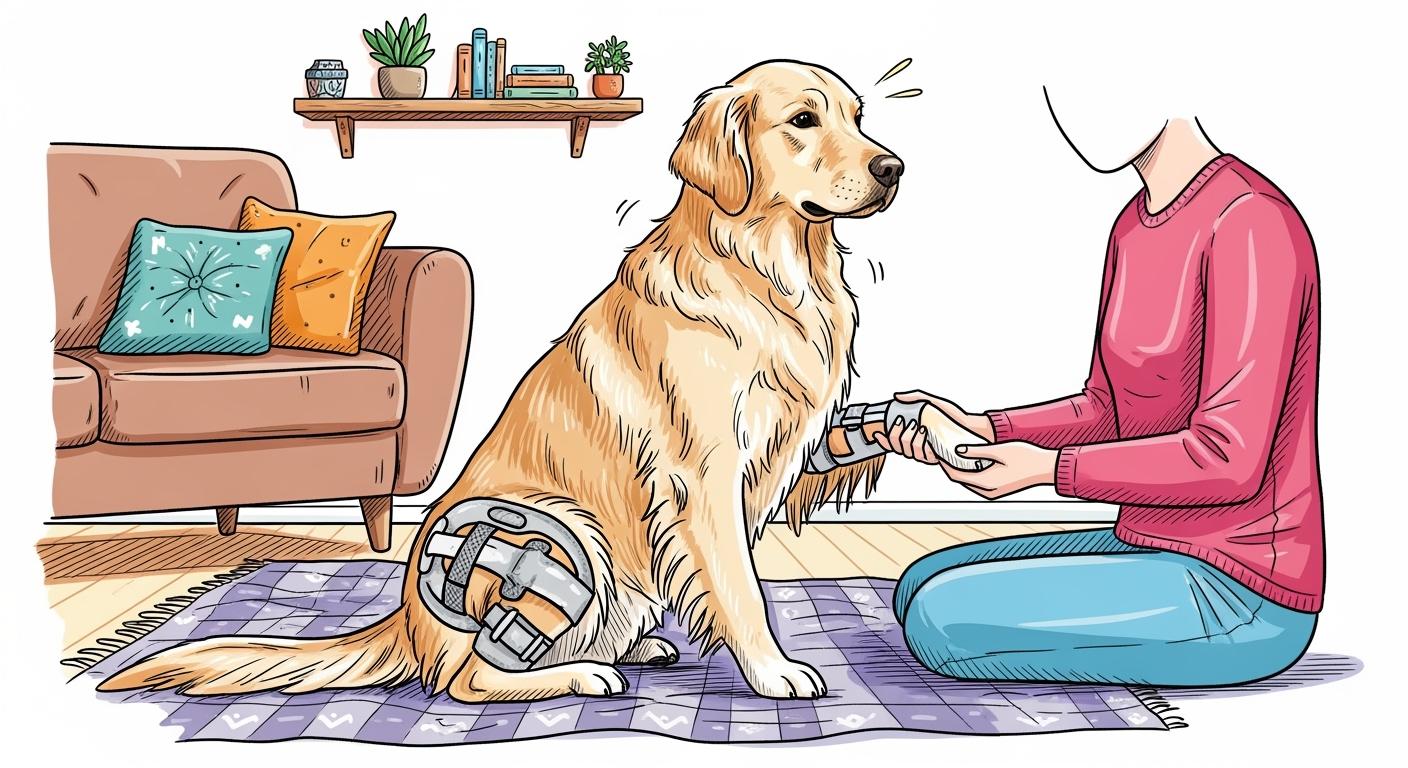
A dog limps after a walk. The dog hock brace was put on exactly as instructed — straps cinched, Velcro pressed flat, nothing loose. Thirty minutes in, the brace has rotated. The hinge no longer lines up with the joint. The dog compensates, shifting weight to the other leg, and the limp returns. The brace is on. It is tight. It is doing almost nothing.
That is the misunderstanding most hock brace comparisons skip past. Support does not come from how tight the straps are. It comes from whether the hinge tracks the joint axis, and whether the strap configuration spreads force instead of concentrating it. Two design details. One separates a brace that stabilizes from one that wraps.
What Makes a Hock Brace Actually Stabilize the Joint
The hock joint flexes through a defined arc. As a dog walks, the joint rotates around a fixed axis — the same way a door hinge swings around its pin. A brace hinge that sits a half-inch above or below that axis does not guide movement. It fights it.
Here is why.
When the brace hinge aligns with the hock joint axis, force travels straight along the joint natural rotation path. Joint surfaces stay evenly loaded. The dog gait stays closer to normal. The brace resists less, so the dog tolerates wearing it longer. Longer daily wear means more cumulative stabilization.
When the hinge is offset — even by a quarter-inch — the force vector angles away from the joint axis. The brace pushes against the leg at an angle the joint was not built to handle. The dog shortens its stride. The limp persists or worsens. Strap tension cannot fix this, because tension pulls along the strap line, not the joint line. Two different force paths. Two different outcomes.
This is why hinge placement is the single most consequential design decision in a hock brace. A brace that fits "small to medium" breeds on circumference alone but uses one fixed hinge position will track correctly on some dogs and miss on others — sometimes within the same size label.
Check this yourself: after 15 minutes of walking, stop the dog and look at where the hinge sits relative to the bony prominence of the hock. If it has drifted more than a quarter-inch, the brace is not tracking the joint axis. Tightening the straps further will not correct it. The hinge position itself is wrong for that leg.
Why Strap Design Decides Whether the Brace Stays Put
A hock brace contends with two forces during movement: the vertical pull of gravity as the leg lifts and sets down, and the rotational force as the joint flexes and extends through each stride. Narrow straps concentrate both forces into a thin contact line. Within minutes, the brace migrates — sliding down or rotating around the leg.
Wide straps spread the same force over more surface area. Lower pressure per square inch means less skin stress and less tendency to slip. But width alone is not the answer. Strap placement matters equally.
A strap above the hock joint plus a strap below it creates a two-point anchor. The brace resists both upward and downward migration. The hinge holds position. Stabilization continues through the full movement cycle.
A single-strap design, or straps clustered on one side of the joint, anchors at only one point. The brace pivots around that anchor. The hinge drifts. The support degrades.
Friction matters too. A neoprene body lined with silicone grip strips on the inner surface creates more static friction against fur than smooth fabric. That means the brace holds position with less strap tension. Less tension means less circulation restriction. Better tolerance over hours of wear. This is the difference between a brace a dog can wear through a full afternoon and one that needs to come off after 45 minutes.
Observable check: after a 10-minute walk, mark where each strap sits. Has any strap edge moved more than half an inch? Slide a finger under the strap. If the fur underneath is noticeably warmer or damp compared to uncovered areas nearby, that strap is tight enough to restrict airflow. The dog brace should hold position without needing maximum tension on every strap.
When a Hock Brace Works — and When It Does Not
A hock brace with an aligned hinge and well-distributed strapping performs best under a specific set of conditions.
Where the design delivers: Hyperextension injuries where the joint needs an external stop at its safe endpoint. Mild to moderate arthritis where limiting the joint end-range motion reduces daily inflammation. Achilles tendon strains where offloading the tendon during the early healing phase prevents re-injury. Post-surgical stabilization where the joint needs protection during the first weeks of recovery. These conditions share one feature — the joint still has intrinsic structure. The brace acts as a checkrein, not a replacement skeleton.
Where the design underperforms: Complete tendon ruptures. A brace can position the joint but cannot replace a severed tendon structural role. Significant angular limb deformities — the joint axis sits where a standard brace does not expect it, so hinge alignment becomes a guessing game regardless of strap adjustment.
Where a brace is the wrong answer entirely: Open wounds or active infections under the brace area. Unstable fractures. Neurological conditions where the dog cannot feel pressure — pressure sores can develop silently.
Disclaimer: The fit checks described above assume a short-coated dog where the hock bony landmarks are visible or easily palpated. Double-coated breeds may show subtler rub marks that require hand-checking rather than visual inspection — run your fingers along the leg under the brace after each wear session. If a dog hind-limb conformation falls outside the breed norms for which standard brace patterns were developed — particularly angular limb deformities or very deep chests that alter stance angles — these fit checks may miss pressure points that a hands-on assessment would catch.
Design Details That Shape Daily Performance
Material choice is not about comfort alone. It determines how the brace behaves across hours of continuous wear.
Neoprene provides even compression and conforms well to leg contours. But it traps heat. A dog wearing a solid neoprene brace for more than two hours in warm conditions can develop moist skin underneath. Moisture softens the skin and increases friction-injury risk. Mesh-lined neoprene or perforated panels reduce this by allowing evaporative cooling while maintaining structural compression. That trade-off — compression uniformity versus heat buildup — is a design decision, not a marketing bullet point.
Rigid shell materials anchor the hinge most securely. A rigid shell resists twisting, keeping the hinge plane aligned with the joint plane through varied movement. But rigid shells add weight. For a 15-pound dog, an extra 4 ounces on one hind leg changes gait mechanics noticeably within 10 minutes. Smaller dogs need lighter shells, or the brace becomes part of the mobility problem it is meant to help solve.
Sizing logic is where design ambition meets reality. A circumference measurement around the hock tells you whether the brace closes around the leg. It says nothing about whether the hinge will line up with the joint. The measurement that matters — and the one missing from most sizing charts — is the vertical distance between the hock bony prominence and the anchor point on the thigh. If that distance does not match the brace hinge-to-top-strap spacing, the brace will either sit too high and pinch the groin, or sit too low with the hinge below the joint. Either way, the dog compensates.
Before committing to a hock support option, check whether the sizing method accounts for vertical anchor distance, not just circumferences. A brace that asks for three circumference measurements and no vertical reference is guessing at hinge placement. A brace that asks for the vertical span from hock to upper anchor point is designed around the geometry that actually determines fit quality.
Hock Brace vs. Knee Brace: Different Joints, Different Design Problems
The hock and the knee sit inches apart on the same hind limb. Their support requirements are not interchangeable.
The hock joint flexes primarily in one plane, like a hinge. It needs a brace that limits extension past neutral — preventing the joint from collapsing backward under load. The hinge axis runs side-to-side through the joint. The dog knee brace addresses a different mechanical problem: the stifle joint rotates and glides, and its primary failure mode is forward tibial thrust — the shin bone sliding ahead of the femur. A knee brace needs to resist that forward translation while still allowing the complex roll-and-glide motion of a healthy stifle.
That is why a knee brace cannot substitute for a hock brace, and vice versa. The hinge axis is different. The primary stabilization direction is different. The strap anchor points are different. Using the wrong brace puts force where the joint does not need it and leaves the vulnerable direction unsupported.
FAQ
How long can a dog wear a hock brace in one stretch?
Start with 20 to 30 minutes. Check the skin under the brace immediately after removal — warmth and light pressure marks are normal. Dampness, deep red lines that do not fade within 10 minutes, or broken skin are signals to shorten sessions. Most dogs build up to several hours of continuous wear over one to two weeks of graduated exposure. Remove the brace during unsupervised rest and overnight.
Does a hock brace need to completely immobilize the joint?
No. A well-designed hock brace limits extension past neutral — the unsafe direction — but allows the joint to flex through its normal range. Complete immobilization would cause the dog to drag the leg, which creates its own set of problems including muscle atrophy and altered gait patterns in the opposite limb.
Why does the brace slip down even when the straps feel tight?
Slipping is rarely a tightness problem. It is usually a strap-placement problem or a hinge-alignment problem. If the top strap sits too low on the leg, there is no anchor above the muscular bulk of the calf to resist downward migration. If the hinge is offset from the joint axis, the brace rotates with each stride and gradually walks itself down the leg. Tightening the straps further just increases pressure without fixing the root cause.
Can a hock brace be used on a front leg?
No. The front-leg equivalent is the carpal joint — the dog wrist. Carpal braces are built around a different joint axis, a different range of motion, and different load patterns because front legs carry roughly 60 percent of a dog body weight. A hock brace placed on a carpal joint puts the hinge in the wrong plane and leaves the actual joint unsupported.
What is the first sign that a brace fits poorly?
The dog licks at the brace or the leg above it — not the paw, but the area where the top edge of the brace meets the leg. Licking at brace edges almost always signals a pressure concentration, not general discomfort. Check that specific spot for warmth, moisture, or a defined red line that matches the brace edge.
0 Comments