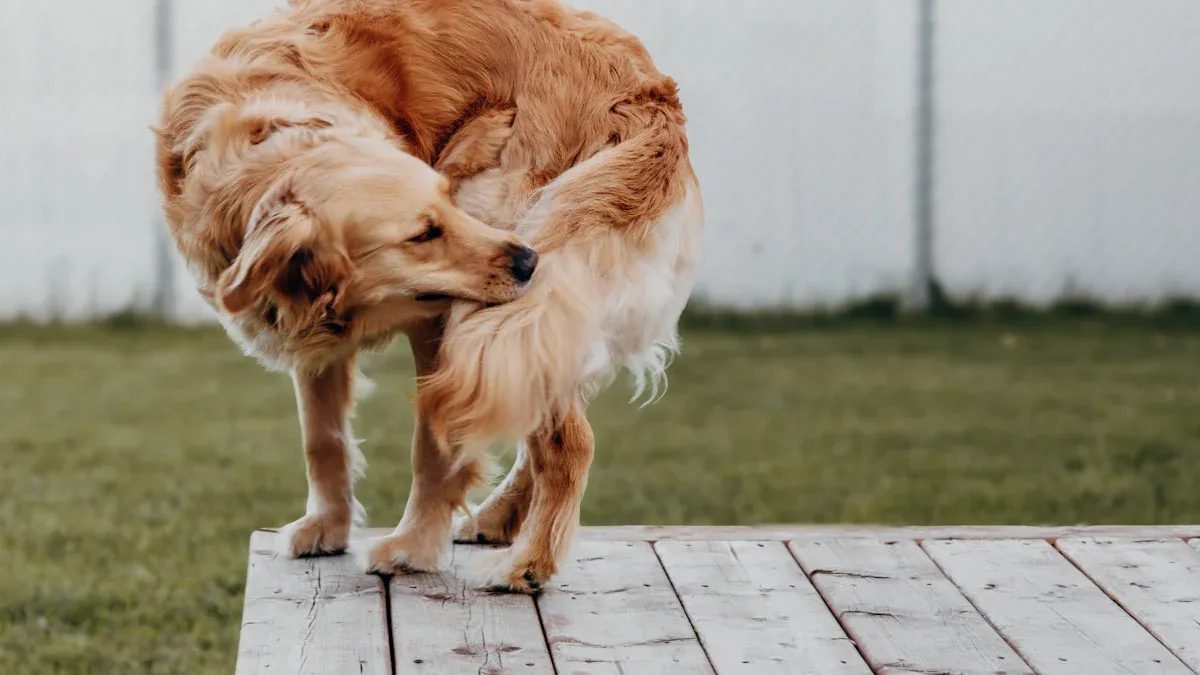
A fabric tube around a dog's leg applies pressure. That does not mean it supports the elbow.
The difference sits in how compression distributes across the joint surface. When a sleeve uses fabric with graduated elasticity — tighter at the cuffs, more forgiving over the joint body — pressure spreads evenly around the elbow rather than concentrating at the top and bottom edges. Point pressure is what makes a dog chew at the sleeve or develop rub marks within the first hour of wear. Distributed pressure, by contrast, is what the dog tolerates — and what actually cushions the joint when the elbow meets a hard floor.
What Makes a Sleeve Cushion the Joint Instead of Just Wrapping It
Elbow skin and the thin tissue layer over the olecranon tolerate distributed pressure well. Concentrated pressure compresses capillaries at the edge line. That triggers the sensation that makes a dog want the thing off.
A sleeve built with a variable-knit panel — denser weave at the cuff, more open structure through the body — shifts the pressure profile from edge-loaded to surface-distributed. The physical reason is straightforward: tighter knitting at the ends creates a higher elastic modulus at the cuff, which anchors the sleeve. The more open body weave exerts lower resting tension over the joint itself. The sleeve holds position through cuff grip rather than uniform squeeze. That single construction choice often separates a sleeve a dog ignores from one it fights.
Seam placement runs on the same logic. A seam sitting directly over the point of the elbow turns every flex into a friction event. The dog lies down, the seam presses into the skin over the bony prominence, and repeated loading creates a hot spot. Move that seam to the medial or lateral side of the leg, and the joint moves freely under a smooth fabric surface. Flatlock construction reduces the friction further: the stitch sits flush rather than raised, so there is no ridge to dig in when contact pressure increases during rest.
This is the core distinction. A sleeve that cushions the elbow distributes contact load through material thickness and even compression. One that merely wraps the leg constricts at the edges and does little for the joint surface itself.
In practice: After 20 minutes of wear, slide a finger under the sleeve at the top and bottom cuffs. If the skin feels cooler or shows a defined red line tracing the cuff edge, compression is edge-concentrated — the sleeve is wrapping, not cushioning. Even skin temperature and no cuff-line imprint mean pressure is distributed across the joint surface.
When Soft Support Works — and When It Does Not
The design strengths of a sleeve map to a specific set of daily situations. Knowing which match — and which do not — prevents expecting the wrong outcome from the product.
Where a sleeve performs well
Dogs that rest on tile, hardwood, or concrete press their elbow skin and the underlying bursa against an unyielding surface for hours. A sleeve interposes a compressible layer between the joint and the floor. The padding absorbs contact load that would otherwise transfer straight into the joint capsule. This is not structural support. It is load redistribution through material thickness. For callus prevention and bursa protection, that is often enough.
Dogs with early-morning stiffness that resolves after a few minutes of movement benefit from retained warmth. The fabric traps body heat around the joint, which lowers synovial fluid viscosity. Thinner fluid circulates more easily, so the first steps of the day meet less internal resistance. A sleeve put on before the dog rises often makes a visible difference. The same sleeve does little for stiffness that persists throughout the day — that signals a mechanical problem warmth alone cannot address.
In early arthritis where joint changes remain mild, compression and warmth can improve daily comfort without the bulk of a structured brace. The key condition is that the joint still has functional cartilage thickness — enough that the sleeve's compressive effect reduces capsular distension pain rather than pressing compromised surfaces together.
Where a sleeve falls short
Structural instability — elbow dysplasia with joint incongruity, advanced osteoarthritis with bone-on-bone contact, or medial coronoid disease — involves forces a fabric layer cannot redirect. The joint needs rigid constraint to limit range of motion or offload specific compartments. A rigid dog elbow brace addresses those forces through hinge alignment and shell rigidity; a sleeve was never built for that job.
Post-surgical stabilization exceeds what soft goods can provide. Fixation during bone healing or after fragment removal requires immobilization or controlled-range bracing. Compression alone does not stabilize a healing osteotomy.
Dogs with angular limb deformities or conformation far outside breed norms present a fit problem. Sleeve size grading assumes a roughly cylindrical leg profile. When the leg shape deviates significantly — pronounced valgus, very deep chests that change foreleg loading angle — compression distribution breaks down and gaps or tight bands form unpredictably.
Disclaimer: If the dog's elbow shows persistent heat, swelling, or fluid build-up that does not subside with rest, a sleeve is not the right tool. Those signs point to active inflammation or joint effusion needing veterinary assessment, not compression. Dogs with very deep chests or pronounced valgus forelimb alignment may get unpredictable sleeve fit even when measurements match the size chart — the leg profile under load differs from the standing measurement position, and standard circumference-based sizing cannot account for that geometry.
Design Details That Change Daily Performance
Three construction choices determine whether a sleeve works reliably across a full day of wear: how it stays put, how it manages moisture, and how size grading handles the gap between measured circumference and actual leg shape.
Grip without overtightening
Silicone bead strips or dot patterns printed on the inner cuff surface create friction against the coat without requiring the sleeve to be cinched tight. Static friction at the cuff resists shear force generated when the dog flexes the elbow. A sleeve with no grip element relies entirely on elastic tension to stay in place — and elastic tension is uniform around the circumference. It tightens everywhere, not just where grip is needed. The result is a sleeve that either migrates (too loose) or constricts (tight enough to hold but uncomfortable). Grip dots decouple retention from compression, so the sleeve body sits at a comfortable pressure while the cuff stays anchored.
Observable check: Walk the dog for 10 minutes on a hard surface. Mark the sleeve position at the top cuff with a small piece of tape on the fur. After the walk, measure any shift. Movement under half an inch is acceptable. More signals that the grip mechanism is not holding — and a sleeve sitting off the joint center contributes nothing regardless of material quality.
Moisture management over hours
Neoprene traps heat effectively and works for short-duration use during rest. But trapped heat comes with trapped moisture. After an hour of wear, skin under neoprene gets damp. Damp skin softens its keratin layer and becomes more vulnerable to friction damage. A breathable knit panel — typically a polyester-spandex blend with an open stitch structure — allows evaporative cooling while maintaining compressive hold. For dogs wearing sleeves during daytime activity, breathable construction extends safe wear time. The trade-off is that breathable knits provide less insulation than neoprene, so the warming effect is milder.
Seam type and size grading
Overlock seams create a raised ridge running along the inside of the sleeve. When the dog lies on that seam, the ridge becomes a pressure concentrator on skin already under compression. Flatlock seams sit flush — fabric edges butt together rather than overlapping, so the stitch line stays level with the surrounding material. For a joint that bears body weight against hard surfaces, that difference is not cosmetic.
Most sleeve sizing uses a single circumference measurement around the elbow. But a leg is not a cylinder. The forearm tapers, the upper arm flares, and the elbow sits at the transition. A sleeve sized purely by elbow circumference can fit the joint but gap at the top or constrict below. Sleeves that include a secondary reference — forearm circumference or elbow-to-carpus distance — give a better shot at matching the actual leg profile. When only one measurement is available, the tighter end of the range tends to work for lean builds; stocky or heavily muscled forelegs often need the looser end.
FAQ
Can a sleeve replace a brace for elbow dysplasia?
No. The mechanical demands differ fundamentally. Dysplasia involves joint incongruity that generates shear and point-loading forces during weight-bearing. A sleeve provides compression and padding — it cannot redirect those forces. When elbow dysplasia or osteoarthritis creates significant joint surface changes, the support requirement shifts from cushioning to structural constraint. For dogs needing that level of support, a structured dog brace with hinge alignment addresses the mechanical forces a soft sleeve was never designed to handle. A sleeve used during non-weight-bearing rest may add comfort alongside a brace program, but it is a complement, not a substitute.
How long can a dog wear an elbow sleeve continuously?
It depends on material and activity. Breathable knit sleeves typically stay comfortable for 4 to 6 daytime hours if skin checks come back clean. Neoprene sleeves should come off after 1 to 2 hours, and the skin needs time to dry before reapplication. For any new sleeve, start with 30 to 60 minute sessions. Remove it, check for moisture, red marks, or indentations that persist more than 5 minutes after the sleeve comes off. Lengthen wear time only when the skin tolerates the current duration without signs of pressure or moisture accumulation.
Does the sleeve need to cover just the elbow or extend further?
A sleeve extending 2 to 3 inches above and below the elbow joint tends to stay in position better than a shorter one. The extra length gives grip bands more surface area to anchor against and reduces the leverage that leg movement exerts on the cuff edges. But sleeves that reach all the way to the carpus can bunch at the wrist when the dog bends the leg. The functional sweet spot covers the elbow with enough margin above and below to create a stable anchor zone without impinging on the adjacent joint.
What if the dog licks or chews at the sleeve during the first few sessions?
Displacement behavior around a new sleeve is common initially and often resolves as the dog habituates. If it persists past the third wear, check for three causes: edge pressure (red lines tracing the cuffs), seam irritation (red marks following seam paths), or trapped moisture (damp, softened skin under the fabric). Each points to a different fix — a different size for edge pressure, a flatlock-seamed sleeve for seam irritation, or shorter wear sessions with dry-off intervals for moisture buildup.
0 Comments