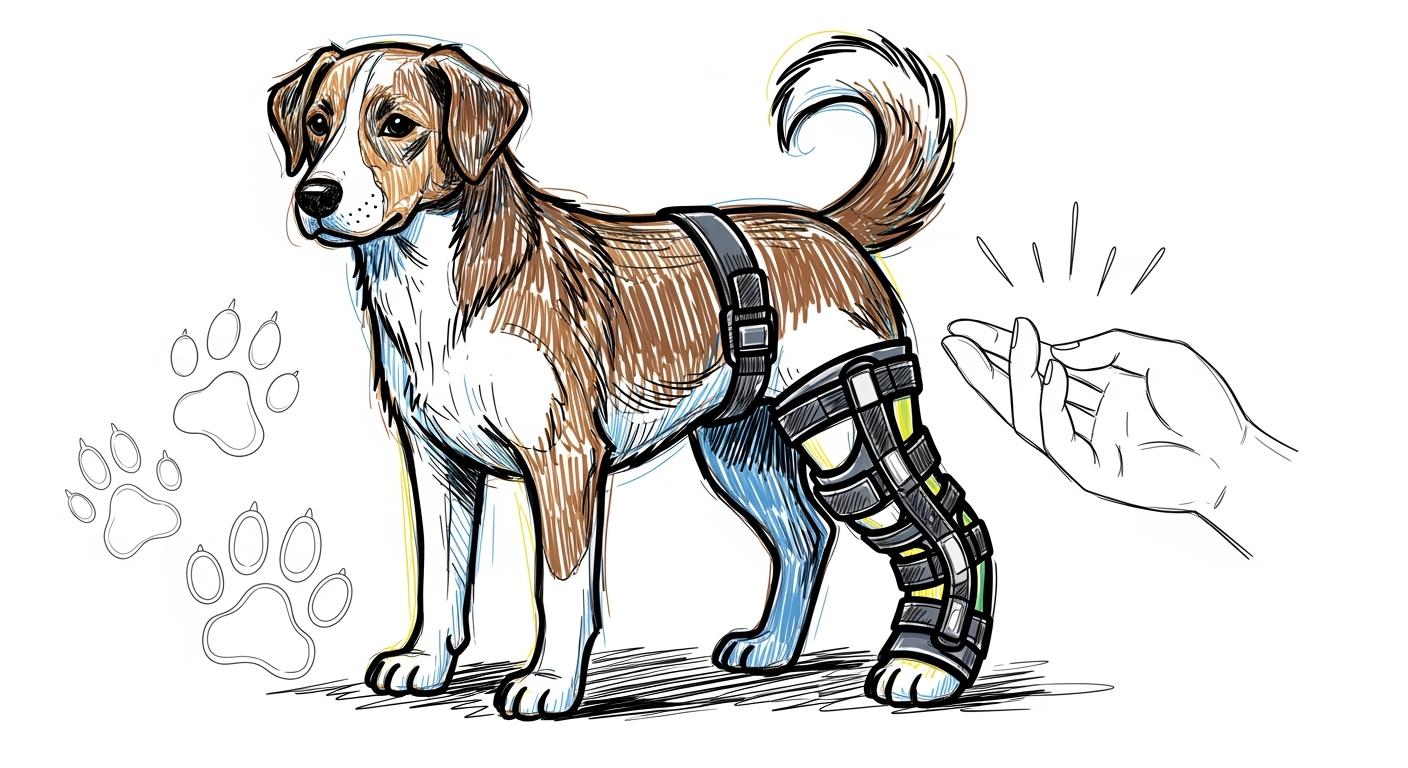
A dog hock brace wraps around the tarsal joint on a dog's rear leg. It is not a cast. It does not immobilize by default. What it actually does depends almost entirely on two design choices: where the hinge sits relative to the joint axis, and how the straps distribute force across the leg. Get those two details right and a semi-rigid brace outperforms a rigid one. Get them wrong and even the stiffest brace adds resistance without adding support.
Why Hinge Position, Not Stiffness, Decides How Well a Hock Brace Works
The hock joint is a collection of seven tarsal bones, multiple small articulations, and a network of ligaments and tendons connecting the tibia and fibula to the metatarsal bones of the paw. When a dog walks, the hock flexes and extends with each stride — absorbing impact at ground contact and generating propulsion at push-off. The joint sits at an angle, so each step loads it eccentrically. Knowing the anatomy matters for one reason: it explains why hinge placement is the single most consequential design variable in any dog hock brace.
| Anatomical Structure | Role During Movement |
|---|---|
| Seven tarsal bones and multiple small articulations | Distributes load across joint surfaces; maintains alignment under weight |
| Ligament and tendon network | Limits end-range motion; provides elastic recoil at push-off |
| Connection from tibia/fibula to metatarsals | Transmits ground reaction force upward; controls paw angle at contact |
A hinge that sits directly over the tarsal joint axis transmits force in a straight line through the joint. Joint surfaces load evenly across their contact area. The dog's gait stays close to its natural pattern. The brace supports without fighting.
A hinge offset by as little as a quarter inch changes the entire force pathway. The brace now creates a lever arm. With each step, it pushes the joint slightly out of its natural arc. The dog compensates — flicking the leg outward, shortening the stride, stiffening the entire hind end to avoid the resistance. That compensation loads other joints unevenly. The stifle takes more lateral stress. The hip changes its swing plane. The dog tires faster. Skin irritation develops at the brace edges where the misaligned force concentrates.
Here is the causal chain: aligned hinge → force stays on the anatomical axis → joint surfaces load evenly → gait remains natural → the dog tolerates longer wear → the brace provides effective support. Misaligned hinge → off-axis force → uneven joint loading and gait compensation → early fatigue and skin breakdown → the dog resists wearing the brace → zero support delivered.
You can check hinge alignment at home. Fit the brace and watch the dog take ten strides from the side. Look for two things. One: the hock should bend and straighten smoothly, without the brace catching mid-stride. Two: after those ten strides, no strap should have shifted more than half an inch from its starting position. Shift means the hinge is not sitting on the joint axis — the dog's own motion is fighting the brace instead of being guided by it.
A hinged dog brace that matches the joint axis allows controlled flexion and extension while blocking hyperextension — the excessive opening of the joint angle that overstretches ligaments. A non-hinged rigid brace blocks all motion, which sounds safer but creates a different problem: the joint cannot move through its normal range, so surrounding muscles weaken with every week of immobilization. Stiffness is not the same as support.
| Performance Difference | Why It Matters | Main Limitation |
|---|---|---|
| Hinge aligned with joint axis vs. hinge offset | Determines whether force travels along or across the joint's natural load path | Alignment depends on both the brace design and the individual dog's leg conformation — same brace, different dogs, different alignment quality |
| Hinged braces vs. rigid non-hinged braces | Controlled motion preserves muscle tone; full immobilization causes atrophy over weeks | Hinged braces cannot protect a joint that requires complete immobilization, such as immediately after certain fracture repairs |
Strap Width and Padding — The Details That Change All-Day Wear
A dog hock brace stays in position through straps — typically one above the hock and one below. The upper strap anchors against the tibia. The lower strap controls rotation of the paw and metatarsals. Together they form a mechanical constraint that limits the joint's end range. How well this works depends less on how tight you make them than on how wide they are.
Force spread across a wide strap — an inch and a half on a medium-sized dog — produces low pressure per square inch of skin. The same total force concentrated into a half-inch strap multiplies the pressure at the contact line. That pressure lands on the same narrow band of skin, under the same strap edge, with every single step the dog takes. High localized pressure is what causes the skin irritation, hair loss, and hot spots that make dogs reject a brace. It is not the brace being "too tight" in the way most owners assume — it is the force being delivered through too small a contact area.
Padding material matters for a different mechanism: moisture. Neoprene is common because it stretches and conforms to leg contours. But neoprene traps heat and sweat. After twenty to thirty minutes of wear, the skin underneath becomes warm and damp. In warm weather or for double-coated breeds, that trapped moisture softens the skin and increases friction — the direct opposite of what the padding is supposed to do. A perforated or moisture-wicking liner changes this by allowing evaporation. Skin stays cooler and drier. Friction drops. The dog tolerates longer wear sessions.
To check how a brace handles heat and moisture: remove it after twenty minutes of indoor wear and feel the skin under the thickest part of the padding. Cool and dry — that is the target. Warm is normal and usually fine. Damp means the liner is not adequately breathable for that dog in that environment. Double-coated breeds need a hand-check under the brace edge rather than relying on visual inspection — thick fur can hide dampness at the skin level.
Strap placement also determines whether the brace stays put. The upper strap should sit on the muscular part of the lower leg, above the hock but below the stifle crease. If it creeps up into the stifle fold, it interferes with knee flexion. If it rides down onto the bony prominences of the hock itself, it creates pressure directly over tissue that has almost no natural padding. Rear leg braces that position straps correctly tend to stay in place through a full walk; those that do not require constant readjustment. The difference shows up within the first ten minutes of use.
Measuring accurately before selecting a brace — circumference above and below the hock, plus the length from paw base to the top of the brace's coverage zone — gives the strap configuration its best chance to work as designed. Even a well-designed strap layout cannot compensate for a size that puts the anchor points on the wrong part of the leg. Hind leg braces sized correctly let the strap positions land where the underlying anatomy can actually support them.
Where a Hock Brace Helps and Where It Reaches Its Limits
A hock brace performs best when the primary problem is instability — a joint that has too much motion in directions it should not move, but still retains its basic structural integrity. The brace adds external constraint. It does not rebuild tissue. This distinction defines the boundary between effective support and wishful thinking.
Conditions where a well-designed hock brace tends to provide meaningful support: mild to moderate hock hyperextension, where the joint angle opens past its normal limit during weight-bearing. Tarsal ligament laxity that allows excessive side-to-side motion but does not involve complete rupture. Post-surgical protection after a procedure that leaves the joint temporarily vulnerable to re-injury. Arthritic hock joints where controlled motion during activity reduces the grinding aggravation of bone-on-bone contact. In each of these, the brace functions as an external limit — not a replacement for missing structure.
The brace does not replace a completely ruptured Achilles tendon. It does not realign a congenital angular limb deformity. It does not stabilize a hock that dislocates under normal weight-bearing loads. These are structural failures that exceed what external bracing can address — regardless of how stiff or well-fitted the brace is. Braces work by constraining motion within a joint's remaining structural envelope. When the envelope itself is gone, constraint alone cannot restore function.
Severe swelling that changes leg dimensions day to day also undermines brace performance. A brace fitted on one day may be too loose two days later if edema decreases, or too tight if inflammation worsens. In these situations, the fit checks described in earlier sections may not catch every pressure point. The brace may need daily adjustment or temporary discontinuation until leg volume stabilizes.
The brace is designed for weight-bearing activity — walks, standing, controlled movement. It is not meant for continuous 24-hour wear. Skin needs unloaded time to recover from contact pressure. Muscles need unloaded time to move through their full range without external constraint. A wear schedule that alternates brace-on activity periods with brace-off rest periods preserves both skin integrity and muscle tone. This principle applies regardless of the joint being supported — front leg braces, knee braces, or other mobility aids all share it.
Disclaimer: This fit assessment assumes a dog with typical hind-leg conformation. Dogs with angular limb deformities, very deep chests that alter hind-leg stance, or previously fused tarsal joints may show different fit signals. In those cases, pressure point checking requires hand palpation under the brace edges rather than visual observation alone. For dogs whose leg shape falls well outside breed norms, a brace patterned on average dimensions may not distribute pressure as intended regardless of how carefully measurement guidelines are followed.
FAQ
How long can a dog wear a hock brace in one session?
Start at fifteen to thirty minutes and build gradually. The ceiling is set by skin tolerance, not joint need. If the skin under the padding stays cool and dry at thirty minutes, extend to an hour. If dampness or redness appears at any duration, that is the current limit. Most dogs top out between two and four hours per session once conditioned — but the number that matters is the one your dog's skin tells you, not a general guideline.
Does a hock brace help a dog that knuckles or drags the paw?
Not if the knuckling is neurological in origin. A hock brace stabilizes the tarsal joint mechanically. Knuckling — the paw folding under so the dog walks on the top of the foot — is typically a proprioceptive deficit, not a structural joint failure. The dog cannot sense where the paw is in space, so it places it wrong. A brace around the hock does not restore that sensory pathway. A knee brace addresses a different joint with different biomechanics, just as a hock brace addresses the tarsal joint specifically — matching the brace to the actual deficit is what determines whether it helps at all.
What is the difference between a hock brace and a hock wrap?
A wrap provides compression and warmth only. It has no structural elements that resist joint motion. A brace adds mechanical constraint — stays, hinges, or rigid shells that limit how far the joint can move in specific directions. Wraps can reduce mild swelling and provide sensory feedback. They cannot prevent hyperextension or control side-to-side instability. If the joint needs motion control, a wrap is the wrong tool.
Can a dog swim or get the brace wet?
Most hock braces are not waterproof. Remove the brace before swimming, bathing, or walking through deep wet grass. If the brace gets wet, air dry it thoroughly before reapplying — do not use heat. Moisture trapped in padding layers degrades the materials and creates the same damp-skin friction problem described earlier. A brace put back on damp is worse than no brace at all for that wear session.
Why does the brace seem to slip even though the measurements were right?
Measurements taken when the dog is standing still capture leg dimensions under one condition. During walking, muscles contract and leg shape changes dynamically. If the strap above the hock is positioned too close to the stifle crease, knee flexion pushes it downward with every stride. If the lower strap sits on a tapering part of the metatarsals, gravity and motion pull it toward the paw. Slippage that persists after repositioning the straps suggests the brace's anchor points do not match that dog's specific leg geometry — the measurements may be correct, but the brace design does not land its straps where that particular leg can hold them.
0 Comments