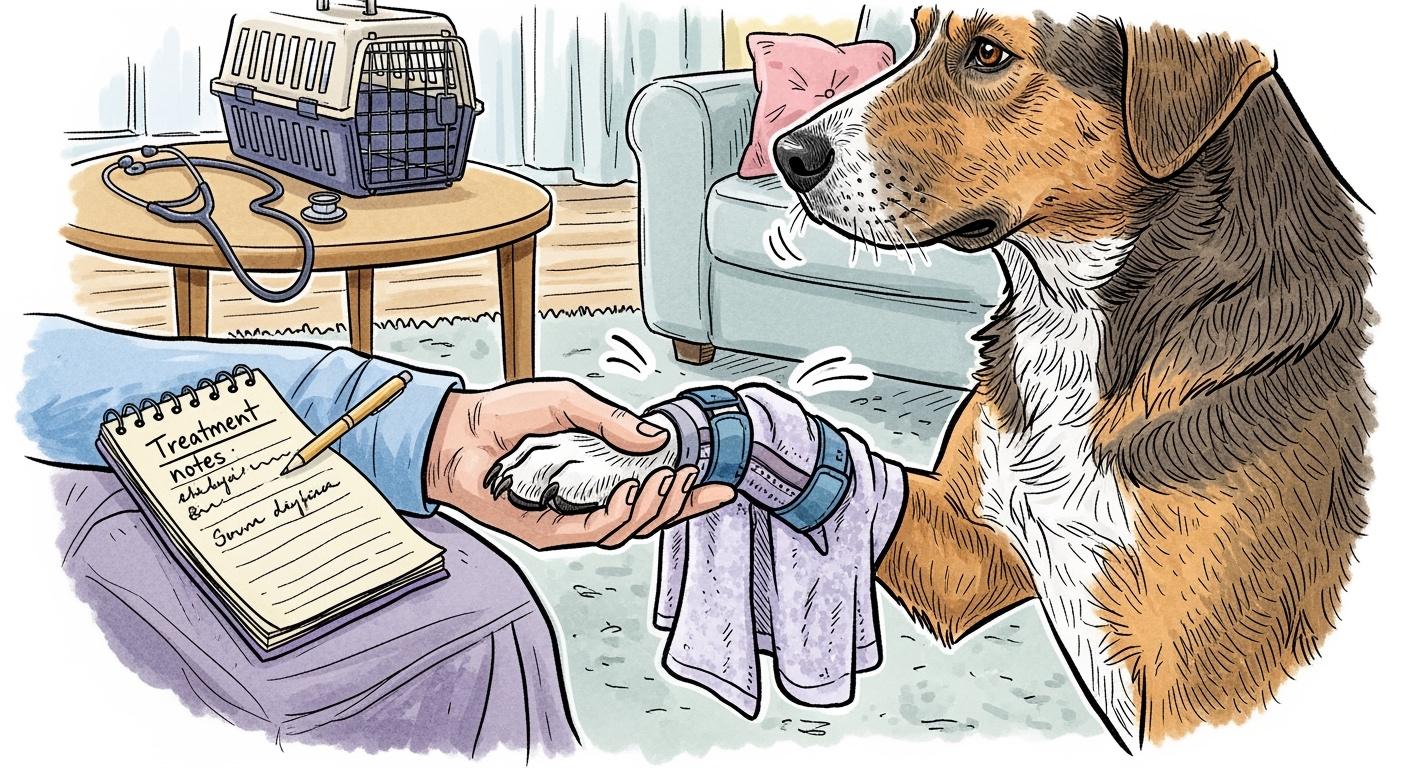
A dog walks across the room and the front paw folds under. The top of the paw scrapes the floor. The dog stumbles, corrects, then does it again two steps later. That is dog knuckling front paw — a failure of paw placement that turns every step into a risk. The question is not just what causes it. The question is what kind of support actually changes the outcome.
Not all paw protection works the same way. A boot that wraps the paw cushions the scrape. A brace that positions the paw changes the mechanics. The difference sits in one design decision: whether the device lifts the paw into a flat stance or simply pads the knuckle that hits the ground.
What Makes Paw Support Work: Toe-Up Positioning Versus Passive Wrapping
Most paw boots solve one problem. They put material between the paw and the ground. That stops abrasion. It does not stop the paw from folding under in the first place. The dog still walks on a bent knuckle. The weight still lands on the wrong surface. Over time, the same abnormal pressure patterns continue — they just happen inside a boot.
A wrist and paw support design built around toe-up positioning works differently. A strap runs under the paw near the toes and pulls upward, lifting the paw into a flat, weight-bearing stance. That is not just coverage. That is positional correction.
Here is the mechanical chain that makes it matter. When the paw folds under, the dog's weight lands on the dorsal surface — the top of the paw, where skin is thin and bones sit close to the surface with almost no cushioning. Every step grinds that surface against pavement or flooring. A passive boot adds a layer between skin and ground, which reduces friction damage, but the knuckle still takes the load at an angle that the joint was never built to bear. The carpal and metacarpophalangeal joints compress unevenly. Soft tissue on the top of the paw stretches under load.
A toe-up strap changes the load path. By pulling the paw into plantar flexion — toes down, pad flat — it redirects body weight through the paw pad, which is thick, fibrofatty tissue evolved for impact absorption. The dorsal surface lifts off the ground. The carpal joint aligns closer to its neutral standing angle. Force travels through the pad, up the aligned column of carpal bones, into the radius. That is the same path the leg uses in a healthy stance. The strap does not make the dog stronger. It removes the positional error so the dog's own skeletal structure can do its job.
You can see whether this is working without waiting for a vet visit. After ten minutes of walking with the brace on, lift the paw and check two things. First, look at the top of the paw — is the skin dry and unmarked, or is there redness from rubbing inside the brace? Dry and unmarked means the paw stayed lifted off the inner surface. Redness means the paw still folded inside the device. Second, check whether the paw pad shows even contact wear — compressed but not abraded in one spot. Uneven pad compression signals the paw is still landing at an angle.
The design detail that often decides success is strap angle. A toe-up strap that pulls straight upward creates vertical lift but can slip backward as the dog walks. A strap routed through a D-ring at the front of the brace and angled slightly forward — pulling the paw up and out — resists that backward migration. Small geometry difference. Large practical difference after a twenty-minute walk.
When a Front-Wheelchair Design Picks Up Where a Foot Brace Leaves Off
A foot brace can reposition the paw. It cannot create strength where none exists. If the dog cannot bear weight on the front leg at all — or if both front paws knuckle simultaneously — a brace alone runs into its limit fast. The paw may be held flat, but the shoulder and elbow still collapse under load. That is where a front-support wheelchair enters the picture.
The design question shifts from paw positioning to weight redistribution. A front-wheelchair frame supports the dog's chest and transfers a portion of body weight off the front legs entirely. The front paws still touch the ground — they are not suspended — but they no longer carry full load. That gives the paw a chance to land flat without the entire dog pressing down on a folded knuckle.
What separates a functional front-wheelchair design from one that just holds the dog up is frame height and chest support geometry. If the chest support sits too low, the dog's shoulders hunch forward — that shortens the stride, makes the dog drag the front paws rather than step, and can worsen knuckling over time. If it sits too high, the dog's front legs dangle without ground contact and lose whatever residual proprioceptive feedback they still have. The right height lets the paws brush the ground with partial weight, enough to trigger the placing reflex without forcing the knuckle to take full body load.
An observable check here is stride quality. Watch the dog from the side during the first five minutes in the wheelchair. The front paw should lift, swing forward, and land pad-first — not drag, not flip, not land on the knuckle. If the paw drags, the frame is too low. If the dog holds the front legs stiff and refuses to step, the frame may be too high or the chest support is pressing into the throat instead of the sternum. Adjust in quarter-inch increments. Small frame changes shift weight distribution enough to change whether the paw lands flat or folds.
A front lifting harness occupies the middle ground between these two approaches. It does not offload weight the way a wheelchair frame does, and it does not position the paw the way a toe-up brace does. What it provides is a handle — a way for the owner to take some weight off the front end during short walks or transitions between rooms. For a dog that knuckles intermittently — fine on grass, struggling on hard floors — a front harness can be the right tool for the hard-surface segments without committing to a full wheelchair setup.
Where These Support Designs Fit — And Where They Reach Their Limits
A toe-up foot brace works best when the dog still has some proprioceptive awareness — the nerves can still sense paw position, even if the muscles or joints cannot execute the correction on their own. The brace supplies the mechanical positioning the dog's body cannot. A front wheelchair works best when proprioception is lost entirely or when both front legs are affected and the dog cannot redistribute weight to a sound limb.
Neither device restores nerve function. Neither stops a degenerative condition from progressing. What they change is the mechanical environment during the time the dog is using them — reducing skin injury, redistributing load, and preserving whatever functional movement the dog still has. That is the realistic ceiling.
These designs also have clear non-applicable scenarios. A dog in acute spinal pain that vocalizes when touched may not tolerate any device, and forcing one on can worsen the underlying injury. A dog with open wounds on the paw or lower leg needs wound management before any brace or boot can be introduced — a moist environment inside a brace turns a scrape into an infection quickly. Very small dogs under five pounds may struggle with the weight and bulk of a structured brace; in those cases, lighter toe-up sock-style solutions or supervised towel-walking may be the only workable option during the acute phase.
Disclaimer: This fit guidance assumes a dog of typical leg conformation for its breed. Dogs with angular limb deformities, very deep chests such as some Dobermans or Great Danes, or disproportionately short legs such as Dachshunds or Basset Hounds may show pressure patterns that do not match the standard fit checks described here. In those cases, do a hand-check — run a finger under every strap edge and along every seam contact line after five minutes of wear, then again after twenty. Warm spots or indentations that persist after removing the device signal pressure points that need strap adjustment or a different size.
Disclaimer: The paw-position check described above — looking for redness on the dorsal paw surface after ten minutes of brace use — works best on short-coated dogs where skin is visible. Double-coated breeds such as Huskies, Malamutes, or Australian Shepherds may show subtler rub marks hidden under fur. For those dogs, rely on touch: after removing the brace, press gently along the top of the paw and watch for a flinch or withdrawal. A warm spot without a flinch may be normal brace contact. A warm spot with a flinch means adjust.
FAQ
Can a foot brace stop knuckling permanently?
No. A toe-up brace corrects paw position mechanically while the dog wears it. It does not repair nerve damage or reverse a degenerative condition. It protects the paw and helps the dog walk more safely during the time the device is on. Remove the brace, and the underlying neurological or orthopedic issue remains unchanged.
How do I know whether my dog needs a foot brace or a wheelchair?
Watch what happens during a short walk on a hard surface. If the paw folds but the dog still bears weight on the leg and can take several steps without collapsing, a toe-up brace is the starting point. If the leg buckles at the shoulder or elbow within the first few steps — or if both front paws knuckle simultaneously — the dog likely needs the weight-offloading a front-wheelchair frame provides. The decision turns on whether the leg can still carry load when the paw is held flat, not on how severe the knuckling looks.
Will a boot alone protect a knuckling paw?
A boot protects the skin from abrasion. It does not stop the paw from folding under. For short-term protection — getting through a weekend before a vet visit, or covering a healing scrape — a boot does the job. For daily walks over weeks or months, a boot without toe-up positioning lets the abnormal joint loading continue, and secondary problems like carpal strain or shoulder compensation tend to accumulate.
0 Comments