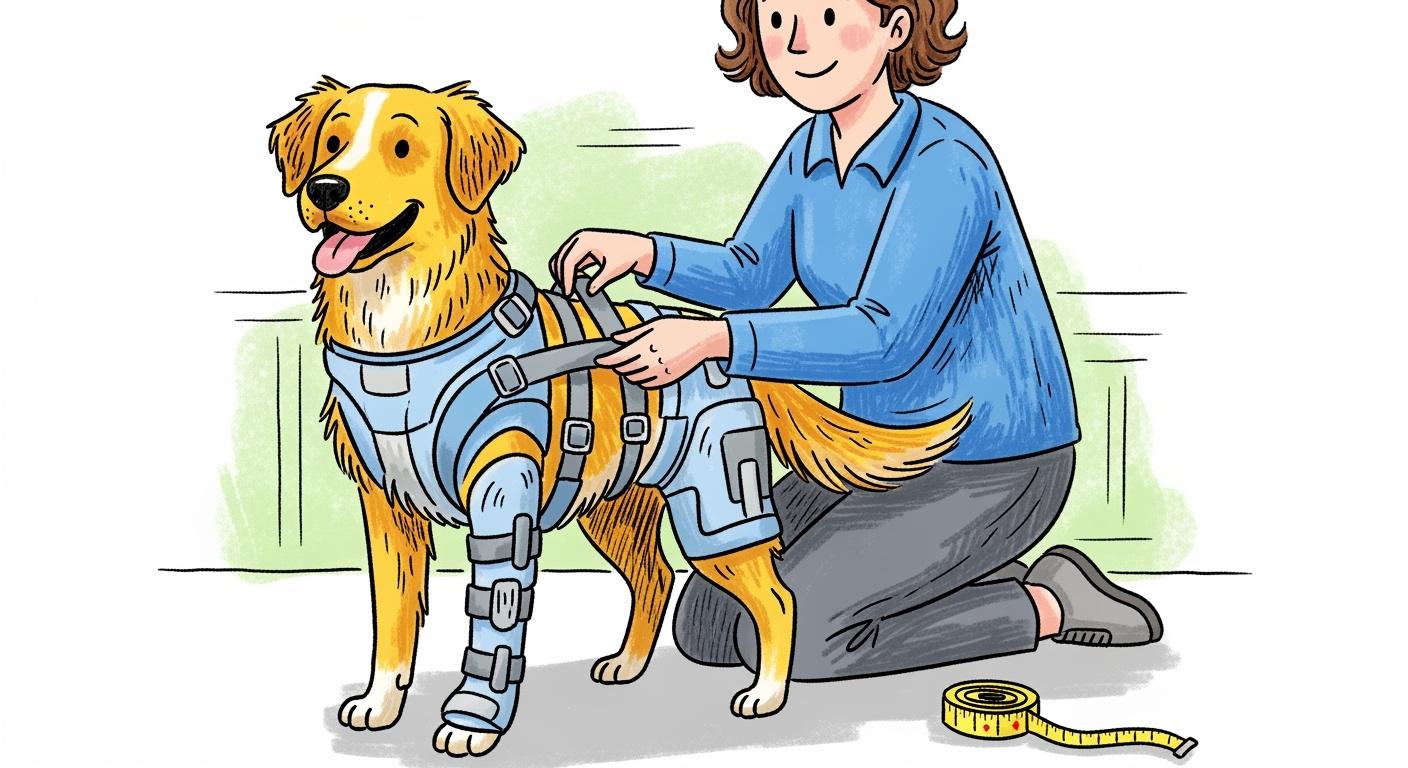
A dog takes a bad step, yelps, and suddenly the hind leg carries no weight. The diagnosis comes back: ACL tear. The question that follows is not just "which brace" but "what makes one brace support the knee while another just wraps the leg and does nothing."
The answer lives in two design details most people never think about until the brace fails.
Why Hinge Alignment Determines Whether a Brace Supports or Just Wraps
A knee is a hinge joint. It bends and straightens along one plane. The axis that this movement rotates around is not a guessable spot on the outside of the leg — it sits inside the joint, running side-to-side through the femoral condyles. A brace that places its hinge anywhere else creates a mismatch.
Here is the causal chain that matters: the hinge on the brace defines where force transmits from the brace into the leg. When that hinge sits directly over the knee's natural axis, force travels straight along the joint line. The condyles bear load evenly. The dog flexes and extends the leg through a familiar path. The brace reinforces what the joint already wants to do.
Miss by half an inch. Now the hinge sits forward of the axis. When the dog takes a step, the brace hinge tries to bend at a point that does not match where the knee actually bends. Force no longer runs straight along the joint line — it veers. The anterior cruciate ligament, already compromised, now absorbs shear it was never meant to handle. The brace becomes a lever working against the joint instead of a guide working with it.
This is why brace tightness matters far less than most people assume. A snug brace with a misaligned hinge still transmits force through the wrong vector. A moderately tensioned brace with a precisely placed hinge channels load through the joint's natural load path. The tightness feels reassuring. The alignment does the work.
You can verify hinge placement without a radiograph. After the dog walks for ten minutes, feel the sides of the knee through the brace fabric. The hinge bulge should sit at the midpoint of the joint — not shifted forward toward the patella, not drifted back toward the hamstrings. If it has migrated, the brace is pivoting around the wrong point.
Strap Width and How Pressure Reaches the Leg
Straps do two things: they keep the brace on, and they transmit the brace's stabilizing force into the leg. How they do the second thing depends almost entirely on width.
Narrow straps concentrate force. A half-inch strap cinched around the thigh puts all its tension through a thin contact band. The pressure under that band — force divided by area — climbs fast. Skin that sits under sustained high pressure loses circulation at the capillary level. Within an hour, the area reddens. Within a day, the hair thins. The dog starts licking. The owner tightens the strap to stop the brace from slipping, which makes the pressure worse.
Broad bands spread the same tension across three or four times the skin area. A two-inch strap carrying the same total tension as a half-inch strap produces one-quarter the pressure on any given patch of skin. The strap still holds. The skin breathes. The brace stays where it was put because even pressure means even friction against the coat — no single pinch point creates a pivot for the brace to rotate around.
The material behind the strap matters for the same reason. A strap backed by neoprene compresses evenly — the foam distributes tension across its entire contact surface before that force reaches the dog. A strap sewn directly to a thin sleeve edge concentrates its load at the stitch line. Same strap tension, wildly different pressure map on the skin.
Walk the dog for ten minutes, then unbuckle each strap and look. A broad strap leaves a uniform impression in the coat — the hair lies flat across the whole band with no bare skin showing. A narrow strap leaves a trench: a depressed groove with raised edges, sometimes with pink skin visible at the bottom. The groove says pressure. The uniform impression says distribution. That difference determines whether the dog tolerates the brace for six hours or starts fighting it after one.
When a Knee Brace Works Well — and When It Does Not
A well-designed dog knee brace does its best work under specific conditions. The dog bears some weight on the leg — the brace guides that load, it does not create it. The injury is a partial tear or a full tear where the joint still has passive stability from the collateral ligaments. The owner can commit to daily skin checks and fit adjustments. In these conditions, the combination of aligned hinge and distributed strap pressure can keep the joint stable enough for the dog to walk, stand, and navigate the house without the tibial thrust that turns a partial tear into a complete rupture.
There are conditions where a brace cannot deliver what the joint needs. A knee with no remaining passive stability — where the tibia translates forward freely regardless of external support — exceeds what a non-rigid external device can control. A dog that will not tolerate anything on the leg defeats the best dog ACL brace design. A leg with significant muscle atrophy changes shape week to week, and a brace sized for week one may gap or pinch by week four. Deep-chested breeds with very angled stifles create geometry that off-the-shelf hinge positions were not patterned for.
The distinction is not about brace quality. It is about whether the specific mismatch between the dog's anatomy and the brace's design can be closed by adjustment, or whether the gap is structural. Hinge position cannot be adjusted after manufacturing. Strap tension can. That is why hinge precision ranks above strap tightness in the hierarchy of what makes a brace work.
Disclaimer: The fit checks described here — checking hinge position after walking, inspecting strap impressions on skin — assume a short-coated dog where visual inspection is straightforward. Double-coated breeds may hide rub marks under dense fur. For these dogs, run your fingers under each strap edge after wear rather than relying on what you can see. If the dog's stifle conformation falls outside typical breed norms, particularly in dogs with angular limb deformities, the hinge-position check described above may not catch every pressure point. Manual palpation for heat or thickening under the strap paths is more reliable than visual alignment in these cases.
What Changes With Daily Use
Even a well-matched dog leg brace drifts over hours. The thigh muscle compresses under the proximal strap. The fabric settles. What was aligned at 8 a.m. may sit a quarter-inch low by 2 p.m. This is normal — it is the difference between static fit and dynamic fit, and no brace eliminates it entirely.
The practical response is not to tighten everything. It is to check and reset. Unbuckle, let the leg breathe for sixty seconds, reposition the hinge to the joint midpoint, re-secure the straps at the same tension as before. Two or three resets across a full day of wear often make the difference between a brace that performs consistently and one that gradually loses effectiveness as the day goes on.
Strap tension itself needs a reference point, not a feeling. After securing each strap, slide one fingertip between the strap edge and the coat. It should meet resistance but not require force. If the fingertip slides in without touching anything, the strap is loose enough to migrate. If you cannot get a fingertip under the edge at all, the strap is tight enough to concentrate pressure regardless of how wide it is. This check takes five seconds per strap and catches the two failure modes — slip and pinch — before the dog tells you about them by limping or licking.
FAQ
Does a tighter strap mean better support?
No. Support comes from hinge alignment and the brace's structural resistance to rotation — not from compression. A strap tightened past the point where a fingertip fits under the edge adds pressure without adding stability. The joint does not become more stable because the skin is squeezed harder.
How do I know if the hinge is in the right place?
Watch the dog take ten steps, then feel for the hinge bulge through the fabric. It should sit at the widest point of the knee joint — not drifted forward or back. If it has shifted, unbuckle, reposition, and resecure. Check again after another half-hour of wear. A hinge that repeatedly drifts in the same direction suggests the brace geometry does not match that dog's stifle angle.
Can a brace replace surgery for a torn ACL?
That decision sits with a veterinarian. A brace can stabilize the joint during weight-bearing activities and may be part of a non-surgical management plan for partial tears or dogs that are not surgical candidates. Full ruptures in active, heavy dogs often exceed what external bracing alone can control. The role a brace plays in ACL injury management depends on tear severity, the dog's weight, and how much passive stability the joint retains.
Why does my dog's brace slip down after an hour?
Slippage usually traces to one of three causes: the thigh strap sits too low, the strap tension is uneven between the proximal and distal bands, or the dog's thigh circumference tapers more sharply than the brace sleeve was patterned for. Check the thigh strap position first — it should sit in the groove where the thigh meets the body, not lower on the muscle belly. If position is correct and slippage continues, the sleeve taper may not match the dog's leg shape, which is a geometric mismatch rather than a strap-tightness problem.
0 Comments