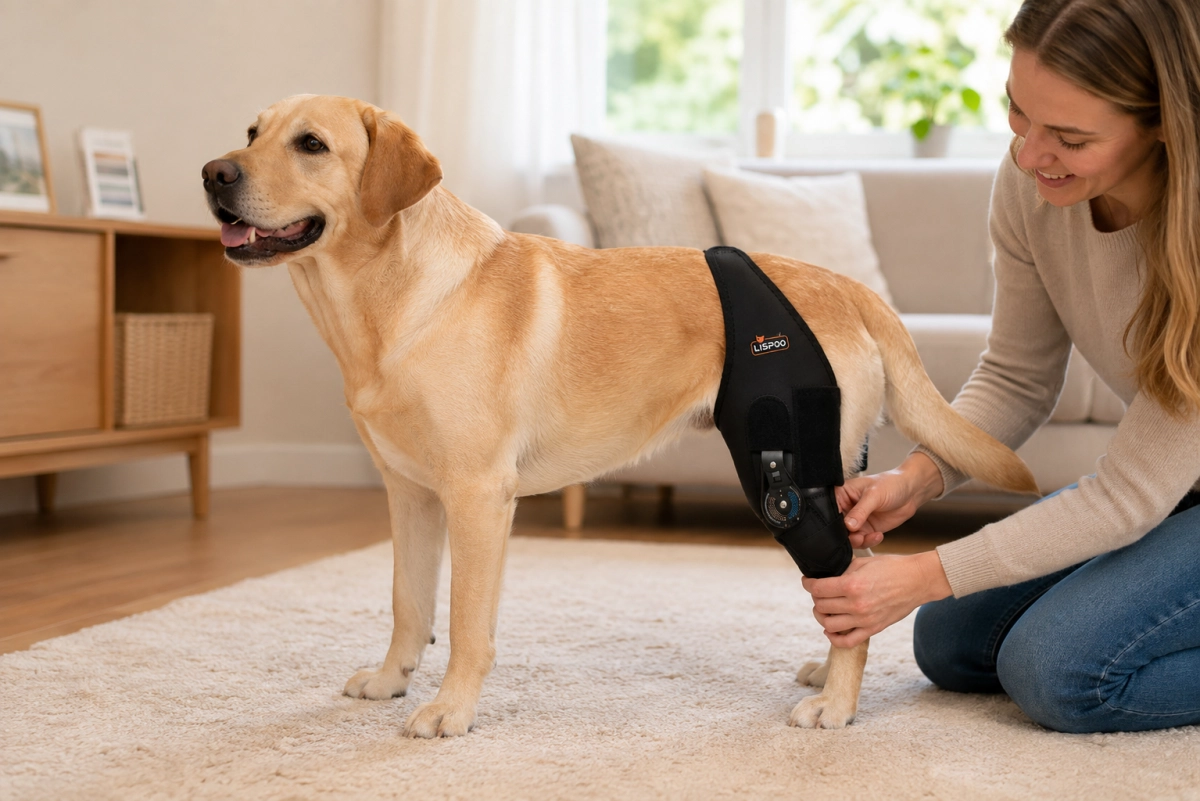
Applying a brace to a knee that already hurts is where most designs reveal what they are. A pull-on sleeve has to travel the length of the leg, and every inch of that travel flexes a stifle the dog is trying to protect. A lay-flat wrap takes a different path: the panel opens up, closes around the leg, and does not ask the joint to bend. That single structural choice shapes daily care more than strap count or padding thickness.
Both structures appear in an dog ACL brace line, and both can hold a knee in place once they are on. The difference shows up before the fit, during the ten seconds when the brace is going onto a dog that flinches at contact.
What the Sleeve and the Wrap Do Differently to the Same Knee
A pull-on sleeve and an open-wrap panel both end up wrapped around the stifle. How they get there is not a convenience detail. The sleeve slides over the paw and travels up, which forces the leg through a sequence of small flexions and extensions. The wrap opens flat, is positioned against the back of the leg, and closes around it while the joint stays still.
That difference is mechanical. When fabric is pulled up a limb, the force follows the fabric's path: through the paw, the hock, and the stifle, in that order. A knee with a torn ligament feels every one of those transitions as load. The open-wrap routes the same force into the closure straps instead of into the joint, because the panel is already seated before any tension is applied. The dog feels pressure at the closure points, not movement through the injured axis.
| Performance difference | Why it matters | Main limitation |
|---|---|---|
| Sleeve slides paw-first up the leg | Each pull flexes a guarded joint | Joint motion is built into the design |
| Wrap closes around a neutral joint | Force lands on the straps, not the axis | Needs each strap tensioned evenly |
| Sleeve needs the paw lifted through an opening | Demands handling a sensitive dog may refuse | Harder to apply on a resisting leg |
What a Sleeve Asks of a Dog That Guards the Limb
A pull-on design presumes a dog will tolerate its paw being held and its leg guided through an opening. Dogs with a torn ACL often will not. Tensing, pulling the leg back, or sitting down mid-fit are signals that the application path is working against the injury.
The steps sound simple: hold the paw steady, guide the foot through the sleeve, then pull fabric up past the hock and over the stifle. The last motion is the problem. Fabric has to climb a bent joint, and a joint that resists bending turns the pull into pain.
You can watch this happen in real time. Count how many times the stifle changes angle while the brace goes on. A wrap should keep that count at zero, with the joint held in one position from start to finish. A sleeve shows at least one visible flex at the moment the fabric clears the knee.
A dog that learns the brace hurts to put on will dodge it the next day. The handling complications compound:
- Touch sensitivity around the joint, flinching the instant the sleeve passes the stifle
- Friction at the opening, where a tight cuff drags skin up with the fabric and leaves red marks
- Compliance that drops as the dog associates the brace with discomfort
- Break-in that rarely becomes routine when every session starts with a fight
When the Open-Wrap Design Is Worth It, and When It Is Not
The lay-flat structure earns its keep on a dog that guards the hind limb. When the knee is acutely painful, any design that removes a step of joint movement removes a source of resistance. That is the open-wrap's real advantage: it trades a multi-step pulling sequence for a single wrap-and-secure motion.
The same advantage shrinks on a dog that tolerates full handling. A calm dog with a stable knee will accept a sleeve without drama, and the sleeve's simpler silhouette can be easier to keep clean or slip on in a hurry. The design is not better in every case. It is better in the specific case where joint motion during application is the thing to avoid.
That distinction is why donning structure deserves as much attention as the support rating when comparing dog brace designs. Two braces can claim the same level of stabilization and behave completely differently in the hands of someone dressing a painful leg.
Disclaimer: These application checks assume a short-coated dog whose stifle you can see while fitting. On a double-coated or heavily muscled dog, the joint angle is harder to read from the outside, so hand-check the leg position instead of relying on visual confirmation of the flex events described above.
What to Check After the Brace Is On
Getting the brace on without bending the knee is step one. Step two is confirming the joint is actually aligned under the structure, because easy application says nothing about whether the hinge is doing its job.
Support on a stifle comes down to where a dog knee brace hinge sits. A hinge centered on the joint axis lets force travel in a straight line through the knee's natural rotation, so the femur and tibia swing on the same arc the brace allows. Move that hinge half an inch up or down, and the same strap tension now pulls the two bones along slightly different paths. The brace fights the joint instead of tracking it, and the dog guards the leg even when it is not being touched.
Check this after ten minutes of walking, not right after fastening. See whether the hinge still sits over the joint space within about a quarter inch. If it has drifted, the straps are redistributing tension instead of holding it, and the fit needs re-setting before the next session.
| Landmark | What it does | Pass signal | Fail signal |
|---|---|---|---|
| Joint space | Reference for hinge placement | Hinge stays centered over the gap | Hinge rides up or down after movement |
| Strap lay | Even pressure across the panel | Straps sit flat with no twisting | Twisted edges dig into one spot |
Pressure points are easier to find by feel than by eye. After a short walk:
- Run a finger under each strap edge and note any red marks or pinched skin.
- Confirm no single strap is doing all the work; tension should feel even across the panel.
- Recheck after movement, since a brace that fits at rest can shift once the leg is load-bearing.
Much of this can be evaluated before a brace ever ships, if you know what to ask of the design. Three things matter most for a knee that resists handling:
- Opening width. A brace that unrolls fully and opens wide around the leg removes the paw-threading step.
- Closure order. Straps that fasten from the thigh down keep the joint still during the final tightening.
- Measurements. Sizing off a standing, weight-bearing leg, not a curled one, is what keeps the hinge near the joint axis later.
Fitting mistakes are where most alignment drift starts, and the checks that catch them are simple enough to run before ordering. The selection criteria and fitting checks for an ACL brace walk through that same logic in more detail.
FAQ
Is an open-wrap brace harder to keep in place than a sleeve?
Not inherently, but the failure mode is different. A sleeve that shifts tends to rotate as one piece. An open-wrap that shifts shows up as one strap loosening while the others hold. Checking each strap after movement catches the wrap's drift earlier.
Does easy application mean better support?
No. Application method only controls what happens to the joint while the brace goes on. Stabilization is a separate question answered by hinge placement and strap configuration, which is why both are checked independently after the brace is on.
How soon can a dog wear the brace for a full day?
Build up in short sessions and let skin tolerance, not a fixed schedule, set the pace. If the skin under the panel stays dry and unmarked after 20 minutes, extend gradually. Wet, red, or warm skin is the signal to back off.
0 Comments