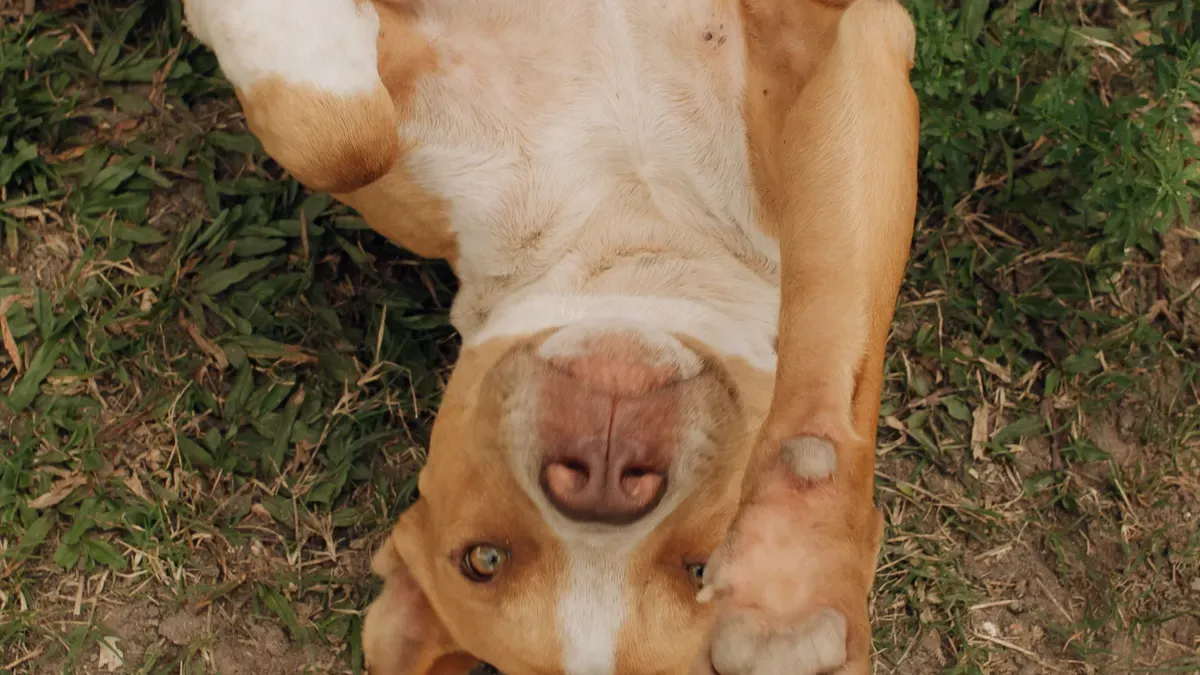
Knuckling is not a paw problem. It is a signaling problem. The nerves that tell a dog where its paw sits in space stop delivering that information, and the paw stays folded under because the brain never got the memo to flip it back. What looks like a dragging foot is actually a gap in the feedback loop between limb and brain — a condition called reduced proprioception. Knuckling can stem from spinal cord compression, degenerative myelopathy, peripheral nerve damage, or advanced joint weakness, and the cause determines what a mechanical assist can and cannot do.
A toe-up brace addresses knuckling at the mechanical level. It does not fix the nerve. It substitutes for the missing signal with a physical assist — an elastic or strap line running from a lower-leg anchor to the paw, pulling the toes upward during the swing phase of each stride. The mechanism is deceptively straightforward: anchor above the ankle, assist line to the paw, tension lifts the toes as the leg moves forward. But the gap between a brace that helps and one that frustrates lives entirely in how those three points relate to one another.
What a Toe-Up Brace Actually Does — and Why Joint Tracking Decides Whether It Works
The assist line needs to track the ankle's natural axis of rotation. When it does, the upward pull follows the same arc the joint wants to travel. The dog's own stride rhythm works with the brace instead of fighting it. When the assist line runs even a quarter-inch off that axis, it creates a side-load — a vector the ankle was never designed to handle. Multiply that by thousands of steps each day, and the dog compensates elsewhere: hips shift, weight redistributes, new sore spots appear.
Think of it as pushing a door. Push near the hinge and the door barely moves — you just strain your arm. Push at the handle and the same force swings it open. A toe-up brace follows the same rule: apply force along the joint's natural path of motion, and a modest elastic band lifts the paw cleanly. Apply it off-axis, and the band either under-delivers or chafes. Sometimes both.
Here is the full chain: anchor position determines assist-line angle → assist-line angle determines whether pull force tracks or crosses the ankle joint axis → tracking the axis means force follows the joint's natural arc → natural arc means less compensatory muscle engagement → less compensation means the dog tolerates longer wear sessions → longer wear means effective paw protection across the full day. Every link in that chain depends on the one before it. Get the anchor wrong, and nothing downstream recovers.
That is the core design question. Not "does it lift the paw." Every toe-up brace for dog lifts the paw on a test bench. The question is whether it keeps lifting the paw after the dog has walked two hundred yards, turned around, lain down, and gotten back up — without the anchor migrating, without the elastic losing consistent tension, and without the dog developing a hot spot where a strap rubs the same patch of skin four thousand times in an afternoon.
In practice: Put the brace on, walk the dog for 20 minutes, then flip back the anchor strap and run a finger across the skin beneath it. Damp — the material is not breathing enough. Warm but dry — the base layer is doing its job. Red lines that match strap edges — pressure concentration, adjust the fit. Diffuse pink that fades in under a minute — distributed contact, the tension is in the right range. Repeat this check at day one, day three, and day seven. The pattern should improve as materials settle and strap tension dials in — not worsen.
Three Design Details That Make or Break a Toe-Up Brace
Strap angle. Elastic tension. Assist-line tracking. These three variables interact — get one wrong, and the other two degrade regardless of how well they were designed in isolation.
Strap Angle — Where the Anchor Sits Relative to the Ankle Joint
The anchor — typically a cuff or strap around the lower leg above the hock — sets the entire geometry. Too high, and the assist line has to cover extra distance as the leg extends, creating a spike in tension at full stride that yanks the paw upward too aggressively. Too low, and the line goes slack mid-stride, dropping the paw before it clears the ground.
The functional sweet spot sits roughly one-third of the way up the lower leg, measured from the hock to the knee. This is not an arbitrary number. It is the point where the distance between anchor and paw changes the least across the full range of the dog's stride. Minimizing that distance delta means minimizing tension fluctuation — and consistent tension is what keeps the paw lifted without sudden jerks that make the dog flinch or compensate.
Watch the dog walk on a flat surface from the side. If the paw lifts smoothly through each stride with no visible snap or hesitation at the top of the arc, the strap angle is in the right neighborhood. If the paw pops up abruptly halfway through the swing or drops suddenly before planting, the anchor position needs adjustment. That is the observable signal. No instrument required.
Elastic Tension — the Variable With No Fixed Setting
Too much tension and the dog fights the brace. Constant upward pull fatigues the muscles that naturally control paw position, and over weeks, that fatigue can accelerate weakness rather than compensating for it. Too little tension and the paw still drags — the brace becomes decoration.
The right tension depends on leg length, muscle tone, and the severity of the proprioceptive deficit. But there is a functional test: the paw should clear the ground by roughly the height of the dog's own pad thickness during the swing phase. Higher — over-lifting, wasted energy. Lower — the paw still scuffs, the brace is not doing its job.
A well-designed brace makes tension adjustable in small increments. Elastic cords with multiple anchor positions on the cuff, or buckle-based strap systems with fine gradations, let owners dial in tension in response to what they observe rather than settling for whatever the factory setting delivers. Single-setting elastic that cannot be adjusted is a design liability — it forces every dog into the same tension regardless of leg geometry. That means it is wrong for most dogs most of the time.
This is where mobility rehabilitation products diverge meaningfully. Some use progressive-resistance elastics that increase tension as the stride extends; others use fixed-length nylon webbing that provides a positional reminder rather than active lift. Neither is universally better. Nylon-based lines suit dogs with only a mild proprioceptive gap — they need a positional cue more than powered assistance. Elastic lines work better when the dog has measurable dorsiflexion weakness and needs mechanical help through the full stride. A brace that offers interchangeable line types gives room to match the assist to the deficit.
Assist-Line Tracking — Why the Path Matters More Than the Material
The assist line must run in a straight pull from anchor to paw attachment. Any curve, any wrap around the leg, any intermediate guide point introduces friction. Friction creates a stiction point — the line catches, tension builds, then releases unpredictably. The dog takes three smooth steps, then one jerky one where the line suddenly lets go. That unpredictability erodes the dog's trust in the brace, and a dog that does not trust the brace compensates in ways that create new problems. A foot brace designed with a clean, direct assist-line path avoids this entirely — the tension stays predictable, and the dog's gait stays consistent.
Material choice follows path quality. On a straight path, nylon webbing delivers consistent length with near-zero stretch — predictable, but unforgiving if the anchor shifts. Rubber-based elastics provide progressive tension that increases with stride extension — more forgiving of minor anchor drift but less precise in the assist angle. Wrist and lower-limb braces that use elastic materials must pair them with non-stretch anchor backing; otherwise the entire system drifts as the elastic creeps under load. The anchor stays put, the elastic does the work — each material handles the job it is built for.
Where the Design Works — and Where It Reaches Its Limit
Toe-up braces solve a mechanical problem: the paw does not clear the ground. They do not solve a neurological problem. That distinction sets the boundary.
The brace performs best when the dog has residual leg strength and the primary deficit is paw positioning, not weight-bearing. Dogs recovering from mild IVDD episodes, dogs with early-stage degenerative myelopathy who can still stand and take steps, dogs with front-paw knuckling from peripheral nerve injuries where leg muscles still fire but paw awareness is diminished — these are the profiles that match what the brace was designed to do. The brace also serves a protective function independent of its lifting action. Even when paw clearance is inconsistent, the boot or paw piece shields the top of the paw from abrasion. That scuff protection alone can prevent the open sores that often cascade into infection in dogs who knuckle chronically.
A brace cannot substitute for absent leg strength. If the dog cannot bear weight on the leg, lifting the paw does not solve the underlying problem. The dog needs a support system that addresses weight-bearing — a lift harness or wheelchair — not just paw clearance. Dogs with complete hind-end paralysis will not benefit from a toe-up brace. The assist mechanism requires the dog to initiate the stride; if there is no stride to initiate, the brace has nothing to assist. Dog lift harnesses address this gap by supporting the dog's weight from above, enabling a walking motion the dog cannot produce on its own.
Dogs with severe angular limb deformities may find that standard anchor geometry does not sit correctly on the leg. The angles the brace assumes — based on typical canine leg conformation — may simply not apply, and the fit problems can outweigh the lifting benefit.
Disclaimer: The fit checks described here assume a breed with typical leg conformation — a straight or near-straight limb axis from hip to paw. Dogs with pronounced bowing, angular limb deformities, or very short legs relative to body depth may need different anchor positions than standard geometry provides. If the assist line visibly angles inward or outward from the leg rather than running parallel to it, the brace geometry is fighting the dog's natural stance — and no amount of strap adjustment will fix it.
Disclaimer: These observations apply to short-coated dogs where skin contact can be checked visually. Double-coated breeds may develop pressure marks beneath the fur that are not visible from the surface. For these dogs, hand-checking — running fingers beneath straps after each wear session — is the reliable method, not visual inspection.
Design Details That Affect Daily Use
A toe-up brace lives on the dog's leg. It gets walked on, lain on, dragged through wet grass. Three design features determine whether it survives that reality or becomes a drawer item by week two.
Washability and Liner Design
Any brace worn daily accumulates skin oil, dirt, and moisture. A design with a removable, machine-washable liner extends usable life — not because the brace physically degrades more slowly, but because owners keep using a brace that does not smell like a gym bag. Fixed liners that require hand-washing and air-drying create friction in the daily routine. Skipped wash days lead to skipped wear days, and skipped wear days mean the paw goes unprotected. Long-term knuckling management depends on consistency, and design details that make consistency easier are not minor conveniences — they are functional features.
Strap Hardware and Closure Systems
Hook-and-loop straps are fast. They are also the first component to fail. Dirt, fur, and moisture degrade hook grip over weeks. A brace that pairs hook-and-loop with a secondary mechanical fastener — a buckle, a snap, a D-ring pass-through — gives the primary closure a backup. When the hook-and-loop eventually loses bite, the secondary closure keeps the brace functional instead of letting it slide down the leg mid-walk.
Metal hardware beats plastic in this application, and not for the reason most people assume. The advantage is not strength — it is tactile feedback. Metal D-rings and buckles transmit tension changes through the strap in a way fingers can read. Plastic hardware provides less of that feedback — you cannot tell by feel alone whether the strap is seated correctly. That difference matters when fitting a brace on a dog that will not stand still.
Paw-Piece Coverage and Weight
The piece that cups or straps around the paw determines scuff protection. Full-coverage boot-style paw pieces protect the entire top surface but add weight — and added weight can make the dog hesitant to place the foot, which alters gait in ways that work against the brace's purpose. Minimal strap-based paw attachments weigh less and interfere less with natural paw placement, but leave portions of the paw exposed to abrasion. Support braces across different joint types face the same trade-off: coverage versus weight, protection versus natural feedback. A dog that drags the paw heavily needs full coverage. A dog with mild knuckling and mostly intact proprioception may do better with a lighter attachment that preserves more natural footfall sensation. The deficit should dictate the coverage — not an assumption that more is always better.
Frequently Asked Questions
What does it mean if a dog knuckles its paws?
It means the dog walks on the top surface of the paw instead of the pads. This typically reflects reduced proprioception — the brain is not receiving reliable position information from the paw, so the automatic flip-back reflex that places the pad on the ground does not fire consistently. The cause can be spinal, peripheral, or muscular. The underlying cause determines what kind of support actually helps, and a veterinary diagnosis is the starting point — not an optional step.
How does a toe-up brace differ from a standard dog boot?
A boot protects the paw from surface abrasion but does not actively position it. If the paw folds under inside the boot, it stays folded — the boot simply prevents the skin from scraping. A toe-up brace adds an active lift component: an elastic or strap line from a leg anchor to the paw piece that pulls the toes upward during the swing phase. Protection versus positioning. Both have a role; they are not substitutes.
Can a dog still exercise while wearing a toe-up brace?
Short, controlled walks on level ground are generally compatible with brace use. The brace is not designed for running, jumping, or uneven terrain — the assist line can snag on brush or stairs, and the anchor can shift under high-impact movement. Let the dog's tolerance set the duration: if the dog shows hesitation or an altered gait after 15 minutes, stop and check strap positioning before continuing.
How often should the brace be cleaned and inspected?
Daily paw inspection under the brace, even on days the brace itself is not washed. Check straps for fraying weekly — a frayed elastic line changes tension unpredictably and needs replacement. The liner or pad contact surface needs washing at minimum every three to four wear days. In wet or muddy conditions, wash after every exposure. Moisture trapped between liner and skin is the fastest path to irritation, and irritation leads to skipped wear days — which leads right back to scuffed paws. Consistent brace use, like any mobility support, depends as much on maintenance routines as on the device itself.
What if the brace does not seem to help?
Run the three observable checks before concluding the brace is the wrong tool. First, verify the strap angle — watch the dog from the side during a 10-yard walk on a flat surface. Second, check paw clearance — the pad should clear the ground by roughly its own thickness during the swing phase. Third, inspect skin condition under every strap contact point after 20 minutes of wear. If all three checks pass and the paw still drags, the dog likely needs a different category of support — a lift harness or a more comprehensive mobility aid rather than a paw-level device. The brace is not failing; it is simply being asked to solve a problem outside its design scope.
0 Comments